

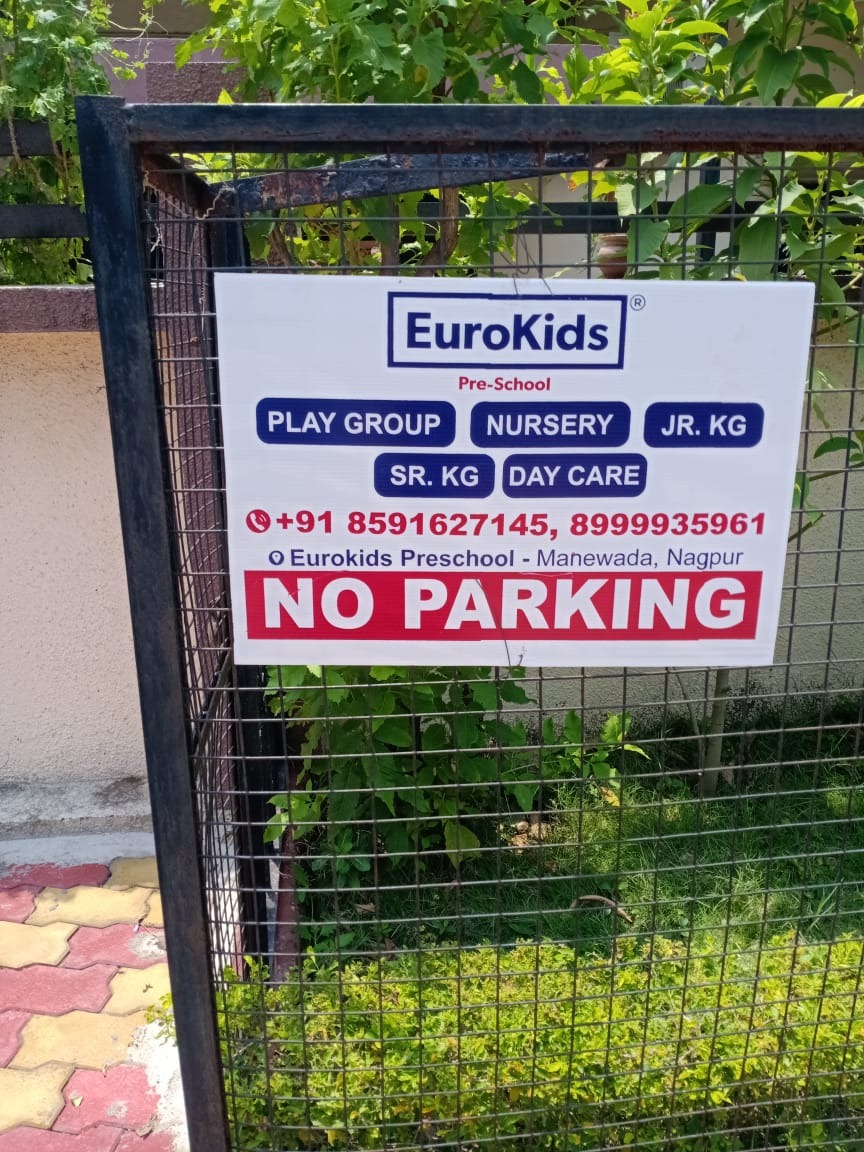
Here is the single number that reframes this whole comparison: a branded No Parking board is a one-time ₹45 per board (or ₹35 each once you order 5,000 or more) — and that price already includes the board, the printing, transport and installation on the gate, with no monthly rental ever. Auto rickshaw branding, by contrast, almost always runs on a recurring per-auto monthly model. So before you compare "reach", you are really comparing two different money shapes: a single fixed payment that keeps displaying versus a monthly cost that keeps recurring. Everything else in this guide flows from that distinction.
Both formats are legitimate, ground-level outdoor advertising. But they solve opposite problems. A No Parking board buys you stationary, household-level reach at exactly the gates you choose. Auto rickshaw branding buys you mobile, city-wide reach that travels wherever the auto goes. This 2026 comparison breaks down cost model, reach type, exposure window, targeting and dwell time so you can pick the right one — or, more often, run both in the right proportion.
How do the two cost models actually differ?
The No Parking board is a one-time, all-inclusive purchase. You pay ₹45 for each board on orders under 5,000, and the rate drops to ₹35 per board once you reach 5,000 boards or more — the 5,000-board mark is the break-even where bulk pricing kicks in. That single figure already covers the 1ft×1.5ft Sunpack sheet, the printing, transport and the actual installation on the gate. There is no rental clock running after that: the board stays up and keeps doing its job. So a 1,000-board run works out to roughly ₹45,000, a 5,000-board run to about ₹1,75,000 at bulk pricing, and 10,000 boards to around ₹3,50,000.
Auto rickshaw branding works on a fundamentally different shape. You are typically paying per auto, per month, for as long as you want your wraps or panels to keep running on the road. That makes it a recurring operating cost rather than a one-time asset. The practical consequence: the longer a No Parking board campaign stays up, the lower its effective cost-per-month falls, because the spend was paid once. A moving auto campaign costs you again every month it continues. Neither is "cheaper" in the abstract — it depends entirely on how long you need the presence and how concentrated you need it.
Fixed household reach or moving city reach — which do you actually need?
A No Parking board lives on the gate of an independent house or at a housing-society entrance. That means the same set of people see it again and again: homeowners and their families, domestic staff, delivery riders, visitors and RWA office-bearers. It is reach measured in frequency — a small, defined audience exposed repeatedly, every single day, in the exact localities you mapped. Because the board also functions as a genuine "No Parking" notice, the message stays put and stays useful, which is precisely why it is allowed to remain on the gate.
A branded auto rickshaw does the opposite. It moves through markets, main roads, residential lanes and commercial hubs, putting your brand in front of a constantly changing crowd. That is reach measured in unique impressions — lots of different eyeballs, each typically for a brief, passing moment, spread across a much wider slice of the city. If your goal is "everyone in this neighbourhood should know us well," boards fit. If your goal is "our name should be visible across the city," autos fit.
No Parking boards vs auto branding: how do they compare side by side?
No Parking boards vs auto rickshaw branding
| Factor | No Parking boards (gate) | Auto rickshaw branding | |
|---|---|---|---|
| Cost model | One-time ₹45/board (under 5,000) or ₹35/board (5,000+), all-inclusive, no rental | Recurring monthly per-auto rental | |
| Reach type | Fixed / household — concentrated at chosen gates | Mobile / city-wide — travels across many routes | |
| Exposure window | Persistent — stays up daily as long as the board lasts | Variable — only while the auto is on the road | |
| Targeting | Precise — pick the exact localities, houses and society gates | Broad — follows auto routes, less locality control | |
| Dwell time | High — seen repeatedly by the same households every day | Low — brief glance as the auto passes by | |
| Best for | Saturating target neighbourhoods; locality launches; repeat recall | City-wide name spread; fresh unique impressions; mobile presence |
Board pricing is all-inclusive (board + printing + transport + installation) with no monthly rental. Auto branding pricing varies by operator and is typically a recurring monthly model.
How much do No Parking boards cost in 2026?
Board pricing has just two tiers, and both are fully inclusive — no hidden rental, no separate installation line. This is the side of the comparison we can quote exactly.
No Parking board pricing (all-inclusive, one-time)
Standard
One-time, all-inclusive price for orders below the 5,000-board break-even.
- 1ft × 1.5ft Sunpack board
- Printing included (UV / solvent / eco-solvent / digital)
- Transport included
- Gate installation included
- No monthly rental
Bulk
Bulk rate that kicks in at the 5,000-board break-even and above.
- Same all-inclusive scope as Standard
- Lowest per-board cost
- Ideal for full-locality saturation
- Geo-tagged proof-of-delivery report
- No monthly rental
Worked out: 1,000 boards is roughly ₹45,000, 5,000 boards is about ₹1,75,000 at the bulk rate, and 10,000 boards lands near ₹3,50,000. Because it is paid once, the real cost question is how many months of equivalent auto rental that single figure replaces in your target localities.
Why does dwell time tilt the comparison toward boards in target areas?
Advertising effect is a product of how many people see you and how long and how often they see you. A passing auto wins on the first part — sheer volume of different viewers — but each impression is fleeting. A No Parking board wins on the second part: because it is bolted to a gate the same household walks past several times a day, every day, your message accumulates frequency in a way a moving vehicle cannot. The dual notice-plus-advertisement function is what earns the board that dwell time; it is welcome on the gate because it genuinely tells people not to park there. For building recognition inside a defined set of localities, that repeated, lingering exposure is hard to beat.
There is also an accountability difference. After a board install, our team hands over a geo-tagged proof-of-delivery report listing exactly where each board went up, so you can audit your coverage gate by gate. A fleet of branded autos is, by its nature, always moving, which makes "where was my brand today" a harder question to answer precisely. If verifiable placement matters to you, that favours the fixed format.
The verdict: which should you choose?
There is no single winner, because the two formats answer different briefs. Choose No Parking boards when you want depth: saturating specific neighbourhoods, launching in a defined locality, or building repeat recall among the households who actually live where your customers are. Choose auto rickshaw branding when you want breadth: spreading your name across the whole city and harvesting fresh, unique impressions on the move. And in most real local campaigns, the smartest answer is both — a fixed neighbourhood base of boards plus a moving city overlay of autos. The boards give you frequency at home; the autos give you reach on the road. They are complementary, not competitors.
Quick decision checklist
- Need depth in specific localities? Lead with No Parking boards.
- Need city-wide name spread? Lean toward auto rickshaw branding.
- Want a one-time spend with no recurring bill? Boards (₹45, or ₹35 at 5,000+) fit better.
- Running a short, time-boxed burst across the city? Recurring autos can suit a brief window.
- Need verifiable, location-by-location proof of placement? Boards come with a geo-tagged proof-of-delivery report.
- Have budget for both? Run a fixed neighbourhood base of boards under a moving city overlay of autos.
If you want to map your target localities and price a board run for your area, get a free quote and our team will work out the tier and coverage for you.
Questions people ask about boards vs auto branding
Is auto rickshaw branding more expensive than No Parking boards over a year?
It usually becomes more expensive over time because auto branding is a recurring monthly cost, while a No Parking board is paid once — ₹45 each under 5,000 units, or ₹35 at 5,000 and above — with no rental after install. Over a full year, the recurring auto spend keeps adding up every month, whereas the board's single payment is spread across however long it stays on the gate, lowering its effective monthly cost the longer it runs.
Do No Parking boards reach as many people as branded autos?
They reach people differently rather than fewer overall. A branded auto generates more unique impressions because it moves across the city and is seen by new faces constantly. A No Parking board reaches a smaller, fixed set of households but reaches them far more often, since the same residents, staff and delivery riders pass it every day. Boards trade total head-count for repeat frequency in chosen localities; autos trade frequency for breadth.
Which format gives better targeting for a specific area?
No Parking boards give sharper targeting. You map the exact localities you want, then place a branded board on each house gate and society entrance, so your spend lands precisely where your customers live. Auto rickshaw branding follows the auto's routes, which you control much less, so it is better for general city coverage than for hitting one defined pocket. For pinpointing a neighbourhood, boards win on control.
What sizes and materials are No Parking boards, and where are they installed?
Each board is 1ft × 1.5ft, printed on rigid, lightweight, weatherproof Sunpack (sunboard) sheet. It is installed on the gates or compound walls of independent houses and at housing-society entry gates, where it works as both a real No Parking notice and a brand advertisement. Printing can be UV, solvent, eco-solvent or digital depending on how long you need it to last and your volume.
Can I run both boards and auto branding in the same campaign?
Yes — that is often the most effective setup. Use No Parking boards to build a fixed, high-frequency base in your priority neighbourhoods, and add branded autos as a moving overlay to carry your name across the wider city. The boards handle depth and daily repetition where your customers live; the autos handle reach and fresh impressions on the road. Together they cover both household frequency and city-wide visibility, which neither format achieves alone.
Tags
Quick Answers
What is the core difference between No Parking boards and auto rickshaw branding?
A No Parking board is a fixed, one-time install on a house gate or society entrance — you pay ₹45 per board under 5,000 units, or ₹35 at 5,000 and above, with board, printing, transport and installation included and no monthly rental. Auto rickshaw branding is mobile media that travels the city on a recurring monthly model. In short, boards buy concentrated household reach at a chosen location; autos buy wide, moving reach across many routes.
Which delivers cheaper long-term advertising, boards or auto branding?
It depends on time horizon. A No Parking board is a single all-inclusive payment — ₹45 each (or ₹35 for 5,000+) — that keeps displaying with no further rental, so the longer it stays up, the lower its effective monthly cost. Auto branding is typically a recurring monthly charge per auto, so cost accumulates every month the campaign runs. For a long, fixed-location presence the one-time board model tends to be cheaper; for short, city-wide bursts, autos can make sense.
Can No Parking boards and auto branding be used together?
Yes, and they often work best together because they cover different gaps. Boards plant a fixed base in the exact localities you care about — saturating society gates where your customers actually live — while branded autos add a moving layer that carries your name across the wider city. Use boards for depth and repeat household exposure in target neighbourhoods, and autos for breadth and fresh impressions on the road. The combination gives you both frequency at home and reach on the move.
Which is better for a hyperlocal launch in one neighbourhood?
For saturating a single neighbourhood, No Parking boards are usually the stronger first move. You can map the target localities, place a branded board on the gate of each house and society entrance, and concentrate repeat exposure on the exact households you want — homeowners, families, domestic staff, delivery riders and RWA office-bearers all see it daily. Auto branding is better when you need name recall spread across the whole city rather than depth in one pocket.
Looking for professional No Parking Board Advertising services?
The Mediaverse runs end-to-end no parking board advertising campaigns across India with geo-tagged delivery and transparent, all-inclusive pricing.
Explore our No Parking Board Advertising solutionsSummarize this guide with AI
Open this article in your favourite AI assistant
Related Guides
Written by

The Mediaverse Team
India's Leading Outdoor Advertising Agency
The Mediaverse is a national-level outdoor advertising and integrated marketing organization that provides complete OOH, ATL, BTL, retail, and transit media solutions across India. With years of experience executing high-performance campaigns for brands in FMCG, Real Estate, E-commerce, EdTech, Automotive, Healthcare, and Retail, The Mediaverse combines creativity, data-driven media planning, and flawless on-ground execution. As a full-stack outdoor advertising provider, The Mediaverse offers Auto Branding, Mobile Van Branding, Newspaper Insertion Advertising, Shop Name Board Branding, In-Store Branding, Hoardings, Transit Media, Kiosks, Mall Media, Activations, and all forms of Below-The-Line marketing. Known for its pan-India network, strategic route planning, premium print quality, and Cheqmate™ GPS-based verification, The Mediaverse ensures 100% transparent and result-oriented campaign delivery. The Mediaverse’s editorial team produces deeply researched, SEO-optimized, and generative-engine-friendly content to help businesses understand the power of outdoor advertising and make informed decisions that maximize brand visibility and ROI across urban, suburban, and rural markets.
Related Articles
Gate-to-street saturation: no-parking boards plus auto hoods in one catchment, the worked plan (2026)
The entry ticket for one catchment covered from gate to street is ₹2,83,200 landed: 1,000 gate boards plus 300 auto hoods. Seven steps, the timings for both formats, three priced plans and the honest list of what the rate card leaves out.
Outdoor advertising for clinics, pharmacies and diagnostic centres: formats, compliance and catchment (2026)
A pharmacy plan of 1,000 gate boards plus a glow sign board is ₹56,168 landed; a clinic plan of 2,000 boards plus 50,000 A5 inserts is ₹1,79,950; a diagnostic centre plan with 300 auto hoods is ₹5,36,900. Plus the rules on what a medical board may say and how far each facility's catchment reaches.
No Parking Board Advertising vs Hoardings: Which Wins for One Locality in 2026?
A hoarding looks like the premium buy — but for dominating ONE locality, it usually loses to no parking gate boards. Here is the honest, side-by-side comparison on cost model, reach, exposure and targeting, plus a clear verdict and decision checklist.