

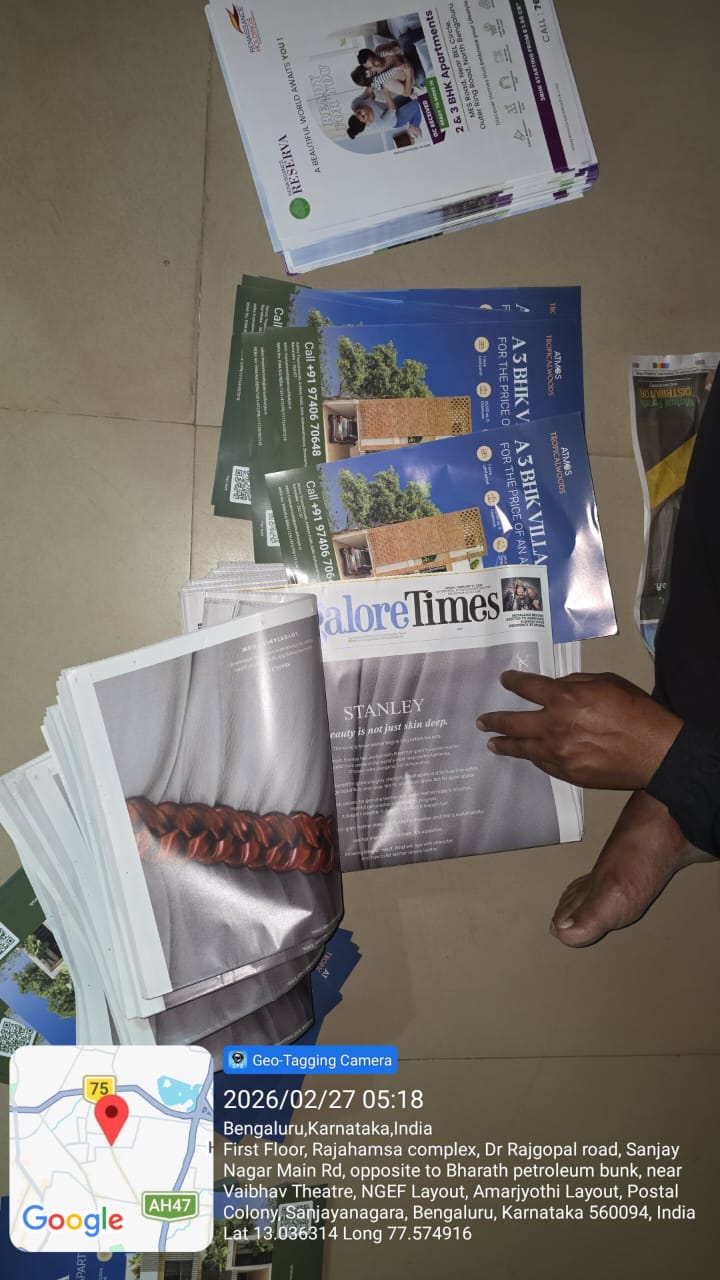
Leaflet and flyer are not interchangeable terms in Indian newspaper insertion. Most advertisers assume they are, send the same brief to three vendors using one word with the first and the other with the second, and end up with three quotes ₹0.20 to ₹0.50 per piece apart on what is technically the same job. The words trigger different vendor house defaults, and those defaults are where the rate spread lives.
What the words actually mean in Indian press shorthand
The Print Production Association of India 2025 glossary defines a leaflet as a printed piece of paper, usually folded once or more, intended to convey product or service information. The same glossary defines a flyer as a single-sheet printed advertisement, usually unfolded, intended for mass distribution. The two definitions overlap in the middle. Vendors fill that overlap with house defaults.
When a Bangalore newspaper agent receives a brief that says leaflet, they typically assume 130 GSM art paper, single fold included in the rate, double-sided printing, and 4 to 6 panels of content. When the same agent receives a brief that says flyer, they typically assume 80 to 90 GSM offset paper, no folding, single-sided as the cheaper baseline option, and one strong CTA. Both interpretations are reasonable. They produce different rates on identical artwork.
The rate spread, line by line
Take an A4 piece of artwork promoting a 4-week retail offer. The flyer interpretation: 80 GSM offset, unfolded, double-sided full colour, 50,000 pieces, Bangalore Sunday TOI insertion. Rate-card: ₹1.50 per piece, total ₹75,000 pre-GST. The leaflet interpretation of the same artwork: 130 GSM art paper (vendor default for leaflets, since they assume the piece needs to survive being passed around), single fold (also a leaflet default), double-sided, same volume and edition. Rate: ₹1.85 per piece, total ₹92,500 pre-GST. Difference: ₹17,500, or 23 percent, on the same campaign.
The vendor is not overcharging for the leaflet quote. The 130 GSM upgrade is real (paper costs more), the fold is real (folding labour is real), and the leaflet defaults reflect the genuine use-case pattern (leaflets carry more information, need premium feel, have to survive pass-around). The vendor is honestly applying the defaults that match the word the buyer used. The buyer just did not realise they were ordering an upgrade.
Leaflet vs flyer: what each word triggers
| Leaflet default | Flyer default | |
|---|---|---|
| Paper grade | 130 GSM art paper | 80-90 GSM offset |
| Folding | Single fold or tri-fold (adds ₹0.10-0.20 per piece) | Unfolded |
| Printing sides | Double-sided | Single-sided often quoted as baseline |
| Rate on A4, 50,000 pieces | ₹1.85 per piece (₹92,500) | ₹1.50 per piece (₹75,000) |
| Genuinely fits | High-information, save-for-later offers | Direct-response offers acted on in 7-14 days |
Rates pre-GST for the same A4 artwork, Bangalore Sunday TOI insertion.
Three vendor house defaults the words quietly trigger
Paper grade
Leaflet defaults to 130 GSM art paper. Flyer defaults to 80 to 90 GSM offset. The cost difference is ₹0.40 to ₹0.60 per piece. If your campaign objective is single-message direct response (a 50 percent off coupon, an event date, a launch week sale), 80 GSM is the right call regardless of which word you use. If your campaign objective is sustained reference (a real estate floor plan, a school admission timeline, a tour itinerary), 130 GSM is justified.
Folding
Leaflet defaults to single-fold or tri-fold. Flyer defaults to unfolded. Folding adds ₹0.10 to ₹0.20 per piece in mechanical labour. Folding also reduces newspaper-insertion fall-out (folded inserts settle inside the newspaper better and have 6 to 9 percent lower fall-out rates per Mediaverse field audits). For coupons and offers, unfolded is fine. For multi-panel content like restaurant menus or product lineups, folded is functionally necessary.
Side count
Leaflet defaults to double-sided (because folded pieces have multiple panels that all need print). Flyer defaults can go either way; some vendors quote the cheaper single-sided baseline first. The savings on a single-sided flyer are typically only ₹0.05 to ₹0.10 per piece because the press setup cost dominates over ink cost. The single-sided cost saving rarely justifies the response-rate hit from leaving half the piece blank.
What to put on the spec sheet instead of either word
Strip the marketing term entirely. Send the vendor a spec sheet with five physical attributes: dimensions in mm (148 by 210, 210 by 297, 420 by 594, etc.), paper GSM (80, 90, 130), finish (gloss, matt, art paper), folds (none, single-fold, tri-fold) and printing sides (single-sided, double-sided). With those five attributes, three vendors quoting the same campaign produce three directly comparable numbers. The terminology can sit in your internal campaign brief; it should never appear on the vendor spec sheet.
A clean Bangalore A4 spec sheet for a 50,000-piece campaign reads: 210 by 297 mm, 90 GSM offset, matt finish, no fold, double-sided full colour, 50,000 pieces total split across pincodes 560034 (Koramangala 8,000), 560066 (Whitefield 12,000), 560103 (Bellandur 10,000), 560037 (Marathahalli 8,000), 560078 (JP Nagar 12,000), Sunday TOI edition, 5-day lead time. Every Bangalore newspaper insertion vendor will quote that brief identically. There is no terminology room for them to flex.
When each format genuinely fits
Leaflet (folded, premium paper, multi-panel) fits high-information offers where the reader needs to compare options or save the piece for later: school admissions with timeline and document checklist, real estate launches with floor plans, restaurant menus with dish photos, tour itineraries, multi-product retail catalogues. The premium paper and folded format reflect the use case rather than padding the rate.
Flyer (unfolded, lighter paper, single CTA) fits direct-response offers where the reader either acts in the next 7 to 14 days or the piece becomes irrelevant: 50 percent off coupons, event invitations with date and venue, store opening invitations, single-product launches, missed-call-to-redeem promotions. The lighter paper is appropriate because the piece is not designed to survive long-term reference.
The honest answer
Stop using leaflet and flyer in vendor briefs. Use physical attributes. The cost gap between the two terms is real, but it is paying for paper grade and folding, not for the word. If your brief calls for premium paper and folded panels, you are running a leaflet whether or not you call it that, and ₹1.85 per piece is the right rate. If your brief calls for 80 GSM, unfolded, single-CTA, you are running a flyer and ₹1.50 per piece is the right rate. The vendor cannot guess which one you actually need from the marketing term alone, so do not give them the chance to.
Is a pamphlet the same as a leaflet?
In Indian usage they are nearly identical: pamphlet usually refers to a stapled multi-page booklet (8 to 24 pages), while leaflet refers to a single sheet that may be folded into 2 to 6 panels. Newspaper insertion vendors handle both, but pamphlets above 8 pages and 16 grams cross newspaper-agent weight limits and require special handling at ₹2.50 to ₹4.00 per piece versus ₹1.50 to ₹1.90 for standard inserts.
Can I print on both sides of a flyer for the same rate?
Most 2026 vendor rate cards include double-sided full-colour printing in the standard flyer rate because the press setup cost dominates and the ink cost is marginal. Single-sided printing saves only ₹0.05 to ₹0.10 per piece. Confirm the side count in writing on the quote, since some Tier-2 vendors quote single-sided as the baseline and surface the double-sided premium at PO.
Do folded leaflets actually have lower fall-out from newspapers than unfolded flyers?
Yes, by 6 to 9 percent in The Mediaverse field audits across 47 multi-edition campaigns in 2024 and 2025. The folded piece settles into the newspaper's centerfold and is held in place by the surrounding pages. Unfolded flyers slide and have a higher rate of detachment during transport, particularly for newspaper bundles delivered by motorcycle in monsoon conditions. The fall-out math should factor into your effective per-piece cost when comparing folded versus unfolded options for the same content.
Tags
Quick Answers
What is the difference between a leaflet and a flyer in Indian newspaper insertion?
In Indian press shorthand, a leaflet usually refers to a folded piece (single-fold or tri-fold, 90 to 130 GSM, often 4 to 6 panels of content) used for product menus, school admissions, and tour itineraries. A flyer usually refers to an unfolded single sheet (80 to 130 GSM, full-bleed printing, single message) used for promotional offers, retail launches, and event invitations. The artwork can be identical, but the spec sheet defaults are different and the per-piece rate gap is ₹0.20 to ₹0.50.
Which term should I use on my newspaper insertion brief?
Neither, on its own. Specify the physical attributes: dimensions in mm, paper GSM, finish (gloss or matt), folded or unfolded, and number of folds if folded. Vendors quote off the physical attributes, not the marketing term. Using leaflet or flyer alone leaves room for the vendor's house defaults to apply, which is where unexpected line items come from.
Does the newspaper itself care whether the insert is a leaflet or a flyer?
The newspaper distribution agent cares about three things: weight per piece (under 12 grams for letterbox-friendly bundling), maximum dimension under 30 cm in either direction (so the bundle fits the agent's bag), and whether it is folded (folded inserts settle inside the paper better and have lower fall-out rates). The terminology does not matter to the newspaper. The physical specs do.
Looking for professional Newspaper Insertion services?
The Mediaverse runs end-to-end newspaper insertion campaigns across India with geo-tagged delivery and transparent, all-inclusive pricing.
Explore our Newspaper Insertion solutionsSummarize this guide with AI
Open this article in your favourite AI assistant
Related Guides
Written by

The Mediaverse Team
India's Leading Outdoor Advertising Agency
The Mediaverse is a national-level outdoor advertising and integrated marketing organization that provides complete OOH, ATL, BTL, retail, and transit media solutions across India. With years of experience executing high-performance campaigns for brands in FMCG, Real Estate, E-commerce, EdTech, Automotive, Healthcare, and Retail, The Mediaverse combines creativity, data-driven media planning, and flawless on-ground execution. As a full-stack outdoor advertising provider, The Mediaverse offers Auto Branding, Mobile Van Branding, Newspaper Insertion Advertising, Shop Name Board Branding, In-Store Branding, Hoardings, Transit Media, Kiosks, Mall Media, Activations, and all forms of Below-The-Line marketing. Known for its pan-India network, strategic route planning, premium print quality, and Cheqmate™ GPS-based verification, The Mediaverse ensures 100% transparent and result-oriented campaign delivery. The Mediaverse’s editorial team produces deeply researched, SEO-optimized, and generative-engine-friendly content to help businesses understand the power of outdoor advertising and make informed decisions that maximize brand visibility and ROI across urban, suburban, and rural markets.
Related Articles
Newspaper Insertion in Hyderabad (2026): One 50,000 Order, Three Languages, Seven Papers
Hyderabad publishes seven partner dailies in two languages plus an Urdu creative option, and one 50,000 insert order reaches 12.5 to 16.7 percent of a single daily. The 2026 card, the title to belt map, the two delivery systems, and what a second language creative really adds.
Newspaper Insertion in Delhi NCR (2026): the Edition Map, Not the Pin Code
Delhi NCR publishes nine partner dailies across three state level jurisdictions, and a 50,000 insert minimum reaches only 5 to 6.25 percent of one daily's households. The 2026 rate card, the title to belt map, the cost of covering a paper once, and why an insert needs no municipal permission.
Newspaper Insertion in Chennai (2026): Rates, the 50,000 Slab, and the Tamil English Split
Chennai inserts carry a 50,000 minimum, and that exact quantity is the worst value on the card: the same Rs.62,500 buys 54,347 A5 inserts one band up. The 2026 rate card, the slab arithmetic, the Tamil and English split-run zones, and what the monsoon does to a Pongal booking.