

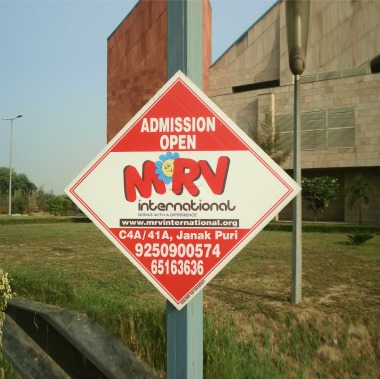
For a new project launch, saturating the gates of your catchment beats one expensive hoarding on the highway. A hoarding buys you a single, fleeting impression on people driving past — most of whom will never buy a flat near your site. A branded No Parking board sits, instead, at the actual gate of a family that already lives in the neighbourhood you are selling into: seen every morning, by the homeowner, by visiting relatives, by the delivery rider, by the broker who works that colony. For a launch, that ground-level density is the whole game, and at ₹45 a board (₹35 at 5,000 and above) you can buy thousands of those gates for the price of one hoarding.
This playbook lays out exactly how a builder should run the No Parking board play around a launch — how to define the catchment, size the order to the ₹35 break-even, design a board that doubles as a legal notice and a launch ad, get it installed with permission, and turn the geo-tagged install proof into a clean coverage report for your marketing file.
Why do gate boards beat a launch hoarding for a project catchment?
A launch lives or dies on the catchment — the band of nearby localities whose residents will realistically book a site visit and buy. A hoarding on the highway sprays its budget across everyone who passes, most of whom are commuting through, not house-hunting in your micro-market. A No Parking board does the opposite: it places your launch creative inside the catchment, at the gates of the households most likely to convert or to refer a buyer.
There are three structural advantages for a launch. First, precision — you choose the exact feeder localities and only pay for gates inside them. Second, repetition — the board stays on the gate for the whole launch window, so a resident sees it daily across the weeks it takes to decide on a home, instead of once at 60kmph. Third, the audience mix at a residential gate is exactly your launch audience: families, the domestic staff and visitors who carry word-of-mouth, and the RWA office-bearers who anchor a colony's conversations.
A hoarding still has a role — for top-of-funnel awareness on an arterial road, it is hard to beat. The argument here is narrower: for the launch-specific job of saturating a defined catchment, your rupees go further on gates. The smartest launches use both, but lead with the boards because that is where attribution and intent are tightest. See the complete 2026 guide to No Parking board advertising for the full format primer.
How do you size a launch order to the ₹35-per-board break-even?
The pricing has one decision point: 5,000 boards. Under 5,000, each board is ₹45; at 5,000 and above, it drops to ₹35. So the break-even question for a launch is simply whether your catchment can absorb 5,000 boards' worth of genuine, permission-able gates. In most metro micro-markets — a cluster of gated colonies and societies within a reasonable drive of the site — it can, which is why launches so often sit right at or above that line.
Work it bottom-up. List your feeder localities, estimate the gated households and society entry gates you can realistically cover in each (this is what our internal coverage maps are for), and add them up. A 1,000-board order is about ₹45,000; a 5,000-board saturation is ₹1,75,000 at the bulk rate; 10,000 boards is ₹3,50,000. Because every figure is all-inclusive — board, printing, transport and installation, with no monthly rental — the number you sign off is the number you spend.
What is the step-by-step launch play for No Parking boards?
Define the project catchment radius
Action: draw the band of localities whose residents will realistically visit and buy — usually a sensible drive-time around the site, not an arbitrary kilometre circle. Why: every board outside the catchment is spend with no intent behind it, so the radius is the single biggest lever on efficiency. Common mistake: drawing the radius around the site's prestige rather than around where your actual buyers live and commute, which inflates the order with gates that will never convert.
Pick the feeder localities
Action: inside the radius, choose the specific gated colonies and societies that feed your buyer profile — the ones matching the configuration and price band you are launching. Why: a launch sells to a profile, not a postcode, so feeder selection is where you concentrate boards on look-alike households. Common mistake: spreading thinly across every locality for vanity coverage instead of saturating the handful of colonies that actually mirror your target buyer.
Size the order to the ₹35 break-even
Action: total the coverable gates across your feeder localities and aim to cross 5,000 boards so the rate drops from ₹45 to ₹35 each. Why: at 5,000+ the per-gate cost falls by over a fifth, so reaching the threshold often lets you cover more gates for a similar budget. Common mistake: ordering a round 4,000 'to be safe' and paying the higher ₹45 rate, when stretching coverage to 5,000 would have been cheaper per gate and wider.
Design the dual-purpose launch board
Action: keep the legal No Parking notice visible, then give the main visual area to the project name, one USP, a directional arrow to the sales office, and a QR to the site-visit booking page. Why: the notice is what earns the board its welcome on a gate, while the three launch elements are all a resident can absorb at gate distance. Common mistake: cramming amenities, floor plans and multiple phone numbers onto a 1ft x 1.5ft sheet so nothing reads at a glance.
Secure permission and install
Action: get homeowner or RWA sign-off at each gate before fixing the board, and install on Sunpack so it survives sun and rain through the launch window. Why: consent is both the legal basis and the goodwill that keeps boards up rather than torn down within a week. Common mistake: installing first and asking later — boards that go up without permission get removed, wasting the unit and souring the colony against the brand.
Hand over geo-tagged proof for reporting
Action: collect the geo-tagged proof-of-delivery report — per-board location tags across the campaign localities — and fold it into the launch marketing file. Why: a developer's launch review needs evidence of coverage, and the geo-tagged record turns an on-ground activity into an auditable line item. Common mistake: treating install as the finish line and skipping the proof, leaving the channel impossible to defend or repeat at the next launch.
How much does a launch-catchment board campaign cost?
No Parking board pricing for a launch catchment (all-inclusive)
Standard
For a focused launch covering one or two feeder localities below the bulk threshold.
- 1ft x 1.5ft Sunpack board
- Board + printing + transport + installation
- No monthly rental
- Dual-purpose No Parking notice + launch creative
- Example: 1,000 boards ≈ ₹45,000
Bulk
For a full catchment saturation across multiple feeder localities — the launch sweet spot.
- Everything in Standard
- Lowest per-gate cost — break-even at 5,000
- Example: 5,000 boards ≈ ₹1,75,000
- Example: 10,000 boards ≈ ₹3,50,000
- Geo-tagged proof-of-delivery report
Gate boards vs a hoarding vs a newspaper buy — which fits a launch catchment?
Three launch channels compared for a defined catchment
| Factor | No Parking gate boards | Highway hoarding | Newspaper insert | |
|---|---|---|---|---|
| Relative cost | ₹45/board, ₹35 at 5,000+, all-inclusive | One large fixed monthly buy | Per-copy print + insertion, repeated per drop | |
| Catchment precision | Gate-by-gate inside chosen feeder localities | Whoever passes the road, in or out of market | Locality-targeted by edition/route, fairly precise | |
| Duration of presence | Stays on the gate through the launch window | Continuous while the contract runs | Single morning per insert drop | |
| Lead attribution | Per-gate geo-tagged proof + on-board QR | Hard to attribute a specific gate or street | QR/coupon possible, but a one-day touch |
Most launches lead with gate boards for catchment precision and duration, then layer a hoarding for arterial awareness and inserts for a timed push.
These channels are not mutually exclusive. A common launch sequence is to saturate the catchment's gates for the whole window, run a newspaper insertion drop into the same localities on key launch weekends, and use mobile van branding to pull footfall to the site office. The boards are the always-on layer the timed pushes amplify.
What design rules make a launch board actually pull site visits?
A board on a gate is read in passing, from a few feet, often by someone walking in or out. That constraint dictates the design. Keep the No Parking notice unmistakable — it is the reason the board belongs on the gate and stays welcome. Then treat the main visual area as a single billboard for the launch.
Lead with the project name in the largest type. Add exactly one USP — the sharpest reason to look: a configuration, a possession timeline, or a location hook. Give a clear directional cue or arrow toward the sales office so a curious resident knows where to go. And place a QR to the site-visit booking page, so intent converts on the spot from the gate. Print on the method that matches the window: UV for the most fade- and scratch-resistant finish on a long campaign, eco-solvent as the clean weatherproof sweet spot, or digital when a short, high-volume launch burst needs the lowest unit cost.
Want this designed and installed across your launch catchment? Get a free launch-catchment quote and we will map feeder localities and size the order to the break-even with you.
How does the geo-tagged proof become developer-grade reporting?
On-ground media has always struggled to prove it ran. The launch fix is the geo-tagged proof-of-delivery report we hand over after installation: each board's location tagged across the campaign localities, packaged as a coverage record. For a developer running a launch review, that converts a street-level activity into an auditable line item — you can show exactly which feeder localities were covered, defend the spend, and replicate the plan at the next phase or the next project.
Pair the coverage report with the on-board QR scans and site-visit sources your sales team already logs, and the channel stops being a faith-based 'on-ground' line and becomes a measurable part of the launch media mix. For city-specific catchment mapping, start with No Parking board advertising in Mumbai or No Parking board advertising in Bangalore.
Launch FAQs for builders
When in the launch timeline should the boards go up?
Install ahead of the launch announcement so the catchment is already seeing the project name when the formal launch, ads and site office go live. Because Sunpack survives sun and rain and there is no monthly rental, boards can stay up through the whole multi-week decision window — matching the weeks a family actually takes to commit to a home — rather than forcing a short, expensive flight like a hoarding contract.
Can we cover more than one project launch with the same campaign?
Yes, but keep each board single-minded. If you are launching two projects in overlapping catchments, run them as separate creatives in their respective feeder localities rather than splitting one board between two sites — a resident at gate distance can absorb one project's name, USP and sales-office cue, not two. Sizing each to its own catchment also keeps the ₹35 break-even maths clean per project.
What happens to the boards after the launch window ends?
Because the board doubles as a genuine No Parking notice, many stay up and keep working as a soft brand presence in the catchment well after the launch push, with no monthly rental to keep paying. If you want them refreshed for a next phase or a price revision, the unit economics are the same ₹45/₹35 per board — you are simply reprinting and reinstalling the catchment you already mapped.
Which cities can you run a launch board campaign in?
Coverage spans Delhi, Mumbai, Bangalore, Hyderabad, Chennai, Kolkata, Pune, Ahmedabad, Jaipur and Lucknow. For a launch, that means we can map and saturate feeder localities around your site in any of these metros, size the order to the local gated-colony density, and hand back the same geo-tagged proof-of-delivery report regardless of city.
How does this fit with our other launch signage?
Treat gate boards as the catchment's always-on layer and build the rest of the on-ground mix around them. Brand the sales office and site approach with shop name board signage, drive footfall with mobile van branding across the same localities, and time newspaper inserts to launch weekends. The boards keep the project name in front of households daily; the other formats add reach and a timed push on top.
Tags
Quick Answers
Should a builder use No Parking boards or a hoarding for a new project launch?
For a launch, use No Parking boards to saturate the project's feeder localities rather than betting the budget on one hoarding. A board is a 1ft x 1.5ft Sunpack sheet installed on individual house gates and society entry gates at ₹45 each (₹35 at 5,000+), all-inclusive. The same money that buys one highway hoarding can place thousands of boards directly at the gates of the families most likely to buy nearby — a precise, ground-level footprint instead of a single passing impression.
How many No Parking boards does a project launch need?
Size the order to your catchment, not a round number. Pick the feeder localities within a sensible drive of the site, estimate gated households and society entries you can cover, and aim to cross 5,000 boards so you hit the ₹35-per-board bulk rate. A 5,000-board saturation of nearby gated colonies costs ₹1,75,000 all-inclusive — board, printing, transport and installation, with no monthly rental. Below 5,000 the rate is ₹45 per board, so the break-even sits squarely at the 5,000 mark.
What should a real estate launch No Parking board say?
Keep the legal No Parking notice visible so the board earns its place on the gate, then give the main visual area to the launch: project name, one sharp USP (configuration, possession, or location hook), a directional cue or arrow to the sales office, and a QR code to the site-visit booking page. Avoid clutter — at gate distance a resident reads three things at most, so lead with the name and the single reason to visit.
Are No Parking boards legal to install on house and society gates?
The board doubles as a genuine No Parking notice, and it is installed only with the homeowner's or RWA's permission at each gate — that consent is the basis on which it goes up. Our process secures owner or RWA sign-off before installation and hands back a geo-tagged proof-of-delivery report. Always follow local civic norms for outdoor signage in your city; treat permission and the residents' goodwill as non-negotiable parts of the play.
Looking for professional No Parking Board Advertising services?
The Mediaverse runs end-to-end no parking board advertising campaigns across India with geo-tagged delivery and transparent, all-inclusive pricing.
Explore our No Parking Board Advertising solutionsSummarize this guide with AI
Open this article in your favourite AI assistant
Related Guides
Written by

The Mediaverse Team
India's Leading Outdoor Advertising Agency
The Mediaverse is a national-level outdoor advertising and integrated marketing organization that provides complete OOH, ATL, BTL, retail, and transit media solutions across India. With years of experience executing high-performance campaigns for brands in FMCG, Real Estate, E-commerce, EdTech, Automotive, Healthcare, and Retail, The Mediaverse combines creativity, data-driven media planning, and flawless on-ground execution. As a full-stack outdoor advertising provider, The Mediaverse offers Auto Branding, Mobile Van Branding, Newspaper Insertion Advertising, Shop Name Board Branding, In-Store Branding, Hoardings, Transit Media, Kiosks, Mall Media, Activations, and all forms of Below-The-Line marketing. Known for its pan-India network, strategic route planning, premium print quality, and Cheqmate™ GPS-based verification, The Mediaverse ensures 100% transparent and result-oriented campaign delivery. The Mediaverse’s editorial team produces deeply researched, SEO-optimized, and generative-engine-friendly content to help businesses understand the power of outdoor advertising and make informed decisions that maximize brand visibility and ROI across urban, suburban, and rural markets.
Related Articles
Gate-to-street saturation: no-parking boards plus auto hoods in one catchment, the worked plan (2026)
The entry ticket for one catchment covered from gate to street is ₹2,83,200 landed: 1,000 gate boards plus 300 auto hoods. Seven steps, the timings for both formats, three priced plans and the honest list of what the rate card leaves out.
Outdoor advertising for clinics, pharmacies and diagnostic centres: formats, compliance and catchment (2026)
A pharmacy plan of 1,000 gate boards plus a glow sign board is ₹56,168 landed; a clinic plan of 2,000 boards plus 50,000 A5 inserts is ₹1,79,950; a diagnostic centre plan with 300 auto hoods is ₹5,36,900. Plus the rules on what a medical board may say and how far each facility's catchment reaches.
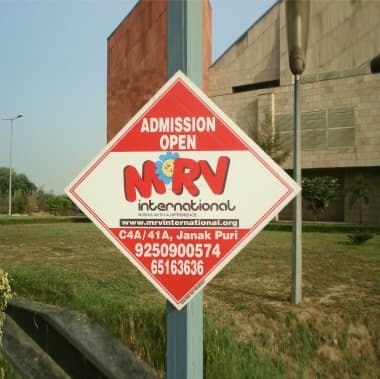
No Parking Board Advertising vs Hoardings: Which Wins for One Locality in 2026?
A hoarding looks like the premium buy — but for dominating ONE locality, it usually loses to no parking gate boards. Here is the honest, side-by-side comparison on cost model, reach, exposure and targeting, plus a clear verdict and decision checklist.