

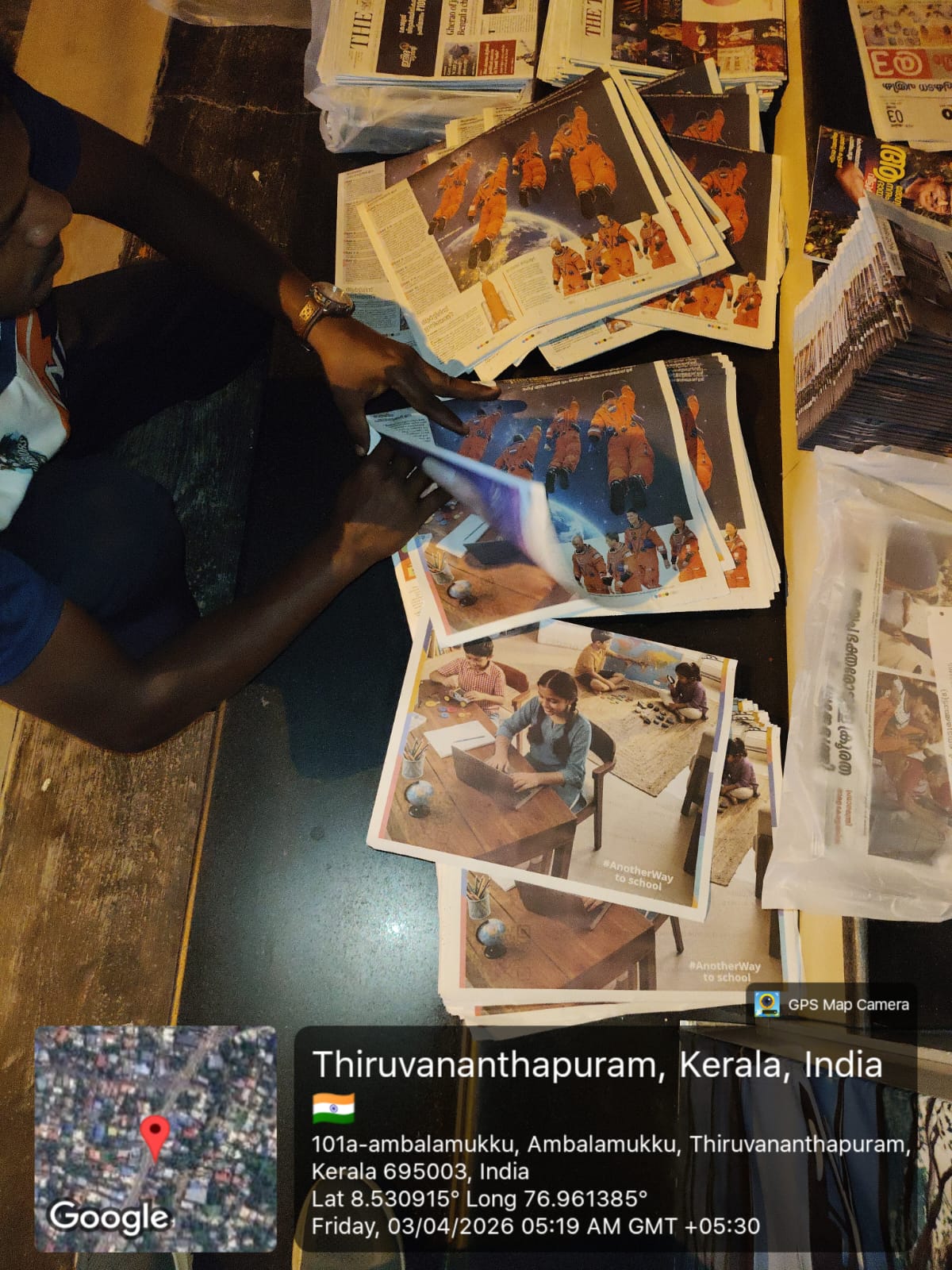
Newspaper insertion generates 500-1,500 qualified site visit enquiries per 1 lakh inserts for real estate projects, making it one of the highest-ROI offline channels for property marketing in India. While digital advertising dominates the media plans of most developers, the homebuyer journey in India still begins at the breakfast table. A family browsing the Sunday edition of Times of India or Deccan Herald discovers a full-size A2 flyer with floor plans, pricing, and amenity details of a new project 8 km from their home. This physical encounter creates a fundamentally different engagement than a scrolled-past Instagram ad. The insert gets discussed, passed to family members, and often kept for days. This guide covers every aspect of planning newspaper insertion campaigns specifically for real estate developers.
Why Newspaper Insertion Works for Real Estate in India
Real estate is the single largest category for newspaper insertion advertising in India, and for good reason. The homebuying decision involves multiple family members. A newspaper insert is shared across the household in ways digital ads cannot be. The purchase cycle is long (3-12 months), and a physical flyer kept on a shelf serves as a persistent reminder. The target demographic (30-55 year old homebuyers) has high newspaper readership. Property decisions are geography-dependent, and newspaper insertion offers pin code level targeting within a 5-10 km radius of the project site. Weekend editions have 30-40% higher readership, aligning perfectly with the leisure browsing behaviour of prospective homebuyers.
A2 Flyer Design Rules for Real Estate Inserts
The A2 format (420mm x 594mm) is the standard for real estate newspaper inserts because it provides enough space for floor plans, amenity images, and pricing details. Design rules: Front side should feature the hero shot of the project, project name, key USP (location advantage, price point, or amenity), starting price, and RERA registration number. The floor plan should occupy at least 40% of one side. Include maximum 3 floor plan variants (1BHK, 2BHK, 3BHK) with carpet area and price. Back side should include location map with distance markers (5 min from metro, 10 min from school), amenity list with icons, and developer credibility (previous projects, years in business). Call-to-action: ONE phone number in minimum 36pt font, QR code linking to virtual tour, and site visit booking link. Critical compliance: RERA number must appear on the insert as per regulations.
Newspaper Selection Strategy for Real Estate Campaigns
The newspaper you choose determines who sees your insert. For real estate, the selection matrix is: Premium projects (Rs.1 crore+) target English newspaper readers. Use Times of India, Hindu, Economic Times. Mass housing (Rs.30-80 lakh) should use a mix of English and regional language papers. Regional language papers reach the first-time homebuyer segment more effectively. Affordable housing (under Rs.30 lakh) should prioritize regional language newspapers with hyperlocal editions. In Bangalore: Deccan Herald and Vijaya Karnataka combination covers both English and Kannada readers. In Mumbai: Times of India and Navbharat Times cover English and Hindi segments. In Chennai: The Hindu and Daily Thanthi cover English and Tamil audiences. Always request edition-level circulation data, not city-level. A zonal edition reaching 50,000 homes in your target micro-market is more valuable than a city edition reaching 5 lakh homes across irrelevant areas.
Pin Code Targeting for Maximum Site Visits
The golden rule: target pin codes within a 10 km radius of your project site. This is based on data from across real estate insert campaigns showing that 70-80% of site visit conversions come from prospects living within 10 km of the project. First ring (0-5 km): These are your highest-conversion prospects. They already know the area, work nearby, or have family in the locality. Allocate 50% of your inserts here. Second ring (5-10 km): Adjacent areas with similar demographics. Allocate 35% of inserts. Third ring (10-15 km): Aspirational movers and investors. Allocate 15% of inserts. For a 1,00,000 insert campaign, this translates to 50,000 inserts in first ring, 35,000 in second ring, and 15,000 in third ring.
Pin-code ring allocation for a 1 lakh insert campaign
| Share | Inserts | Prospect profile | |
|---|---|---|---|
| First ring (0-5 km) | 50% | 50,000 | Highest conversion; already know the area or work nearby |
| Second ring (5-10 km) | 35% | 35,000 | Adjacent areas with similar demographics |
| Third ring (10-15 km) | 15% | 15,000 | Aspirational movers and investors |
70-80 percent of site visit conversions come from prospects living within 10 km of the project.
Weekend vs Weekday Insertion: Timing Strategy
Saturday and Sunday editions deliver 30-40% higher engagement for real estate inserts. This is because homebuyers browse newspapers leisurely on weekends. Family members are present to discuss the property. Site visits are typically planned for the same weekend or the following one. Saturday morning inserts give prospects the entire weekend to discuss, research online, and plan a visit. Sunday inserts reach the largest readership day but compete with more advertising clutter. Recommendation: For maximum response, insert on Saturday in your primary ring and Sunday in secondary and tertiary rings. This creates a wave effect where core area prospects get first access.
ROI Tracking for Real Estate Inserts
Every real estate insert campaign must have four tracking mechanisms in place: A dedicated phone number that is used only on the insert (not on hoardings or digital ads). A QR code linking to a virtual tour or site visit booking page with UTM parameters. A unique coupon code for any pre-launch discount or booking benefit. A walk-in tracking form at the site office asking how the prospect heard about the project. With these in place, ROI calculation becomes straightforward. Average conversion funnel: 1,00,000 inserts at Rs.2.00 (A2 volume rate above 50,000 pieces) = Rs.2,00,000 total cost. At 0.8% response rate = 800 enquiries. At 25% site visit conversion = 200 site visits. At 5% booking conversion = 10 bookings. At Rs.50 lakh average ticket size = Rs.5 crore revenue. ROI = Rs.5 crore / Rs.2 lakh = 250x return. For campaign booking, explore The Mediaverse newspaper insertion services.
Campaign Calendar: When to Run Real Estate Inserts
Real estate insert campaigns should align with buying seasons. January-March: Post New Year, budget announcements. Strong buying intent. April-June: Pre-monsoon rush. Buyers want to close before rains. October-December: Festival season (Dussehra, Diwali, Christmas). Highest buying intent. Developers offer festive discounts. Avoid: July-August (monsoon in most cities, reduced newspaper readership), April-May (extreme heat in North India). Plan minimum 3 insertions per campaign phase: Week 1 (awareness), Week 2 (reinforcement), Week 3 (urgency with limited-time offer). This frequency pattern is critical because real estate decisions are not impulsive. A single insert is informational. Three inserts create urgency.
Frequently Asked Questions
What is the best newspaper insert size for real estate projects?
A2 format (420mm x 594mm) is the industry standard for real estate inserts. It provides sufficient space for floor plans, amenity images, location maps, and pricing details. A2 uses 45 GSM newsprint paper at Rs.2.20 per insert (Rs.2.00 above 50,000 pieces).
How many inserts do I need for a real estate launch campaign?
Minimum 50,000 inserts for a single project launch across 2-3 micro-markets. Standard campaigns use 1-2 lakh inserts spread across 3 insertion dates. Large township or premium projects may require 3-5 lakh inserts across multiple newspapers.
Should real estate inserts include RERA details?
Yes, including RERA registration number on newspaper inserts is mandatory under RERA regulations. The RERA number must be prominently displayed along with the project name and developer name.
What response rate can I expect from real estate newspaper inserts?
Real estate newspaper inserts typically generate 0.5-1.5% response rates. For a 1 lakh insert campaign, expect 500-1,500 enquiries. Of these, 20-30% convert to site visits, and 3-5% of site visitors convert to bookings.
Can I target specific societies or apartment complexes with newspaper insertion?
Yes, newspaper distribution can be targeted to specific residential societies, apartment complexes, and gated communities within a pin code. This is particularly effective for upgrade buyers in older complexes near your new project.
Launch Your Real Estate Insert Campaign
Get a custom newspaper insertion plan for your real estate project with newspaper selection, pin code mapping, and A2 flyer design. Request your free campaign plan or call +91 95800 88540.
Why Real Estate Insertion Campaigns Fail
Three failure patterns. Using A4 format instead of A2 for floor plans. A4 is too small to show floor plan details that homebuyers need to make a site visit decision. A2 format is the industry standard for real estate inserts. Running weekday insertions instead of Saturday. Homebuyers browse newspapers leisurely on weekends. Saturday editions get 30-40% higher response. Targeting city-wide instead of 10km radius. 70-80% of site visit conversions come from prospects living within 10km of the project. City-wide distribution wastes 60-70% of budget.
What is the best day for real estate newspaper insertion?
Saturday delivers 30-40% higher response than weekday editions. Homebuyers browse leisurely on weekends. Family members present to discuss property. Site visits planned for same or next weekend. Sunday also works but has more ad clutter. Saturday is gold standard.
Key Insight: The 10km radius rule: 70-80% of real estate site visit conversions come from prospects within 10km. Allocate 50% of inserts to 0-5km ring, 35% to 5-10km, and 15% to 10-15km. City-wide distribution is budget waste.
Tags
Quick Answers
What is the best insert format for real estate?
A2 format (420x594mm) at Rs.1.90/insert. Provides space for floor plans, amenity images, location maps, and pricing. Saturday editions deliver 30-40% higher response. Target pin codes within 10km of project site.
What ROI do real estate inserts deliver?
0.5-1.5% response rate generating 500-1,500 enquiries per 1 lakh inserts. 20-30% convert to site visits. 3-5% book. At Rs.50L average ticket: Rs.5 crore revenue vs Rs.1.9L campaign cost = 2,631% ROI.
Looking for professional Newspaper Insertion services?
The Mediaverse runs end-to-end newspaper insertion campaigns across India with geo-tagged delivery and transparent, all-inclusive pricing.
Explore our Newspaper Insertion solutionsSummarize this guide with AI
Open this article in your favourite AI assistant
Written by

The Mediaverse Team
India's Leading Outdoor Advertising Agency
The Mediaverse is a national-level outdoor advertising and integrated marketing organization that provides complete OOH, ATL, BTL, retail, and transit media solutions across India. With years of experience executing high-performance campaigns for brands in FMCG, Real Estate, E-commerce, EdTech, Automotive, Healthcare, and Retail, The Mediaverse combines creativity, data-driven media planning, and flawless on-ground execution. As a full-stack outdoor advertising provider, The Mediaverse offers Auto Branding, Mobile Van Branding, Newspaper Insertion Advertising, Shop Name Board Branding, In-Store Branding, Hoardings, Transit Media, Kiosks, Mall Media, Activations, and all forms of Below-The-Line marketing. Known for its pan-India network, strategic route planning, premium print quality, and Cheqmate™ GPS-based verification, The Mediaverse ensures 100% transparent and result-oriented campaign delivery. The Mediaverse’s editorial team produces deeply researched, SEO-optimized, and generative-engine-friendly content to help businesses understand the power of outdoor advertising and make informed decisions that maximize brand visibility and ROI across urban, suburban, and rural markets.
Related Articles
The 50,000-Insert Minimum in 10 Cities: What Share of Each City's Dailies It Reaches (2026)
One national card, ten denominators. What share of each city's published daily copies a 50,000-insert minimum reaches, what it costs, and which city pages contradict their own figures.
Gate Board or Newspaper Insert for One Colony? The 2026 Cost per Home
One board costs 36 A5 inserts, yet for a single colony the board is usually cheaper per home, because the insert bills a 50,000-copy run. The break-even colony copy counts for A5, A4 and A2, a 1,200-house worked example, and when the insert wins instead.
Newspaper Insertion in Pune (2026): PMC Against PCMC, and the Marathi Line That Actually Decides the Run
Pune gives the 50,000 insert minimum one of the deepest bites in India, a sixth to a quarter of one daily. The 2026 card, why PMC against PCMC does not move the quote, the housing stock rule for Marathi or English, and the three season insert calendar.