

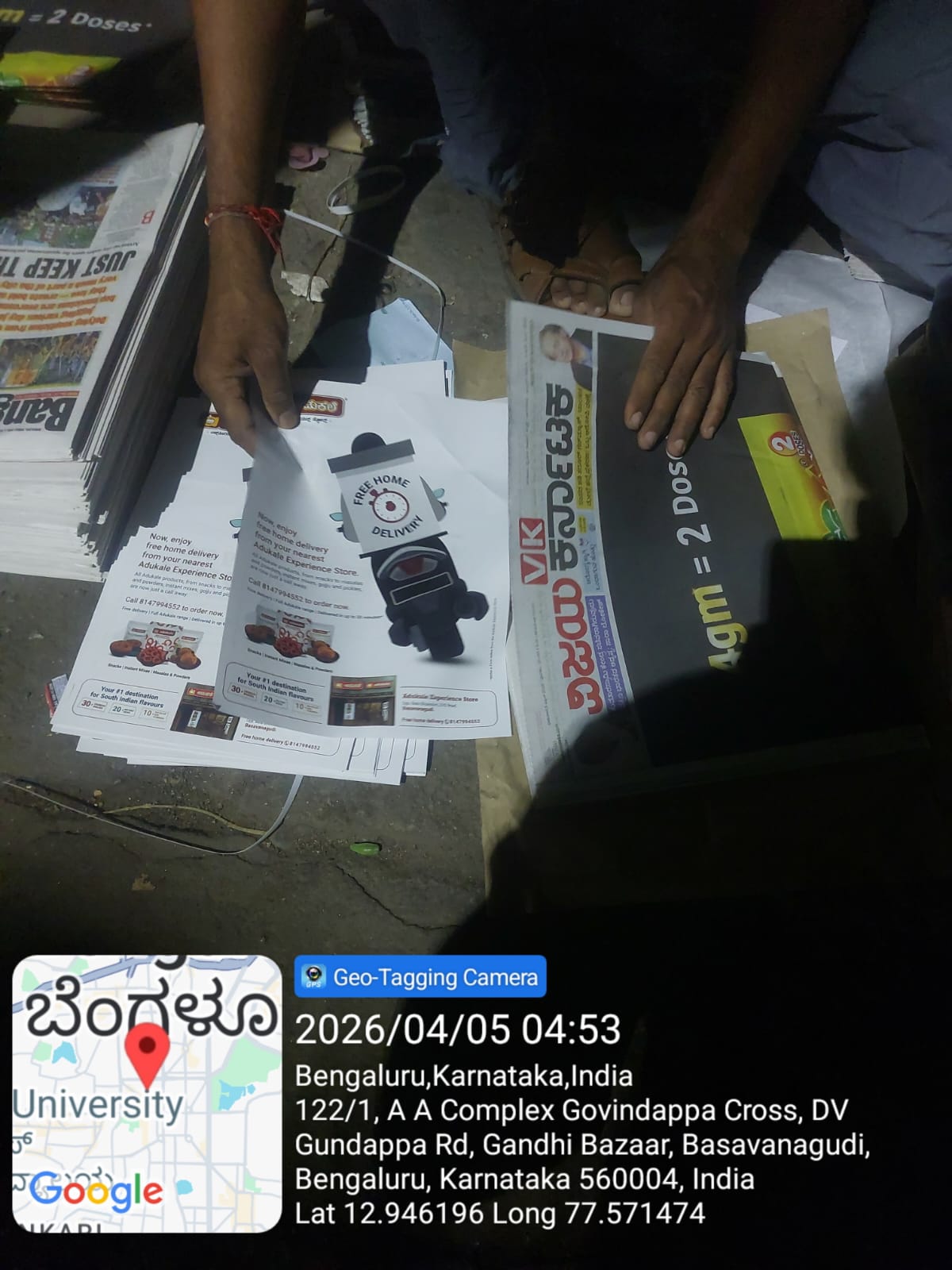
I spent four months in Lucknow last year, on the ground, auditing newspaper distribution routes from Hazratganj to Gomti Nagar to outer Aliganj. Three things surprised me. Lucknow has three Hindi dailies that share the city more evenly than any other UP market: Dainik Jagran dominates outright but Amar Ujala and Hindustan Hindi capture distinct demographic slices that do not fully overlap. The Vidhan Sabha government-corridor creates rate-spike windows during UP Budget and Assembly sessions that no rate card publishes openly. And Hazratganj retail still runs on Awadhi cultural cues that out-of-state advertisers consistently get wrong: an artwork that ignores Nawabi visual identity under-converts by 25 to 40 percent in Hazratganj jewellery and premium retail categories. This guide is the playbook that came out of those four months.
Lucknow's three-Hindi-daily structure
Six dailies carry roughly 95 percent of Lucknow's newspaper readership. Three Hindi dailies dominate. Dainik Jagran Lucknow (Hindi, morning) at 22.4 lakh average issue readership per IRS Q1 2026 data. Amar Ujala Lucknow (Hindi, morning) at 14.6 lakh. Hindustan Hindi Lucknow at 12.1 lakh. The three together reach roughly 49 lakh readers daily but with only 60 to 65 percent cross-readership overlap, meaning each captures a distinct demographic slice in addition to the shared core.
Two English dailies plus one regional Hindi serve specific segments. Times of India Lucknow at 4.4 lakh covers government, corporate, and Gomti Nagar Vibhuti Khand audiences. Hindustan Times Lucknow at 2.1 lakh skews younger professional. Rashtriya Sahara (Hindi, regional) at 1.8 lakh skews older and outer-suburb. The three together reach roughly 8.3 lakh readers, less than half of any single Hindi daily.
Operational implication. Any Lucknow campaign that goes English-only undershoots reach by 84 percent. Single-Hindi-daily campaigns capture roughly 60 to 65 percent of relevant Hindi-reading households because the three-daily fragmentation is real: a Dainik Jagran subscriber may not see your offer in Amar Ujala, and vice versa. For campaigns above ₹50,000 the right mix is Dainik Jagran plus one or both of Amar Ujala and Hindustan Hindi. For sub-₹50,000 pilots, Dainik Jagran alone is usually the right call because of its absolute reach lead.
Which Lucknow insertion zone should you target first?
Zone A: Hazratganj-Civil Lines-Vidhan Sabha premium (pincodes 226001, 226005, 226018)
Hazratganj (226001), Civil Lines (226001 east), Vidhan Sabha corridor (226005), Mahanagar (226006), the new commercial belt around Janpath and Sahara Ganj. Per-piece rates run 16 to 20 percent above the city average. ₹1.38 for A5, ₹1.72 for A4, ₹2.18 for A2 on standard paper. The premium reflects HNI density (UP government officials, established Awadhi business families, Lucknow Bar Council and judiciary HNI), and the corridor's role as both the political and commercial showcase of the state capital. For luxury, premium retail, fine dining, finance, and government-adjacent commerce, this zone delivers 3 to 4 times the response per rupee of mass-market alternatives. The Awadhi cultural cue requirement is highest here: artwork without Nawabi visual identity under-converts by 25 to 40 percent.
Zone B: Gomti Nagar-Vibhuti Khand corporate corridor (pincodes 226010, 226024)
Gomti Nagar (226010), Vibhuti Khand (226010 extension), Vikas Nagar (226024), the new corporate corridor stretching toward Sushant Golf City. Per-piece rates track the city average within 4 to 6 percent. ₹1.20 for A5, ₹1.50 for A4, ₹1.92 for A2. The corridor's distinctive feature is the corporate-and-government professional household: senior officials, PSU executives, IT professionals, real estate developers, and the residential audience of UP's most aspirational new neighbourhoods. English daily consumption runs 1.5 to 1.8 times the city average here. For B2B SaaS, EdTech, premium real estate, finance launches, and corporate hiring, an English-heavy mix (TOI plus Dainik Jagran) outperforms an Amar-Ujala-heavy mix by roughly 1.4 to 1.8 times in this corridor.
Zone C: Indira Nagar-Aliganj-mass-market belt (pincodes 226016, 226022, 226020, 226002)
Indira Nagar (226016), Aliganj (226022), Rajajipuram (226020), Alambagh (226005), Telibagh, Aminabad-Chowk old-city commercial belt. Per-piece rates run 7 to 11 percent below the city average. ₹1.05 for A5, ₹1.32 for A4, ₹1.70 for A2. The discount reflects very high household density and the family-decision-maker composition that makes Hindi dailies disproportionately effective for retail, school admissions, FMCG, and household-decision categories. For mass-market campaigns this zone delivers Lucknow's best CPM by a clear margin. The Aminabad-Chowk old-city pincodes also serve the Awadhi traditional retail audience with Hindi-Urdu-bilingual artwork driving 30 to 40 percent higher response than Hindi-only artwork in this specific segment.
Lucknow's three insertion rate zones (2026)
| A5 rate | A4 rate | A2 rate | Best for | |
|---|---|---|---|---|
| Zone A: Hazratganj-Civil Lines-Vidhan Sabha | ₹1.38 | ₹1.72 | ₹2.18 | Luxury, premium retail, finance, government-adjacent commerce |
| Zone B: Gomti Nagar-Vibhuti Khand | ₹1.20 | ₹1.50 | ₹1.92 | B2B SaaS, EdTech, premium real estate, corporate hiring |
| Zone C: Indira Nagar-Aliganj-Rajajipuram | ₹1.05 | ₹1.32 | ₹1.70 | Retail, school admissions, FMCG, household categories |
Hindi-Urdu bilingual artwork lifts response 30-40 percent in the Aminabad-Chowk old-city segment.
The Hazratganj-to-Gomti-Nagar arc, pincode by pincode
The corridor from Hazratganj through Civil Lines and Mahanagar to Gomti Nagar carries roughly 55 percent of Lucknow newspaper insertion volume. The Mediaverse 2026 rate map: Hazratganj (226001): ₹1.40 A5, ₹1.75 A4. Civil Lines (226001 east): ₹1.38 A5, ₹1.72 A4. Vidhan Sabha corridor (226005): ₹1.36 A5, ₹1.70 A4. Mahanagar (226006): ₹1.30 A5, ₹1.62 A4. Nishatganj (226007): ₹1.25 A5, ₹1.55 A4. Gomti Nagar (226010): ₹1.22 A5, ₹1.52 A4. Vibhuti Khand (226010 extension): ₹1.20 A5, ₹1.50 A4. The arc shows a 17 percent rate spread between Hazratganj (premium) and Vibhuti Khand (corporate-suburb) across roughly 8 kilometres.
Operationally, the arc has one quirk. The 226010 Gomti Nagar pincode encompasses three distinct sub-routes: Gomti Nagar phase I (older residential), Gomti Nagar phase II (newer corporate-housing), and Vibhuti Khand (commercial-corporate). The three skew differently on daily mix and household income. A 226010 brief without phase or Vibhuti Khand specification receives a blended distribution that overpays or underdelivers. Specify on every brief.
LMC compliance and the cantonment-board dual-regulator context
Lucknow distribution maps to the 110 LMC wards across 8 zones. The Vidhan Sabha corridor pincodes also overlap with the Lucknow Cantonment Board jurisdiction for some commercial-advertising rules, creating a dual-regulator context for campaigns inside that corridor. For most newspaper insertions this dual-regulator overlap does not materially affect the artwork approval flow, but for any campaign featuring military, defense, or government-procurement messaging (rare in retail), the Cantonment Board pre-screen adds 2 to 4 working days to the schedule.
Three compliance points apply to inserted artwork in Lucknow. First, no political content within 14 days of any election under SEC UP jurisdiction, with a stricter enforcement window during Lok Sabha and Vidhan Sabha cycles than other UP cities. Second, ASCI-compliant claims for ayurveda, supplements, and traditional medicine, which have a stricter LMC enforcement than other UP cities because of the high consumer category presence in Hazratganj retail. Third, religious-sensitivity review for any artwork featuring Awadhi heritage cues or religious imagery, which can be flagged by LMC zonal officers if treated insensitively. The Awadhi cultural cue requirement that drives commercial success is the same cue that can backfire if used carelessly.
The Hindi-Urdu vendor network
Lucknow newspaper insertion runs through three vendor types. The newspaper agencies themselves handle direct booking. Jagran Prakashan handles Dainik Jagran. Amar Ujala Publications handles Amar Ujala. Hindustan Media Ventures handles Hindustan Hindi. Times Internet handles TOI Lucknow. These direct channels offer the best per-daily rate for single-daily campaigns.
The Lucknow metro insertion specialists are the second category. They bundle Dainik Jagran plus Amar Ujala plus Hindustan Hindi plus optional English campaigns, handle LMC and cantonment-board pre-screening, and provide both Hindi and Urdu translation rigor when the campaign targets Aminabad-Chowk old-city audiences. The Mediaverse falls into this category. Multi-daily campaigns above ₹50,000 typically save 8 to 14 percent through specialist booking, and the bilingual Hindi-Urdu artwork capability avoids the cultural-mismatch under-conversion patterns that out-of-state brands run into.
The third vendor type is the printer-distributor combine, often a Telibagh or Sitapur Road industrial-area facility. They quote the cheapest per-piece rate but rarely offer the Awadhi cultural review, the dual-regulator pre-screening, or the Hindi-Urdu bilingual capability. For first-time Lucknow advertisers the language-and-regulatory specificity makes the metro specialist worth the marginal premium.
Wedding season and the government-event window
Lucknow runs on two overlapping seasonal cycles. The wedding season (November Karwa Chauth through February-end) drives 48 percent of annual newspaper insertion revenue. Retail, jewellery, clothing, catering, event-venue, and family-event categories see 2 to 3 times the non-wedding response rates. Newspaper rates climb 18 to 25 percent in this window. The Mediaverse field data across 42 wedding-season campaigns shows redemption rates climb 2.4 to 3.4 times over non-wedding windows for relevant categories, comfortably justifying the premium.
The government-event cycle is the Lucknow-specific overlay. UP Budget sessions (typically February-March), Vidhan Sabha sessions (multiple windows per year), and major state events (R-Day, I-Day, state foundation day) drive 8 to 14 percent rate spikes for Vidhan Sabha-corridor pincodes lasting 2 to 4 weeks. These spikes do not appear on standard rate cards but vendors price them in for the corridor specifically. Brands targeting government employees, contractors, and government-adjacent commerce can use these windows as positive frequency lifts. Brands not targeting government audiences should plan campaigns for non-Vidhan-Sabha windows in the same corridor to avoid the spike overpay.
A 2026 Lucknow campaign launch playbook
Walk through a real campaign brief. A premium wedding-clothing brand launching a flagship store on Hazratganj for the December wedding peak. ₹4.5 lakh all-in budget. Target audience: 25 to 50 year old Awadhi families across Hazratganj, Civil Lines, Mahanagar, and the upper-middle-class Gomti Nagar phase I. Goal: store walk-ins in the wedding fortnight and consultation appointments for custom orders.
Step 1, working budget. ₹4,50,000 minus 18 percent GST = ₹3,81,355 ex-GST. Reserve ₹30,000 for design plus Awadhi cultural-cue artwork pre-screening (Hindi-primary with optional Urdu accent for Aminabad-Chowk targeting). Reserve ₹45,000 for printing setup. Working budget for media: ₹3,06,355.
Step 2, edition mix. Target audience reads Dainik Jagran (dominant), Amar Ujala (older-Lucknow established families), and Hindustan Hindi (younger professional households). TOI Lucknow adds incremental English-reading HNI plus government-corridor reach. Mix: Dainik Jagran 40 percent, Amar Ujala 25 percent, Hindustan Hindi 15 percent, TOI Lucknow 20 percent.
Step 3, pincode targeting. Hazratganj (226001), Civil Lines (226001 east), Mahanagar (226006), Gomti Nagar phase I (226010), Aliganj north (226022). Five pincodes, total target households roughly 2.1 lakh.
Step 4, campaign cadence. Two waves: launch Sunday Dainik Jagran with the Sapno Ki Yatra supplement (aspirational-targeted, high engagement for wedding-clothing category), then a Saturday Amar Ujala plus Sunday TOI combo for second-impression frequency in week two. A4 size, 130 GSM premium (wedding category justifies premium feel), Hindi-primary artwork with Awadhi visual cues, double-sided, no fold.
Step 5, volume math. ₹1,22,542 for Sunday Dainik Jagran Sapno Ki Yatra at ₹1.85 average per piece (Sunday wedding-season surcharge included): roughly 66,200 pieces. ₹76,589 for Saturday Amar Ujala at ₹1.75 per piece: roughly 43,800 pieces. ₹45,953 for Hindustan Hindi at ₹1.68 per piece: roughly 27,400 pieces. ₹61,271 for Sunday TOI Lucknow at ₹1.92 per piece: roughly 31,900 pieces. Total: 169,300 pieces across two weeks. With 2.5 readers-per-copy in Hindi daily readership and 2.7 in English daily readership, total reader exposure ~4.4 lakh impressions including frequency overlap.
Step 6, attribution. Print a unique missed-call number, a unique launch-fortnight discount code, and a Hindi QR-code routing to a Hindi landing page with custom-order consultation booking. Hindi QR-scan rate for wedding-clothing in Lucknow runs roughly 2.4 times the English scan rate, confirming the Hindi-primary positioning works in this category.
Bottom line for a 2026 Lucknow campaign
Pick your zone first (Hazratganj-Civil Lines premium, Gomti Nagar-Vibhuti Khand corporate, or Indira Nagar-Aliganj mass-market). Pick your edition mix second, weighted heavily Hindi (Dainik Jagran plus at least one of Amar Ujala or Hindustan Hindi) for almost every category. Pick your pincodes third, splitting 226010 into Gomti phase I, Gomti phase II, and Vibhuti Khand where it matters. Time campaigns to wedding season for category-relevant offers and away from Vidhan Sabha session windows for non-government categories. Pre-screen artwork for Awadhi cultural cues plus LMC-Cantonment dual-regulator review. With these five disciplines your Lucknow campaign will outperform the same budget spent on any single digital channel for retail, wedding, jewellery, and traditional commerce objectives by 2 to 4 times on landed cost-per-walk-in.
Should I run Hindi-only campaigns in Lucknow or do I need English supplementation?
For mass-market retail, FMCG, school admissions, household appliances, and family-decision categories, Hindi-only campaigns capture roughly 94 to 97 percent of relevant reach at the cleanest per-rupee cost. For B2B SaaS, EdTech targeting Vibhuti Khand corporate audiences, premium real estate, and finance, add TOI Lucknow at 15 to 25 percent of media spend. English-only campaigns are almost never the right choice in Lucknow regardless of target audience because even the corporate audience reads Hindi at home.
How does Aminabad-Chowk old-city advertising differ from Hazratganj or Gomti Nagar?
Aminabad-Chowk runs on a distinct Hindi-Urdu bilingual commercial culture rooted in Awadhi heritage. Artwork that ignores Urdu typography or that treats the audience as identical to Hazratganj's modern HNI under-converts by 30 to 40 percent in ethnic-wear, traditional jewellery, and Awadhi-cuisine categories. Brands targeting this audience should commission bilingual Hindi-Urdu artwork from a Lucknow-based designer rather than translating Mumbai or Delhi creative. Vendors that handle Aminabad-Chowk campaigns specifically should be able to demonstrate prior Urdu-script work, not just claim the capability.
What is the smallest Lucknow newspaper insertion campaign that still has good economics?
4,000 pieces in a single pincode through Dainik Jagran weekday edition is the practical floor for Lucknow. Below 4,000, per-piece rates climb above ₹1.85 because of the standard printer-setup-plus-route-list-fixed-cost math. For pilots below 4,000 pieces, the Mediaverse recommends auto rickshaw branding in the same pincode at ₹170 per auto per month for back-panel branding, which outperforms a tiny newspaper campaign on landed CPM. Above 4,000 pieces in a Lucknow pincode, insertion is the clear winner.
Tags
Quick Answers
How much does newspaper insertion in Lucknow cost in 2026?
Suburban rates: A5 ₹1.15, A4 ₹1.45, A2 ₹1.82 on 80-90 GSM paper, weekday Hindi daily. Hazratganj, Gomti Nagar Vibhuti Khand, and Aliganj premium pincodes (226001, 226010, 226022): add 16 to 20 percent. Hindi dailies (Dainik Jagran, Amar Ujala, Hindustan Hindi): rate-parity with English in Lucknow because of three-daily dominance rather than vernacular discount. Sunday adds 14 to 18 percent. Wedding season (November-February) adds 18 to 25 percent. A 50,000-piece A4 Sunday Dainik Jagran campaign across Hazratganj-Gomti Nagar pincodes lands at roughly ₹80,000 all-inclusive.
Which Lucknow neighborhoods are best for newspaper insertion?
Three corridors deliver disproportionate response. The Hazratganj-Civil Lines-Vidhan Sabha corridor for premium retail, government-adjacent commerce, hospitality, and luxury jewellery. The Gomti Nagar-Vibhuti Khand corporate belt for B2B SaaS, EdTech, real estate, and tech-corridor audiences. The Indira Nagar-Aliganj-Mahanagar residential belt for FMCG, school admissions, household appliances, and family-decision categories. The Aminabad-Chowk old-city commercial belt has its own niche for traditional retail, ethnic-wear, and the Awadhi-heritage cultural shopping wallet.
Does the UP government Vidhan Sabha corridor affect newspaper insertion economics in Lucknow?
Yes, in two specific ways. First, the Vidhan Sabha corridor pincodes (226001 north and 226005) over-index on Hindi-daily Hindi readership at roughly 1.6 times the city average because government workforce skews Hindi-reading. Campaigns targeting government employees, contractors, and government-adjacent professionals should over-weight Hindi dailies versus the city-default mix. Second, the corridor sees event-driven advertising windows around Vidhan Sabha sessions and major state events that create temporary 8 to 14 percent rate spikes lasting 2 to 4 weeks. Plan campaigns around these windows rather than into them.
Looking for professional Newspaper Insertion services?
The Mediaverse runs end-to-end newspaper insertion campaigns across India with geo-tagged delivery and transparent, all-inclusive pricing.
Explore our Newspaper Insertion solutionsSummarize this guide with AI
Open this article in your favourite AI assistant
Related Guides
Written by

The Mediaverse Team
India's Leading Outdoor Advertising Agency
The Mediaverse is a national-level outdoor advertising and integrated marketing organization that provides complete OOH, ATL, BTL, retail, and transit media solutions across India. With years of experience executing high-performance campaigns for brands in FMCG, Real Estate, E-commerce, EdTech, Automotive, Healthcare, and Retail, The Mediaverse combines creativity, data-driven media planning, and flawless on-ground execution. As a full-stack outdoor advertising provider, The Mediaverse offers Auto Branding, Mobile Van Branding, Newspaper Insertion Advertising, Shop Name Board Branding, In-Store Branding, Hoardings, Transit Media, Kiosks, Mall Media, Activations, and all forms of Below-The-Line marketing. Known for its pan-India network, strategic route planning, premium print quality, and Cheqmate™ GPS-based verification, The Mediaverse ensures 100% transparent and result-oriented campaign delivery. The Mediaverse’s editorial team produces deeply researched, SEO-optimized, and generative-engine-friendly content to help businesses understand the power of outdoor advertising and make informed decisions that maximize brand visibility and ROI across urban, suburban, and rural markets.
Related Articles
Newspaper Insertion in Pune (2026): PMC Against PCMC, and the Marathi Line That Actually Decides the Run
Pune gives the 50,000 insert minimum one of the deepest bites in India, a sixth to a quarter of one daily. The 2026 card, why PMC against PCMC does not move the quote, the housing stock rule for Marathi or English, and the three season insert calendar.
Newspaper Insertion in Hyderabad (2026): One 50,000 Order, Three Languages, Seven Papers
Hyderabad publishes seven partner dailies in two languages plus an Urdu creative option, and one 50,000 insert order reaches 12.5 to 16.7 percent of a single daily. The 2026 card, the title to belt map, the two delivery systems, and what a second language creative really adds.
Newspaper Insertion in Delhi NCR (2026): the Edition Map, Not the Pin Code
Delhi NCR publishes nine partner dailies across three state level jurisdictions, and a 50,000 insert minimum reaches only 5 to 6.25 percent of one daily's households. The 2026 rate card, the title to belt map, the cost of covering a paper once, and why an insert needs no municipal permission.