

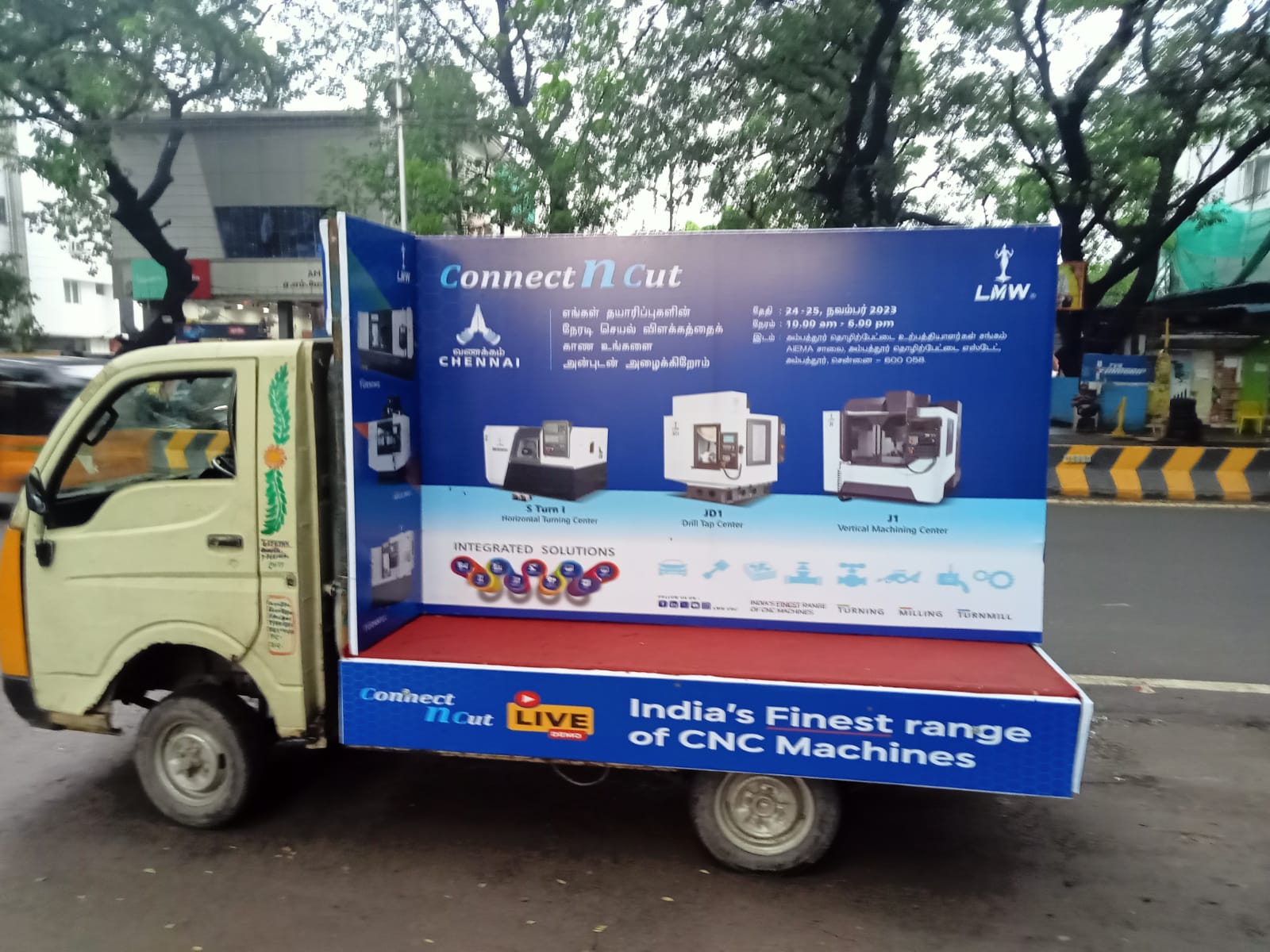
An Ahmedabad textile-export client told us, after a campaign that nominally hit its impression target but missed its sales conversion target by 35 percent, that we had under-weighted Navratri in our route plan. He said it as a question. Why did we route the vans through SG Highway at standard daytime hours when garba grounds across the city pull 80 percent of the festival-relevant audience into specific 6 PM to midnight clusters during the nine-night cycle. He was right. The campaign ran in October but treated the nine-night festival as a generic October week. The Mediaverse playbook that came out of that mistake (Navratri-aware routing, garba-ground-adjacent stationary visibility, evening-only operations for nine consecutive nights) is what this guide documents.
AMC, AUDA, and Gujarat's dry-state regulatory context
Ahmedabad mobile van advertising operates under three regulators plus a state-wide regulatory layer. Ahmedabad Municipal Corporation (AMC) governs 64 wards across 6 zones covering Navrangpura, Vastrapur, Bodakdev, CG Road, Maninagar, and the core city. Ahmedabad Urban Development Authority (AUDA) governs the outer zones including Bopal, Sanand industrial belt, and SG Highway extension beyond Iskcon Crossroads. Gandhinagar Municipal Corporation governs the state-capital corridor and GIFT City. The state-wide layer is the Gujarat Prohibition Act 1949 that makes Gujarat dry: zero alcohol-related artwork passes AMC mobile van pre-screening regardless of which jurisdiction the campaign operates in.
Three dry-state compliance points apply. First, no alcohol-related artwork including indirect references (cocktail pairings, beer-and-snack combinations, party-themed messaging implying alcohol, restaurant menus listing alcoholic beverages). Out-of-state brands frequently fail pre-screen on artwork that ran successfully in Mumbai or Delhi. Second, dietary claims (especially vegetarian-only positioning for restaurants) require ASCI-compliant evidence because Ahmedabad has the highest vegetarian-population concentration in urban India. Third, religious-sensitivity review for any artwork with religious imagery, particularly during festival windows when zonal officers handle complaints faster. First-time non-Gujarat advertisers see 14 percent artwork rejection on initial submission.
Where do Ahmedabad van rates change across zones?
Zone A: SG Highway-Bodakdev-Vastrapur premium
SG Highway (380054, 380015), Bodakdev, Thaltej, Vastrapur, Satellite, Bopal, Prahlad Nagar. Per-day rates run 12 to 16 percent above city average. ₹3,100 per day for T-Shape, ₹3,500 for L-Shape, ₹5,000 for Canter, ₹9,500 for LED. The zone reaches Ahmedabad's HNI households: Gujarati industrial business families, IT corridor professionals working at the SG Highway IT clusters, and Bodakdev family-office residents. For luxury automotive, premium real estate, jewellery, finance, and high-ticket consumer brands, this zone delivers 3 to 4 times the luxury-category conversion versus mass-market alternatives. SG Highway specifically delivers 15.8 lakh impressions per van per day during cool-season days.
Zone B: CG Road-Navrangpura central commercial belt
CG Road (380009), Navrangpura (380009, 380006), Ellis Bridge, Paldi (380007), Naranpura (380013), Sabarmati Riverfront commercial belt. Per-day rates run 6 to 9 percent above the city average for retail-density routing. ₹3,000 per day for T-Shape, ₹3,400 for L-Shape, ₹4,800 for Canter, ₹9,000 for LED. The belt covers Ahmedabad's traditional Gujarati commercial households and retail-decision audience: family-business owners, multi-generation Gujarati families, and the women-decision-maker audience that drives retail spending in this market. The Sabarmati Riverfront promenade specifically delivers an evening-walking-audience that creates an unusual dwell-time advantage for LED van campaigns parked along the linear stretch.
Zone C: SP Ring Road outer plus GIFT City corporate
Sardar Patel Ring Road outer loop (the 76 km circumference highway around Ahmedabad), GIFT City (Gandhinagar district), Sanand industrial belt, Gota, Chandkheda. Per-day rates run 4 to 6 percent below the city average at the baseline ₹2,800 T-Shape rate. The Ring Road outer covers industrial-corporate workforce plus the cross-Ahmedabad commuter flow. GIFT City reaches the fintech, financial services, and international-corporate audience. AMC plus Gandhinagar Municipal Corporation permits required for GIFT City routing add 8 to 12 percent permit overhead. For B2B fintech and financial services, GIFT City. For mass-market industrial-adjacent campaigns, Ring Road outer.
Ahmedabad Mobile Van Rates by Zone (2026)
| T-Shape | L-Shape | Canter | LED | |
|---|---|---|---|---|
| Zone A: SG Highway-Bodakdev-Vastrapur | ₹3,100/day | ₹3,500/day | ₹5,000/day | ₹9,500/day |
| Zone B: CG Road-Navrangpura central belt | ₹3,000/day | ₹3,400/day | ₹4,800/day | ₹9,000/day |
| Zone C: SP Ring Road outer plus GIFT City | ₹2,800/day | ₹3,200/day | ₹4,500/day | ₹8,500/day |
Navratri window adds 35 to 45 percent. GIFT City routing adds 8 to 12 percent permit overhead. GST extra.
SG Highway plus Ring Road: the cross-city loop
The combination of SG Highway through Bodakdev, Vastrapur, Iskcon Crossroads to Sanand on one axis plus the Sardar Patel Ring Road outer loop covers roughly 65 percent of Ahmedabad mobile van impression volume. The Mediaverse 2026 rate map: SG Highway Bodakdev (380054): ₹3,200 T-Shape. Vastrapur (380015): ₹3,100 T-Shape. Iskcon Crossroads (380054): ₹3,150 T-Shape. Prahlad Nagar (380015): ₹3,000 T-Shape. CG Road (380009): ₹3,000 T-Shape. Navrangpura (380009): ₹2,950 T-Shape. SP Ring Road North: ₹2,750 T-Shape. SP Ring Road South: ₹2,750 T-Shape. The arc shows roughly 16 percent rate spread reflecting the inner-city to ring-road demographic gradient.
Operationally, the SG Highway-Iskcon Crossroads junction during 6 PM to 9 PM evening corporate-departure peak delivers the highest stationary-impression density in Ahmedabad at 18,000 to 22,000 impressions per minute. Routes that explicitly include this junction during peak window outperform routes that avoid it by 20 to 28 percent on cost-per-impression. The cross-junction-during-rush-hour cost penalty (slower transit) is offset by the impression-density gain.
Navratri economics and the garba-ground routing
Navratri is Ahmedabad's commercial peak. The nine-night cycle (Sashthi through Navami plus Dashami) drives 40 percent of festival-relevant mobile van spend in the city. Demand spikes 46 percent versus August baseline. Fleet utilisation hits 88 percent during peak nights. Rates climb 35 to 45 percent. The unusual factor: Navratri pulls audience attention into specific garba-ground clusters between 6 PM and midnight (United Way of Baroda Garba grounds, Karnavati Club, Rajpath Club, GMDC Ground, Sabarmati Riverfront) rather than spreading across normal route patterns. Campaigns that route through garba-ground-adjacent zones during evening hours outperform standard SG Highway-only campaigns by 50 to 75 percent during Navratri windows.
Operational implications. First, route plans for Navratri campaigns should concentrate vans within 1.5 kilometre radius of major garba grounds during 6 PM to midnight, not run generic SG Highway routes. Second, book Navratri campaigns 30 to 45 days ahead minimum. Third, brands targeting festival-relevant categories (clothing, jewellery, food, footwear, beauty, event-services) see 2.3 to 2.9 times higher response that justifies the 40 percent premium. Non-festival categories should defer to August or November.
Summer heat and AMC permits
Ahmedabad's April-June peak heat (40 to 45 degree days) affects mobile van operations through driver-fatigue and vehicle-cooling stops similar to Hyderabad. The 12 to 14 percent summer operational premium funds driver-rotation and route-time-shifts to evening-only operations. AMC standard permits process in 2 to 4 working days for first-time advertisers and 1 to 2 days for repeat. AUDA permits for outer zones take similar timelines. Cross-jurisdictional campaigns (AMC plus AUDA plus Gandhinagar MC for GIFT City) require 7 to 10 working days lead time minimum.
Ahmedabad vendor ecosystem
Three vendor types operate. The fleet owner-operators (3 to 14 vans each, based in Naroda, Vatva, or Odhav industrial estates) offer the cheapest per-day rate but require advertiser-handled permits and dry-state pre-screening. The Ahmedabad mobile van specialists aggregate 80 to 250 vehicles, hold active permits across AMC, AUDA, and Gandhinagar MC, and handle Gujarati-language plus dry-state artwork pre-screening. The Mediaverse covers 420 vehicles via partner agreements. Multi-vehicle multi-day campaigns above ₹1 lakh typically save 10 to 14 percent through specialist booking. The third vendor type is the Navratri-experiential combine that bundles van with garba-ground promoter activations, ethnic-wear sampling, and festival-themed creative production. Suitable specifically for Navratri-window campaigns.
A 2026 Ahmedabad mobile van campaign launch playbook
An ethnic-wear retailer launching a Navratri collection across Ahmedabad. ₹5 lakh all-in budget. Target: 22 to 45 year old Gujarati women and family-decision-maker households across SG Highway, CG Road, Navrangpura, and the major garba-ground catchment areas. Goal: store walk-ins and online order capture during the 12-day Sashthi to Dashami window.
Step 1, budget. ₹5,00,000 minus 18 percent GST = ₹4,23,728 ex-GST. Reserve ₹30,000 for creative including Gujarati-language pre-screening. Reserve ₹45,000 for AMC plus AUDA permits. Working media budget at Navratri 40 percent premium: ₹3,48,728.
Step 2, vehicle mix. 1 LED van for garba-ground stationary visibility at ₹12,000 per day Navratri rate (₹8,500 baseline plus 40 percent) plus 3 T-Shape at ₹3,950 per day (₹2,800 baseline plus 40 percent) for 12 days = ₹1,44,000 (LED) + ₹1,42,200 (T-Shape) = ₹2,86,200, leaving reserve for emergency-fleet contingency.
Step 3, route allocation. The LED van runs evening 6 PM to midnight stationary visibility at the major garba ground clusters (GMDC Ground, Karnavati Club, Rajpath Club, Sabarmati Riverfront garba area) on rotation by night. The 3 T-Shape vans run the SG Highway-CG Road-Navrangpura corridor in mornings then concentrate around garba-ground feeder roads in evenings. Daily impression count estimate: 4 vans times 13 lakh average (Navratri-elevated) equals 52 lakh daily impressions. Over 12 days: 6.2 crore total. With 14 percent unique-reach in the targeted demographic: 87 lakh unique exposures of Gujarati women and family-decision-maker audiences.
Step 4, attribution. Unique Gujarati-language QR codes per vehicle routing to ethnic-wear collection landing pages. Gujarati missed-call number on each van. Issue Navratri-specific discount codes for night-by-night redemption tracking. GPS-tracked daily routes with hourly footfall correlation at retail stores. Cross-channel attribution layering with Instagram audience-pixel data from Ahmedabad geo-targeted ads for full-funnel measurement.
What makes an Ahmedabad campaign work
Three disciplines drive success. First, dry-state pre-screening discipline: every artwork must pass the Gujarati Prohibition Act test plus dietary-claim ASCI test before printing. Second, Navratri-window discipline: festival-relevant categories should concentrate budgets in the 12-day Sashthi-Dashami window with garba-ground routing; non-festival categories should defer to August or November. Third, audience-matched corridor selection: SG Highway for HNI luxury, CG Road for traditional commercial retail, Ring Road outer plus GIFT City for B2B and industrial. Mismatch drops conversion by 30 to 50 percent. Brands practising these three see 2 to 3 times per-rupee response of brands that treat Ahmedabad as a generic Indian metro with a dry-state asterisk.
Bottom line for a 2026 Ahmedabad mobile van campaign
Pick your audience first (HNI luxury, traditional Gujarati commercial, B2B fintech, industrial mass-market). Pick your corridor second (SG Highway-Bodakdev for HNI, CG Road for retail, Ring Road outer plus GIFT City for B2B). Pick your timing third (Navratri peak for festival-relevant categories, August or November for everything else). Pre-screen artwork for dry-state plus dietary plus Gujarati-language compliance 5 working days ahead. With these five disciplines your Ahmedabad mobile van campaign will outperform digital channels for retail, ethnic-wear, real estate, and direct-response objectives by 2 to 4 times on landed cost-per-walk-in.
How does the GIFT City permit overhead change campaign economics for fintech brands?
GIFT City operates under Gandhinagar Municipal Corporation rather than AMC. The 8 to 12 percent permit overhead reflects the cross-jurisdiction routing plus the dedicated GIFT City fintech-zone access permits. For fintech, financial services, and international-corporate audiences (the primary GIFT City audience), the premium is justified because GIFT City delivers concentrated B2B fintech impressions that no other Ahmedabad corridor offers. For non-fintech campaigns the GIFT City premium is overpay and routing should stay within AMC and AUDA zones.
Does Ahmedabad mobile van advertising work outside Navratri?
Yes, with adjusted economics. Non-Navratri windows deliver baseline rates without the 40 percent premium, fleet availability runs 70 to 80 percent rather than 88 percent, and the audience attention is on regular work-life rhythms rather than festival shopping. For mass-market FMCG, automotive, real estate, B2B SaaS, and any non-festival category, August to mid-September plus November to March windows deliver the best per-rupee economics. The Navratri premium is only justified for categories that compete for festival-shopping wallet.
What is the smallest Ahmedabad mobile van campaign that still works?
2-vehicle 7-day single-corridor campaigns are the practical floor in non-Navratri windows. Below this floor, unique-reach drops below 35 percent of target audience. During Navratri the practical floor rises to 3-vehicle 9-night campaigns to align with the nine-night cycle plus garba-ground-rotation logistics. Below Navratri floor, brands should defer to non-festival windows. For pilots below the floor, the Mediaverse recommends auto branding at ₹145 per auto per month.
Tags
Quick Answers
How much does mobile van branding cost in Ahmedabad in 2026?
Per-day per-van rates: T-Shape ₹2,800, L-Shape ₹3,200, Canter ₹4,500 to ₹5,000, LED van ₹8,500 to ₹9,500. SG Highway-Bodakdev-Vastrapur premium pincodes (380054, 380015) add 12 to 16 percent for HNI route density. Navratri peak window (nine-night cycle in September-October) adds 35 to 45 percent because demand spikes and fleet availability tightens. GIFT City operates under Gandhinagar Municipal Corporation and adds 8 to 12 percent permit overhead. A 30-day campaign with 4 T-Shape vans covering SG Highway plus CG Road lands at roughly ₹4 lakh all-inclusive in non-Navratri windows.
Which Ahmedabad routes are best for mobile van branding?
Three corridors dominate. The SG Highway-Bodakdev-Vastrapur HNI corridor reaches Ahmedabad's premium retail, real estate, and finance audience. The CG Road-Navrangpura central commercial belt covers traditional Gujarati commercial households and retail-decision categories. The Sardar Patel Ring Road outer loop plus the GIFT City corridor covers industrial-corporate audiences and the cross-Ahmedabad commuter flow. For luxury and premium retail, SG Highway. For traditional retail and family-decision categories, CG Road. For B2B and corporate, GIFT City plus Ring Road outer loop.
Does the Gujarat dry-state regulation affect mobile van advertising in Ahmedabad?
Yes, materially. The Gujarat Prohibition Act 1949 makes the state dry. Zero alcohol-adjacent artwork passes AMC mobile van pre-screening, including indirect references like cocktail pairings, beer-and-snack combinations, party-themed messaging that implies alcohol, or restaurant menus listing alcoholic beverages. Out-of-state brands frequently fail pre-screen on artwork they ran successfully in Mumbai or Delhi. First-time non-Gujarat advertisers see 14 percent artwork rejection on initial submission. Pre-screening for dry-state plus dietary (vegetarian-claim) compliance is mandatory and adds 3 to 5 working days lead time.
Looking for professional Mobile Van Branding services?
The Mediaverse runs end-to-end mobile van branding campaigns across India with geo-tagged delivery and transparent, all-inclusive pricing.
Explore our Mobile Van Branding solutionsSummarize this guide with AI
Open this article in your favourite AI assistant
Related Guides
Written by

The Mediaverse Team
India's Leading Outdoor Advertising Agency
The Mediaverse is a national-level outdoor advertising and integrated marketing organization that provides complete OOH, ATL, BTL, retail, and transit media solutions across India. With years of experience executing high-performance campaigns for brands in FMCG, Real Estate, E-commerce, EdTech, Automotive, Healthcare, and Retail, The Mediaverse combines creativity, data-driven media planning, and flawless on-ground execution. As a full-stack outdoor advertising provider, The Mediaverse offers Auto Branding, Mobile Van Branding, Newspaper Insertion Advertising, Shop Name Board Branding, In-Store Branding, Hoardings, Transit Media, Kiosks, Mall Media, Activations, and all forms of Below-The-Line marketing. Known for its pan-India network, strategic route planning, premium print quality, and Cheqmate™ GPS-based verification, The Mediaverse ensures 100% transparent and result-oriented campaign delivery. The Mediaverse’s editorial team produces deeply researched, SEO-optimized, and generative-engine-friendly content to help businesses understand the power of outdoor advertising and make informed decisions that maximize brand visibility and ROI across urban, suburban, and rural markets.
Related Articles
Mobile Van Branding in Lucknow (2026): Rates, Routes and the E-Rickshaw Question
Lucknow van branding is fabrication plus a day rate: Rs.11,000 buys a single T-Shape day. The full 2026 card, why the LED truck is the cheap option for a one-day booking, what the published three-van and four-van budgets land at after GST, and how the format compares with a Lucknow auto on cost per view.
LED Truck at Rs.8,000 a Day vs T-Shape Van at Rs.2,500: When the 3.2x Premium Pays (Chennai, 2026)
Chennai prices a T-Shape van at Rs.2,500 a day and an LED display truck at Rs.8,000, both with the same published 40 km route and 6 hour window. Here is what the extra Rs.5,500 a day buys, the three cases where it pays, and the arithmetic that shows when it does not.
The One-Day Campaign: Mobile Van Is the Only Outdoor Format You Can Book for a Single Day (2026)
Auto hoods start at 300 autos, no-parking boards at 1,000 and newspaper inserts at 50,000 copies. The mobile van is the only outdoor format The Mediaverse publishes with a minimum measured in days rather than units, and one day starts at Rs.2,200.