

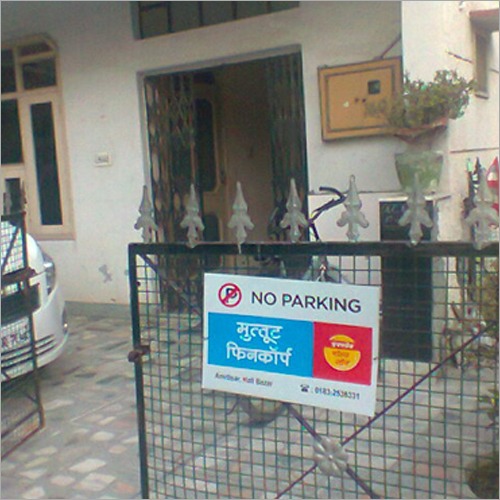
Day 1, 10 AM: you've just approved a hyperlocal push and you have exactly two weeks before your offer goes live. No hoardings to negotiate, no monthly rental to commit to — just a clean idea: put a branded No Parking board on the gates of houses and society entrances across the localities you care about, where families, domestic staff, delivery riders and visitors see it every single day. The only question on the table is whether 14 days is enough to go from this empty calendar to boards actually mounted on gates. It is — if you sequence the work correctly. This playbook turns the real five-stage process behind a no parking board advertising campaign into a day-by-day plan you can hand to a team.
Before we get into days, here is the product you are deploying, because it shapes the schedule. Each board is 1ft × 1.5ft, printed on Sunpack (sunboard) sheet — rigid, lightweight and weatherproof, which is why it survives months on an outdoor gate. It is dual-purpose: it stays a genuine "No Parking" notice while the main visual area carries your brand. Pricing is all-inclusive (board, printing, transport, installation) with no monthly rental: ₹45 per board under 5,000 boards, ₹35 per board at 5,000 and above. Keep that 5,000-board break-even in mind — it is the one number that decides whether your 14 days run as a single push or a couple of batches.
What does the 14-day timeline look like at a glance?
The campaign maps the real five-stage process across two weeks, with stages deliberately overlapping. The table below shows each phase, the days it occupies, and what you — the owner or marketer — actually need to do during it. Notice that nothing waits idly: while the design is being approved, permission outreach has already begun.
14-Day No Parking Board Campaign — Phases, Days and Your Action
| Phase | Days | What you do as owner/marketer | |
|---|---|---|---|
| Map target localities | Days 1–3 | Approve area list and board count; share brief | |
| Design dual-purpose board | Days 3–6 | Approve artwork; lock the campaign number/offer | |
| Owner + RWA permission | Days 5–9 | Sign off outreach list; approve any society terms | |
| Print on Sunpack | Days 8–12 | Confirm final count; no changes after print starts | |
| Install on gates | Days 11–14 | Be reachable for install-day questions | |
| Geo-tagged proof report | Day 14 | Review coverage against your target map |
Phases overlap on purpose — permission starts while design is still being approved, so approvals and printed boards converge around Day 11–12.
How do you run Week 1 — mapping, design and permission?
Week 1 is where the campaign is won or lost, and almost none of it is about printing. It is about deciding exactly which gates you want, designing a board that earns its place on them, and getting permission moving early. Treat the first seven days as the setup that makes the second week mechanical.
Day-by-day steps for the full 14 days
Each step below states the action, why it matters, and the common mistake that derails it. Follow them in order and the overlaps take care of themselves.
Days 1–2 — Map your target localities and lock a board count
Action: list the exact independent-house clusters and society entrances you want, then convert that into a board count and approve it. Why: the board count drives both your budget (₹45 vs ₹35) and how many install days Week 2 needs. Common mistake: targeting too wide and too thin — a focused cluster that gets saturated beats scattered boards across a whole city.
Day 3 — Write a one-page brief and decide your campaign response path
Action: write down the single message, the offer, and exactly how you want people to respond — a campaign phone number, a WhatsApp line, or a QR/short URL. Why: this is what makes the campaign measurable later when there is no impressions meter. Common mistake: leaving the response path vague, so the board looks nice but you can never tie any enquiry back to it.
Days 3–5 — Design the dual-purpose board (No Parking notice + brand)
Action: design the 1ft × 1.5ft board so the "No Parking" message stays clearly readable while the main visual area carries your brand and offer. Why: the No Parking function is what convinces a homeowner or RWA to keep it up for months — a pure ad gets removed. Common mistake: letting the brand swallow the notice, which kills both the goodwill and the campaign's longevity.
Day 6 — Approve artwork and pick your print method
Action: sign off the final artwork and choose the print method — UV for the most fade/scratch-resistant premium finish, Eco-Solvent for the clean-and-weatherproof sweet spot, or Digital for the cheapest big-volume short-window run. Why: the method should match how long boards must stay legible. Common mistake: approving artwork late, which shoves printing past Day 12 and compresses installation.
Days 5–9 — Start owner and RWA permission outreach in parallel
Action: begin reaching homeowners and society RWAs for permission while the design is still being approved, not after. Why: permission is the single biggest risk to a 14-day plan because a slow committee can stall everything. Common mistake: waiting until boards are printed to ask — by then a delayed RWA approval has nowhere to hide in the schedule.
Days 8–12 — Print the boards on Sunpack
Action: confirm the final, permission-backed board count and run the print on weatherproof Sunpack sheet. Why: locking the count first means you print only boards that have a gate to go on, avoiding waste. Common mistake: changing the count or artwork after printing starts, which forces reprints and breaks the back half of the timeline.
Days 11–14 — Install on gates and capture field photos
Action: secure each board on the approved gate or society entrance and photograph it in place. Why: gate-level placement is what puts your brand in the daily eyeline of households, staff, riders and visitors. Common mistake: installing without checking the No Parking message is still legible after mounting — a covered notice invites removal.
Day 14 — Hand over the geo-tagged proof-of-delivery report and review coverage
Action: collect the geo-tagged proof report listing every installed board and compare it against your Day 1 target map. Why: with no rental or impressions meter, this report plus your campaign response path is your entire measurement layer. Common mistake: filing the report and never checking it against the target map, so coverage gaps go unnoticed for the next campaign.
How does Week 2 turn approvals into installed boards?
If Week 1 was decisions, Week 2 is execution. By Day 8 your artwork is approved and permission outreach is well underway, so printing on Sunpack can begin against a count you trust. As permissions land, installation rolls gate by gate from around Day 11, each board photographed in place. The work converges on Day 14, when the geo-tagged proof-of-delivery report closes the loop. The reason this back half feels calm is entirely down to Week 1: you are now only printing and mounting boards that already have a home.
How much does it cost, and should you run one push or batches?
Pricing is all-inclusive — board, printing, transport and installation — with no monthly rental, so your 14-day budget is simply rate × board count. The decision that matters is the 5,000-board break-even. Below 5,000 you pay ₹45 per board; at 5,000 and above the rate drops to ₹35. If your target map lands you near 5,000, it is usually worth pushing to the threshold in a single 14-day run rather than splitting into two smaller batches that both pay the higher rate.
All-inclusive board pricing (no monthly rental)
Standard
For focused 14-day campaigns below the break-even — e.g. 1,000 boards ≈ ₹45,000.
- Board + printing + transport + installation included
- No monthly rental — one-time, all-in
- 1ft × 1.5ft weatherproof Sunpack board
- Geo-tagged proof-of-delivery report
Bulk
Break-even rate for saturation campaigns — 5,000 ≈ ₹1,75,000; 10,000 ≈ ₹3,50,000.
- Everything in Standard at a lower per-board rate
- Best value once you cross 5,000 boards
- Ideal for one large 14-day push over batches
- Same all-inclusive scope, same proof report
What is the final go-live checklist before Day 14?
Run through this before you call the campaign live. If every line is ticked, your 14 days have done their job.
- Target locality list and final board count approved and matched to your budget tier (₹45 or ₹35).
- Artwork signed off, with the No Parking notice clearly legible and the campaign response path (number/WhatsApp/QR) on every board.
- Owner and RWA permissions secured for the gates and society entrances you intend to use.
- Print method chosen (UV / Eco-Solvent / Digital) to match how long the boards must stay legible, and printing run against the locked count.
- Installation completed with a field photo per gate, and the geo-tagged proof-of-delivery report reviewed against your Day 1 target map.
Frequently asked questions
Do I need permission for every single gate, or just the society?
Both situations occur. For an independent house, the homeowner's go-ahead is what you need; for a housing society, the RWA or its office-bearers approve placement at the entry gates and common entrances. That is why the plan starts permission outreach in Week 1 — independent-house approvals tend to move quickly, while society committees can take longer, so you give the slower track a head start.
What if my board count is just under 5,000 — is it worth pushing to the bulk rate?
Often, yes. Below 5,000 you pay ₹45 per board; at 5,000 and above it is ₹35. If your target map already lands you near the threshold, adding the remaining boards to cross 5,000 lowers the rate on the entire order rather than just the extras, so the saturation usually pays for itself. If you are far below 5,000, stay focused rather than padding the count just to hit the tier.
Which print method should I choose for a 14-day campaign?
Match the method to how long the boards must stay legible on the gate. UV printing is the most fade- and scratch-resistant and suits boards you want looking sharp for many months. Eco-Solvent is the clean, weatherproof sweet spot for most campaigns. Digital is the cheapest option for very large volumes on a short window. All four — UV, Solvent, Eco-Solvent and Digital — print on the same weatherproof Sunpack sheet.
Can the 14-day plan slip, and where?
The most likely slip is permission. If society approvals lag, installation for those gates moves later even though printing is done. The plan absorbs this by starting outreach early and by installing in waves — gates with approvals in hand go up first from around Day 11 while the rest follow. The second risk is approving artwork late, which pushes printing past Day 12; locking the design by Day 6 protects the back half of the schedule.
Which businesses get the most from a gate-board campaign?
Anything that sells to households and is chosen locally. Real estate and builders, hospitals, clinics and diagnostics, coaching centres and schools, banks and NBFCs, jewellery and retail, restaurants and cloud kitchens, home services like plumbing, pest control, solar and water purifiers, and ward-level political or election outreach all fit, because the board lands the message at the gate where families, staff, riders and visitors pass it daily.
Tags
Quick Answers
Can you actually launch a No Parking board campaign in 14 days?
Yes, for a typical hyperlocal volume a 14-day window is realistic because each step is short and runs in parallel. Days 1–3 cover locality mapping and a brief, Days 3–6 cover dual-purpose design and approval, Days 5–9 run owner and RWA permission outreach, Days 8–12 handle Sunpack printing, and Days 11–14 cover gate installation plus the geo-tagged proof report. The main risk to the timeline is permission, which is why outreach starts in the first week rather than after printing.
What is the single biggest thing that delays a 14-day campaign?
Permission. A No Parking board sits on a private gate or a society entrance, so you need the homeowner's or the RWA's go-ahead before installation. If you wait until boards are printed to start asking, a slow RWA committee can stall the whole campaign. The fix is to begin permission outreach in the first few days — in parallel with design — so that approvals and installation-ready boards arrive at roughly the same time, around Day 11–12.
How much does a 14-day No Parking board campaign cost?
Pricing is all-inclusive — board, printing, transport and installation, with no monthly rental. It is ₹45 per board for orders under 5,000 boards and ₹35 per board for 5,000 boards and above. So 1,000 boards is about ₹45,000, 5,000 boards is about ₹1,75,000 at the bulk rate, and 10,000 boards is about ₹3,50,000. The 5,000-board mark is the break-even where the lower rate kicks in, which often decides whether you run one large push or split into batches.
How do you measure a campaign with no monthly rental or impressions meter?
The measurement layer is the geo-tagged proof-of-delivery report handed over at the end. Because each board is a physical install on a known gate, the report records where every board went, so you can map coverage against the localities you targeted. Combined with the campaign-specific number, WhatsApp line or offer printed on the board, that proof report is what lets you tie response back to the areas you covered.
Looking for professional No Parking Board Advertising services?
The Mediaverse runs end-to-end no parking board advertising campaigns across India with geo-tagged delivery and transparent, all-inclusive pricing.
Explore our No Parking Board Advertising solutionsSummarize this guide with AI
Open this article in your favourite AI assistant
Related Guides
Written by

The Mediaverse Team
India's Leading Outdoor Advertising Agency
The Mediaverse is a national-level outdoor advertising and integrated marketing organization that provides complete OOH, ATL, BTL, retail, and transit media solutions across India. With years of experience executing high-performance campaigns for brands in FMCG, Real Estate, E-commerce, EdTech, Automotive, Healthcare, and Retail, The Mediaverse combines creativity, data-driven media planning, and flawless on-ground execution. As a full-stack outdoor advertising provider, The Mediaverse offers Auto Branding, Mobile Van Branding, Newspaper Insertion Advertising, Shop Name Board Branding, In-Store Branding, Hoardings, Transit Media, Kiosks, Mall Media, Activations, and all forms of Below-The-Line marketing. Known for its pan-India network, strategic route planning, premium print quality, and Cheqmate™ GPS-based verification, The Mediaverse ensures 100% transparent and result-oriented campaign delivery. The Mediaverse’s editorial team produces deeply researched, SEO-optimized, and generative-engine-friendly content to help businesses understand the power of outdoor advertising and make informed decisions that maximize brand visibility and ROI across urban, suburban, and rural markets.
Related Articles
Gate-to-street saturation: no-parking boards plus auto hoods in one catchment, the worked plan (2026)
The entry ticket for one catchment covered from gate to street is ₹2,83,200 landed: 1,000 gate boards plus 300 auto hoods. Seven steps, the timings for both formats, three priced plans and the honest list of what the rate card leaves out.
Outdoor advertising for clinics, pharmacies and diagnostic centres: formats, compliance and catchment (2026)
A pharmacy plan of 1,000 gate boards plus a glow sign board is ₹56,168 landed; a clinic plan of 2,000 boards plus 50,000 A5 inserts is ₹1,79,950; a diagnostic centre plan with 300 auto hoods is ₹5,36,900. Plus the rules on what a medical board may say and how far each facility's catchment reaches.
No Parking Board Advertising vs Hoardings: Which Wins for One Locality in 2026?
A hoarding looks like the premium buy — but for dominating ONE locality, it usually loses to no parking gate boards. Here is the honest, side-by-side comparison on cost model, reach, exposure and targeting, plus a clear verdict and decision checklist.