

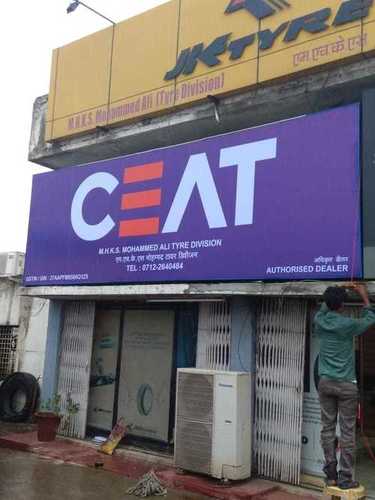
Picture this. You signed the shop lease three weeks ago. The interior is half-done. The fabricator is asking for the final go-ahead on the GSB shop name board so he can cut the 8 ft x 4 ft acrylic. You want to open in two weeks. Then someone in the local business WhatsApp group asks if you have BBMP approval. You do not, because nobody told you that you needed one.
This scene plays out in Bangalore every week. The cost of figuring it out the wrong way runs from a removal notice to a fine to having to scrap a fabricated board. The cost of figuring it out the right way is a 14 to 35 day buffer in the launch plan and a few thousand rupees in fees. This playbook is the version we walk every shop owner through when we install GSB boards at ₹250 a square foot in Bangalore.
Who needs this BBMP approval playbook?
First-time shop owners in any of the 198 BBMP wards. Retail chains rolling out new stores in Bangalore. Restaurant operators planning new branches. Anyone whose board exceeds 25 sq ft or overhangs a public footpath.
What you'll have at the end
- A BBMP no-objection certificate for the board design
- A board that complies with Karnataka language signage rules and BBMP dimension caps
- A clear paper trail if BBMP enforcement comes knocking
- Reduced risk of removal, fine, or forced replacement
Prerequisites before you start
You need three things on day one. Your shop trade licence (or at minimum the application receipt), your premises property tax paid receipt for the current year, and a draft board design with dimensions, material spec (GSB, ACP, flex, or LED), and the language split between Kannada and English. Karnataka Local Authorities (Amendment) provisions require Kannada to be at minimum 60 percent of board area on commercial signage. Most rejection patterns we see at BBMP counters trace back to brands that filed with Kannada below 50 percent.
The seven steps
Step 1: Confirm the size threshold and ward jurisdiction (Day 1, 2 hours)
Walk into the assistant revenue officer counter at your local BBMP ward office. Ask for the current size threshold above which a board needs approval. The default in most wards is 25 sq ft, but some arterial-road wards apply lower thresholds for facades visible from notified roads. Confirm whether your specific premises falls under the arterial-road list. Common mistake: assuming the 25 sq ft threshold applies city-wide. It does not.
Step 2: Compile the document pack (Days 2 to 4)
The standard pack includes trade licence, premises property tax paid receipt, GST registration, owner consent letter (if tenant), board design with full dimensions and material, and the owner's photograph. Some wards also ask for a building elevation sketch showing where the board sits. Get all of these scanned and printed in two sets so the BBMP officer can keep one and you keep the other endorsed. Common mistake: filing without the GST certificate. The application gets returned the same day.
Step 3: Audit Kannada language compliance (Day 5)
Calculate the Kannada area on your board design. It must be at least 60 percent of the total signage area. Most rejection patterns we see trace to brands using English at 60 percent and Kannada as a smaller subtitle. The rule is the opposite. Kannada is the primary, English is the secondary. Get the design font-checked by a Kannada designer or fabricator. Common mistake: equal-area Kannada and English on the same line. Equal area is below the 60 percent threshold and triggers rejection.
Step 4: File at the ward office (Days 6 to 7)
Submit the document pack at your BBMP ward office. The standard application fee runs ₹1,000 to ₹4,500 depending on board size and ward. Get a stamped acknowledgement copy and note the file reference number. Common mistake: paying the fee in cash without insisting on the file reference number stamped on your copy. Without the reference, you have no audit trail if the application gets misplaced.
Step 5: Track the file (Days 8 to 25)
Standard processing is 14 to 28 working days. Visit the ward office on day 14 with your acknowledgement copy and ask for a status update. If the file is at the assistant revenue officer level, the next gate is the medical officer of health (for sanitation clearance) and then the ward executive engineer. Common mistake: not making the day-14 visit. Files that nobody asks about get stuck. Files that someone asks about with a polite paper trail move.
Step 6: Receive the no-objection certificate (Days 25 to 35)
The no-objection certificate (NOC) typically issues with the file reference, board dimensions, location address, and validity period (usually 1 year, renewable). Keep the original at the shop premises and a scan in cloud storage. The fabrication can now begin against the approved design. Common mistake: starting fabrication before the NOC issues. Any post-NOC design change requires re-filing.
Step 7: Install with photo proof and renewal calendar (Day 36 onward)
Photograph the board on the day of installation showing the full facade with surrounding landmarks visible. Email this to your accountant alongside the NOC scan. Calendar the renewal date 11 months out. Renewal is typically faster than first-time approval (5 to 14 days) if no design change has occurred. Common mistake: forgetting the renewal. An expired NOC is functionally the same as no NOC during enforcement.
Realistic budget for the approval
- Application fee: ₹1,000 to ₹4,500 (size-dependent)
- Document compilation (printing, photocopies, scans): ₹300 to ₹700
- Kannada designer or fabricator design check: ₹1,000 to ₹3,500 if outsourced
- Time cost: 4 to 6 owner-hours across the 35-day window
- Total realistic cost: ₹2,500 to ₹8,500 against a board fabrication cost that is typically 5 to 30x larger
BBMP approval budget at a glance
| Cost | Notes | |
|---|---|---|
| Application fee | ₹1,000-4,500 | Size and ward dependent |
| Document compilation | ₹300-700 | Printing, photocopies, scans |
| Kannada design check | ₹1,000-3,500 | If outsourced |
| Owner time | 4-6 hours | Across the 35-day window |
| Total | ₹2,500-8,500 | Typically 5-30x smaller than the board fabrication cost |
First-time approval; renewal with no design change runs 5 to 14 days.
Final 7-step checklist
- Confirm size threshold and arterial-road status at ward office (Day 1)
- Compile document pack (Days 2-4)
- Audit Kannada is at minimum 60 percent of board area (Day 5)
- File application with stamped acknowledgement (Days 6-7)
- Track and follow up at day 14 (Days 8-25)
- Receive NOC and store original plus cloud copy (Days 25-35)
- Install with photo proof, calendar 11-month renewal (Day 36+)
If you would prefer not to navigate the seven steps yourself, we handle BBMP filing as part of our shop name board installation service in Bangalore, bundled with the GSB or ACP fabrication.
Confirm size threshold and ward jurisdiction
Visit the assistant revenue officer at your BBMP ward office. Ask if your premises falls under arterial-road oversight and what the current size threshold is for board approval (default 25 sq ft, often lower on arterial roads).
Compile the document pack
Trade licence, property tax paid receipt, GST certificate, owner consent letter (if tenant), board design with dimensions and material spec, owner photograph, building elevation sketch if asked. Two printed sets.
Audit Kannada compliance
Verify Kannada is at least 60 percent of total signage area as required by Karnataka Local Authorities (Amendment) provisions. Get a Kannada designer or fabricator to font-check the design.
File application with stamped acknowledgement
Submit at the BBMP ward office with the application fee (₹1,000 to ₹4,500). Insist on a stamped acknowledgement copy with the file reference number written on it.
Track the file at day 14
Visit the ward office on day 14 with your acknowledgement copy. Ask which gate the file is at (assistant revenue officer / medical officer of health / ward executive engineer). Polite follow-up moves stuck files.
Receive the no-objection certificate
Collect the NOC with file reference, dimensions, address, and validity period (typically 1 year). Store the original at premises plus a cloud scan. Begin fabrication only after NOC issues.
Install with photo proof and renewal calendar
Photograph the installed board with surrounding landmarks. Email the photo plus NOC scan to your accountant. Calendar the 11-month renewal reminder. Renewal is faster (5-14 days) if design unchanged.
What happens if I install a Bangalore shop name board without BBMP approval?
BBMP enforcement teams issue removal notices for unapproved boards. First notice is typically a 7-day removal window. If unaddressed, BBMP can dismantle the board and bill the owner for the dismantling cost. Repeat offences can attract fines under municipal byelaw schedules. The cost of forced removal usually exceeds the cost of approval fees by a factor of 5 to 15 times.
Is the 60 percent Kannada rule strictly enforced in commercial Bangalore zones?
Yes, with growing enforcement intensity since 2024. We have seen rejections in Indiranagar 100ft Road, Brigade Road, and Commercial Street where Kannada was below 50 percent. Suburban wards have historically been less strict but the rule applies city-wide. Design to 60 percent Kannada from day one rather than risk re-filing.
Can I file the BBMP application online for a Bangalore shop board?
BBMP has been rolling out an online portal for some application types since 2023. As of 2026, shop name board applications are still primarily handled at the ward office counter, though some wards accept document submission via email after a counter visit. Confirm with your specific ward. Plan for an in-person counter visit at minimum.
What is the renewal process for a Bangalore shop name board NOC?
Renewal is filed 30 days before the existing NOC expires. The document pack is reduced (latest property tax receipt, current trade licence, photograph of installed board, original NOC). If no design change, renewal typically issues in 5 to 14 working days at a reduced fee (₹500 to ₹2,000). Skip the renewal at your peril; an expired NOC is functionally the same as no NOC during enforcement.
Tags
Quick Answers
Does a Bangalore shop name board need BBMP approval before installation?
Yes for permanent boards above a defined size threshold (currently 25 sq ft for most BBMP wards), and yes for any board that overhangs the public footpath or is visible from a notified arterial road. Internal-only boards behind a glass facade and small temporary boards are typically exempt. Confirm threshold for your specific BBMP ward at the assistant revenue officer counter before fabrication begins.
What documents do I need for BBMP shop name board approval in Bangalore?
The standard document set is: trade licence (or trade licence application receipt), property tax paid receipt for the premises, owner consent letter if you are a tenant, board design with dimensions and material spec, GST registration certificate, and a passport-size photograph of the owner. Some BBMP wards also ask for a sketch showing the board’s position on the building elevation. The full pack should be filed before the fabricator starts cutting material.
How long does BBMP shop name board approval take in Bangalore?
Standard timeline is 14 to 35 working days from filed application to issued no-objection certificate, varying by ward workload. Premium-zone wards (Indiranagar 100ft Road, Brigade Road, Commercial Street) tend toward the slower end because of arterial-road oversight. Suburban wards in Whitefield, Electronic City, and Kengeri tend toward the faster end. Build the buffer into your shop launch date.
Looking for professional Shop Name Board services?
The Mediaverse runs end-to-end shop name board campaigns across India with geo-tagged delivery and transparent, all-inclusive pricing.
Explore our Shop Name Board solutionsSummarize this guide with AI
Open this article in your favourite AI assistant
Related Guides
Written by

The Mediaverse Team
India's Leading Outdoor Advertising Agency
The Mediaverse is a national-level outdoor advertising and integrated marketing organization that provides complete OOH, ATL, BTL, retail, and transit media solutions across India. With years of experience executing high-performance campaigns for brands in FMCG, Real Estate, E-commerce, EdTech, Automotive, Healthcare, and Retail, The Mediaverse combines creativity, data-driven media planning, and flawless on-ground execution. As a full-stack outdoor advertising provider, The Mediaverse offers Auto Branding, Mobile Van Branding, Newspaper Insertion Advertising, Shop Name Board Branding, In-Store Branding, Hoardings, Transit Media, Kiosks, Mall Media, Activations, and all forms of Below-The-Line marketing. Known for its pan-India network, strategic route planning, premium print quality, and Cheqmate™ GPS-based verification, The Mediaverse ensures 100% transparent and result-oriented campaign delivery. The Mediaverse’s editorial team produces deeply researched, SEO-optimized, and generative-engine-friendly content to help businesses understand the power of outdoor advertising and make informed decisions that maximize brand visibility and ROI across urban, suburban, and rural markets.
Related Articles
Who Are the Best Shop Name Board Manufacturers in Bangalore and How Much Do They Cost in 2026?
Looking for reliable shop name board manufacturers in Bangalore? This in-depth guide explains pricing, materials, BBMP rules, installation timelines, and ROI insights based on real execution experience from The Mediaverse.
How to choose a shop name board in India: the 2026 decision guide
How much does a shop name board cost, what material lasts, do you need permission, and which board should you choose? The complete 2026 guide to shop name boards in India.
ACP or LED shop board: a decision guide by shop type and budget for 2026
ACP board or LED sign board for your shop? A 2026 decision guide with costs, an apples-to-apples spec table, when each wins, our recommendation, and a checklist.