

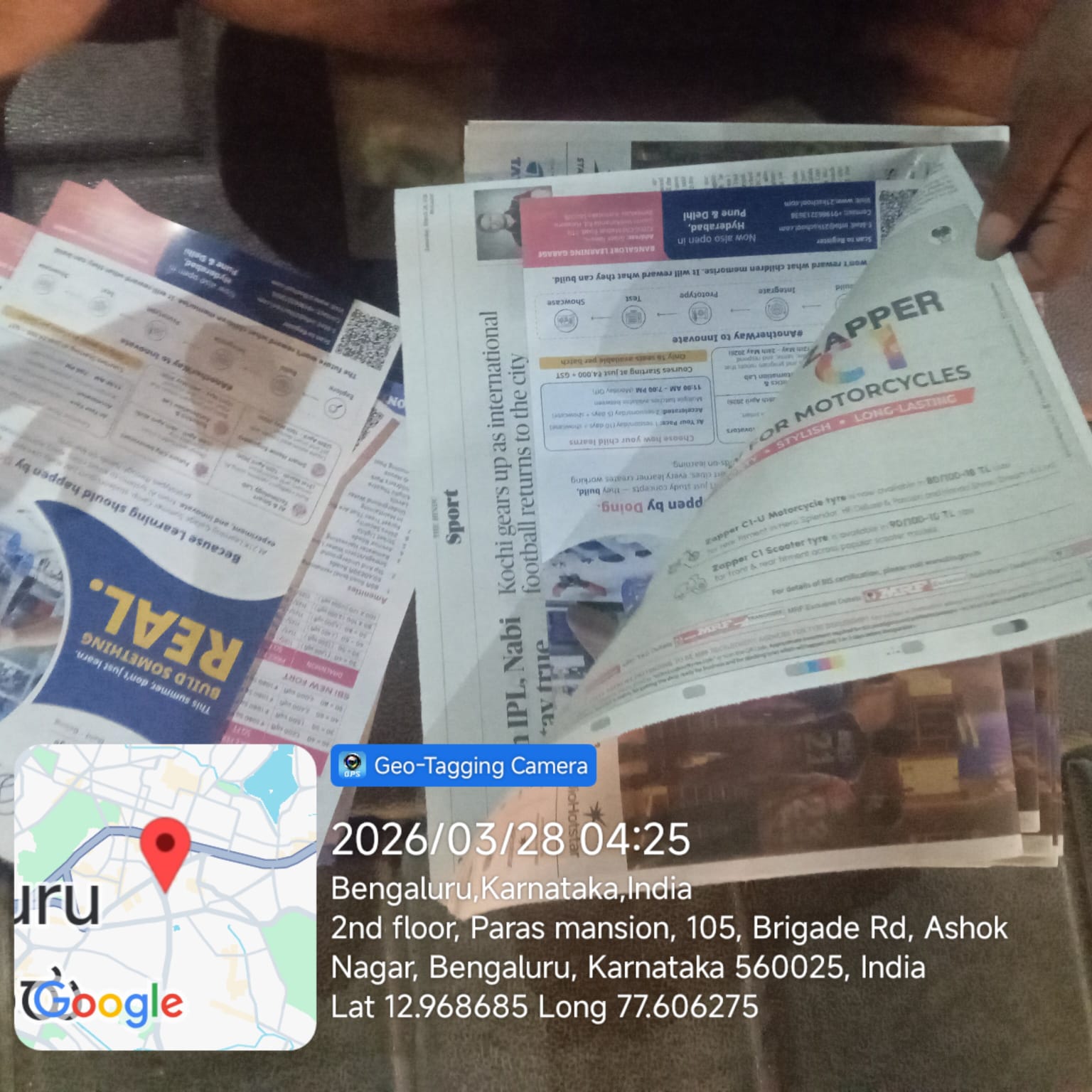
FMCG brands achieve 3-5% coupon redemption rates through newspaper insertion, making it the highest-converting offline coupon distribution channel in India. While digital coupons get lost in email inboxes and app notifications, a physical coupon inside the morning newspaper sits on the kitchen counter next to the grocery list. This tangibility drives action. For retail brands launching new stores, newspaper inserts with Rs.500-off coupons generate 1,500-2,500 walk-ins per 50,000 inserts within the first week. This guide covers every aspect of using newspaper insertion for FMCG and retail campaigns.
Why FMCG Brands Rely on Newspaper Insertion
FMCG (Fast Moving Consumer Goods) brands face a unique challenge: their products are low-ticket, high-frequency purchases. A Rs.50 shampoo bottle does not justify Rs.200-500 cost per lead from digital advertising. Newspaper insertion solves this economics problem. At Rs.1.15 per A5 insert (volume rate above 50,000 pieces), even a 3% coupon redemption rate means about Rs.38 per new trial customer. For a product with 40% repeat purchase rate, the lifetime value calculation makes newspaper insertion one of the most profitable channels. Key advantages for FMCG: Mass household reach in targeted pin codes. Physical coupons act as purchase reminders at the point of decision (kitchen, grocery list). Sachet sampling creates trial without store visit. Weekend editions reach the primary grocery shopper (typically the homemaker) during shopping planning time. Regional language newspapers reach tier-2 and tier-3 city households where digital penetration is lower but FMCG growth is highest.
Coupon Distribution via Newspaper Insertion
The A5 format (148mm x 210mm) at Rs.1.25 per insert (Rs.1.15 above 50,000 pieces) is the standard for FMCG coupon distribution. Design rules for maximum redemption: One product, one offer, one CTA. Do not put multiple products on a single coupon insert. Offer must be specific and time-bound: Rs.20 off on 200ml Shampoo X, valid till 30th April. Include a scannable barcode for POS redemption tracking. The expiry date creates urgency, driving redemption within 2-3 weeks. Redemption tracking: Every coupon must have a unique barcode or serial number. Work with your retail distribution partners to track redemption at the POS (point of sale). Average redemption rates: Rs.10-20 off coupons see 2-3% redemption. Rs.30-50 off coupons see 4-5% redemption. Buy-1-Get-1 offers see 5-8% redemption.
Coupon offer type vs typical redemption rate
| Typical redemption | |
|---|---|
| Rs.10-20 off coupon | 2-3% |
| Rs.30-50 off coupon | 4-5% |
| Buy-1-Get-1 offer | 5-8% |
Redemption tracked via unique barcodes scanned at POS; expiry dates drive redemption within 2-3 weeks.
Product Sampling with Newspaper Inserts
Product sampling via newspaper insertion involves attaching a product sachet (shampoo, face wash, detergent, tea, coffee) to the A5 or A4 insert using a sachet pouch or adhesive strip. Total cost per sampled household: Rs.2.5-5.5 depending on sachet cost and attachment method. This is significantly cheaper than in-store sampling (Rs.15-30 per trial) or door-to-door distribution (Rs.10-20 per household). Sachet attachment methods: Heat-sealed pouch on the insert (most secure, Rs.0.50-1.00 additional cost). Adhesive strip attachment (cost-effective, Rs.0.30-0.50 additional). Envelope-style insert with sachet inside (premium, Rs.1.00-1.50 additional). Best product categories for newspaper sampling: Personal care (shampoo, face wash, body lotion sachets). Beverages (tea, coffee, health drink sachets). Household cleaners (liquid detergent, floor cleaner sachets). Foods (spice mixes, instant noodle flavour sachets).
Retail Store Launch Campaigns via Newspaper Insertion
New store launches are the second-largest use case for newspaper insertion in India after real estate. The playbook: Pre-launch (7 days before): 25,000 A4 pamphlets with store details, map, and opening day offer. Target all pin codes within 5 km of the store. Launch day: 25,000 A5 leaflets with Rs.500-off coupon (minimum purchase Rs.2,000) in the same pin codes. This drives opening week footfall. Post-launch (Week 2): 25,000 A5 leaflets with loyalty program signup offer targeting the same areas for repeat visit conversion. This 3-wave approach typically generates: Wave 1 (pre-launch): 800-1,200 awareness impressions per 1,000 inserts. Wave 2 (launch coupon): 1,500-2,500 walk-ins per 50,000 inserts. Wave 3 (loyalty): 500-800 loyalty signups per 25,000 inserts.
ROI Tracking for FMCG and Retail Insert Campaigns
FMCG ROI tracking: Unique barcodes on each coupon scanned at POS. Track redemption by pin code to identify highest-performing areas. Measure incremental sales lift by comparing insert areas vs non-insert control areas. Calculate cost per trial: Total campaign cost / Number of redemptions. Retail ROI tracking: Unique coupon codes per insert batch (different codes for different pin codes). Walk-in counter data compared to pre-campaign baseline. Average basket value of coupon customers vs organic customers. Repeat visit rate of coupon customers within 30 days. Sample FMCG calculation: 2,00,000 A5 inserts at Rs.1.15 = Rs.2,30,000. At 3% redemption = 6,000 new trials. At 40% repeat purchase rate = 2,400 repeat customers. At Rs.200 annual spend per customer = Rs.4,80,000 annual revenue. Year 1 ROI = 109%.
Festival Season Insert Strategy for FMCG
Festival periods account for 40-50% of annual FMCG sales in India. Newspaper insertion during these peaks amplifies results. Diwali (October-November): Cleaning products, cooking oils, sweets, dry fruits. Insert A5 coupons 10-15 days before Diwali for pre-festival shopping. Holi (March): Colours, skin care, personal care. Insert coupons 7 days before Holi. Navratri/Dussehra (October): Garments, jewellery, personal grooming. Regional newspaper focus based on festival relevance (Gujarat for Navratri, pan-India for Dussehra). Monsoon (July-August): Rainwear, umbrellas, immunity boosters, hot beverages. Target metro cities with high monsoon impact. Back to School (June): Stationery, school supplies, backpacks, lunch boxes. Target residential areas near schools.
Frequently Asked Questions
What is the average coupon redemption rate for newspaper inserts?
Newspaper insert coupons achieve 2-5% redemption rates in India depending on the offer value. Rs.10-20 off coupons see 2-3% redemption, Rs.30-50 off coupons see 4-5%, and Buy-1-Get-1 offers see 5-8% redemption.
How much does product sampling via newspaper insertion cost?
Product sampling via newspaper insertion costs Rs.2.5-5.5 per sampled household including sachet cost and attachment. This is cheaper than in-store sampling (Rs.15-30 per trial) or door-to-door distribution (Rs.10-20 per household).
Which newspaper insert format is best for FMCG coupons?
A5 format (148mm x 210mm) at Rs.1.25 per insert (Rs.1.15 above 50,000 pieces) is the standard for FMCG coupon distribution. It is cost-effective, fits easily alongside the newspaper, and provides enough space for one product, one offer, and a scannable barcode.
How many inserts do I need for a retail store launch?
Plan 50,000-75,000 inserts across 3 waves for a retail store launch: 25,000 pre-launch awareness inserts, 25,000 opening day coupon inserts, and 25,000 loyalty program inserts in week 2. Target pin codes within 5 km of the store.
Plan Your FMCG Insert Campaign
Get a custom FMCG or retail newspaper insertion plan with coupon design, newspaper selection, and ROI tracking setup. Request your free campaign plan or call +91 95800 88540.
Hidden Costs of FMCG Newspaper Insertion Campaigns
GST 18% on all insertion rates. Sachet attachment costs Rs.0.50-1.50 per unit additional. Print file preparation and pre-press charges Rs.3,000-8,000 if artwork needs modification. Bulk printing discount only kicks in above 1 lakh units. Warehouse storage for printed inserts before distribution Rs.500-1,000 per pallet per day if there is a gap between printing and insertion dates. POS tracking system setup for barcode redemption Rs.5,000-15,000 one-time with retail partners.
How do FMCG brands track newspaper insertion ROI?
Unique barcode per coupon scanned at POS. Track redemption by pin code to identify best-performing areas. Compare insert areas vs non-insert control areas for incremental sales lift. Cost per trial = total campaign cost / number of redemptions. Average FMCG: 3% redemption, about Rs.38/trial customer.
Key Insight: The Rs.1.25/insert price makes newspaper insertion appear cheap, but the real cost per sampled household (with sachet attachment) is Rs.2.5-5.5. Still 3-5x cheaper than in-store sampling at Rs.15-30 per trial.
Why FMCG Insertion Campaigns Fail
Three failure patterns. Running a single insertion expecting measurable sales lift. Newspaper insertion builds frequency — minimum 3 insertions over 2-4 weeks for results. Using A2 flyer format for coupon distribution. A5 is the optimal coupon format because it fits alongside the newspaper without falling out. A2 is too large and gets discarded. Not coordinating with retail partners for coupon redemption tracking. Without POS barcode scanning, you cannot measure ROI and the campaign becomes a branding exercise instead of a performance campaign.
What is the minimum budget for FMCG newspaper insertion?
Minimum 50,000 inserts at Rs.1.15/A5 = Rs.57,500 + GST. Recommended: 50,000-1,00,000 inserts across 2-3 newspapers for measurable impact. Sachet attachment adds Rs.0.30-1.50 per unit on top, plus the sachet product cost.
Tags
Quick Answers
What is coupon redemption rate for newspaper inserts?
2-5% average. Rs.10-20 off coupons: 2-3%. Rs.30-50 off: 4-5%. Buy-1-Get-1: 5-8%. Track via unique barcodes scanned at POS. Physical coupons outperform digital because they sit on kitchen counter next to grocery list.
How much does product sampling via newspaper cost?
Rs.2-5 per sampled household including sachet and attachment. Cheaper than in-store sampling (Rs.15-30) or door-to-door (Rs.10-20). Heat-sealed pouch Rs.0.50-1.00 extra. Best for: shampoo, tea, detergent sachets.
Looking for professional Newspaper Insertion services?
The Mediaverse runs end-to-end newspaper insertion campaigns across India with geo-tagged delivery and transparent, all-inclusive pricing.
Explore our Newspaper Insertion solutionsSummarize this guide with AI
Open this article in your favourite AI assistant
Written by

The Mediaverse Team
India's Leading Outdoor Advertising Agency
The Mediaverse is a national-level outdoor advertising and integrated marketing organization that provides complete OOH, ATL, BTL, retail, and transit media solutions across India. With years of experience executing high-performance campaigns for brands in FMCG, Real Estate, E-commerce, EdTech, Automotive, Healthcare, and Retail, The Mediaverse combines creativity, data-driven media planning, and flawless on-ground execution. As a full-stack outdoor advertising provider, The Mediaverse offers Auto Branding, Mobile Van Branding, Newspaper Insertion Advertising, Shop Name Board Branding, In-Store Branding, Hoardings, Transit Media, Kiosks, Mall Media, Activations, and all forms of Below-The-Line marketing. Known for its pan-India network, strategic route planning, premium print quality, and Cheqmate™ GPS-based verification, The Mediaverse ensures 100% transparent and result-oriented campaign delivery. The Mediaverse’s editorial team produces deeply researched, SEO-optimized, and generative-engine-friendly content to help businesses understand the power of outdoor advertising and make informed decisions that maximize brand visibility and ROI across urban, suburban, and rural markets.
Related Articles
The 50,000-Insert Minimum in 10 Cities: What Share of Each City's Dailies It Reaches (2026)
One national card, ten denominators. What share of each city's published daily copies a 50,000-insert minimum reaches, what it costs, and which city pages contradict their own figures.
Gate Board or Newspaper Insert for One Colony? The 2026 Cost per Home
One board costs 36 A5 inserts, yet for a single colony the board is usually cheaper per home, because the insert bills a 50,000-copy run. The break-even colony copy counts for A5, A4 and A2, a 1,200-house worked example, and when the insert wins instead.
Newspaper Insertion in Pune (2026): PMC Against PCMC, and the Marathi Line That Actually Decides the Run
Pune gives the 50,000 insert minimum one of the deepest bites in India, a sixth to a quarter of one daily. The 2026 card, why PMC against PCMC does not move the quote, the housing stock rule for Marathi or English, and the three season insert calendar.