

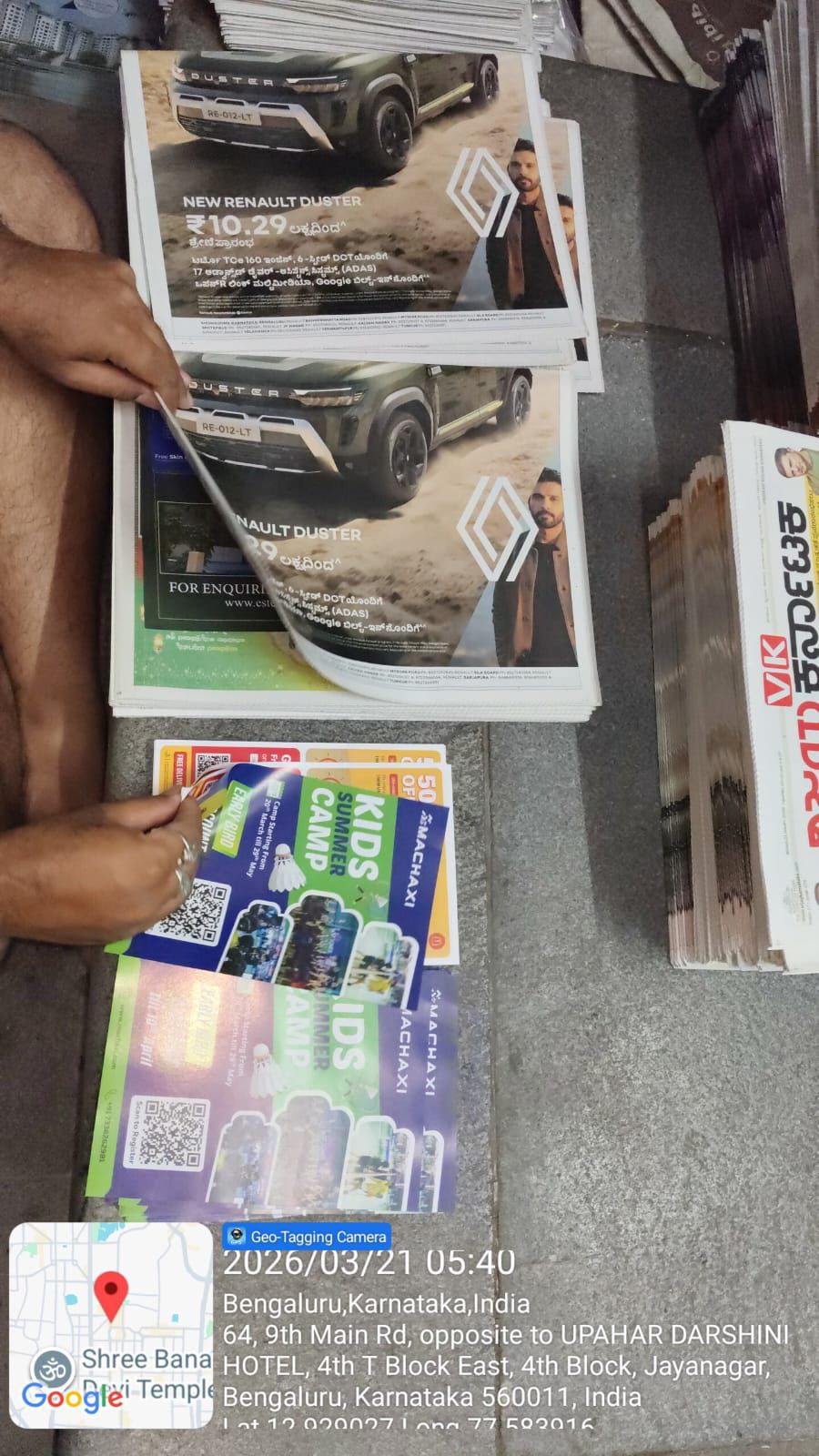
Most Bangalore SMEs running newspaper inserts give the agency a brief that says "distribute 25,000 pamphlets in South Bangalore". The agency dispatches across 8 to 12 BBMP zones with rough per-zone allocation. The brand cannot say which neighbourhood received which pamphlets, which makes per-conversion measurement nearly impossible. The same campaign can be run with pin-code level targeting for 8-15 percent more per pamphlet, with full audit visibility, with measurably better ROI on hyperlocal goals.
We have run pin-code targeted campaigns for restaurants, clinics, K-12 schools, and residential real estate launches in Bangalore over the last 24 months. The brief and audit playbook below is the distillation of what works.
Who should use pin code targeting in Bangalore?
Hyperlocal SMEs in Bangalore: restaurants opening in specific neighbourhoods, clinics with defined catchment areas, K-12 schools with admission radius, real estate projects targeting specific income bands, gyms, salons, retail outlets, healthcare brands. Anyone whose campaign cares more about precision than reach.
What you'll have at the end
- A pin-code allocation table with quantities per pin code
- Three written audit deliverables from the distributor
- Confidence that pamphlets actually reached the targeted neighbourhoods
- A measurable per-pin-code conversion rate for future campaign refinement
Prerequisites
A list of target pin codes for the SME catchment area. The list should be backed by some logic: customer geography from existing CRM data, school admission radius, restaurant delivery radius, clinic walk-in catchment, real estate buyer income mapping. Do not generate the list speculatively; ground it in real data even if the data is rough. A trackable response mechanism (coupon code, QR, or unique landing page) so per-pin-code conversion can be measured.
The seven-step brief and audit process
Step 1: Build the pin-code allocation table
List the target pin codes (typically 5 to 15 for a hyperlocal Bangalore campaign). Allocate quantities per pin code based on household density and audience priority. A 10,000-pamphlet campaign in 8 pin codes might allocate 2,000 to the highest-priority pin code (closest to the SME), 1,500 each to the next two, and 700-1,000 to the remaining five. Document the allocation in a table with pin code, allocation quantity, and rationale.
Step 2: Write the brief in writing
Hand the distributor a written brief with the allocation table, the insertion paper, the dispatch date, and a request for confirmation that pin-code targeting is feasible at the requested allocation. Do not accept a verbal yes; the verbal yes often becomes a city-wide allocation at delivery. Get the feasibility confirmation in email.
Step 3: Confirm the depot-side audit deliverables in the contract
Three deliverables to write into the contract or PO. Depot allocation report listing pamphlets dispatched per pin code with quantities. Per-pin-code distribution log signed by depot supervisor with morning timestamp. Household call-back sample of 30-50 random recipients across the targeted pin codes for spot verification. Without all three in the contract, the agency can substitute pin codes silently when depot capacity falls short.
Step 4: Pre-dispatch confirmation
The day before dispatch, ask for the printed depot allocation sheet showing the planned per-pin-code dispatch. Cross-check against the brief allocation. Any deviation must be explained and corrected before dispatch. Common deviation: distributor consolidated two adjacent pin codes into one because of carrier capacity. This may or may not be acceptable; insist the brand decides, not the depot.
Step 5: Dispatch day audit
Visit the depot on dispatch morning if budget permits, or have the distributor send the depot dispatch photo with timestamp showing the full pamphlet run loaded for distribution per pin-code allocation. The signed distribution log per pin code should arrive by end of dispatch day.
Step 6: Household call-back verification
Within 24 to 48 hours of dispatch, run the household call-back. The distributor provides 30-50 random recipient phone numbers across pin codes. Brand or agency calls them, asks if they received the pamphlet that morning, and confirms the paper. Record the verification rate per pin code. Anything below 80 percent verification on a pin code suggests delivery shortfall and should be raised with the distributor immediately.
Step 7: Per-pin-code conversion attribution
If the campaign uses a trackable response mechanism (coupon, QR, landing page), tag each pamphlet variant by pin code so conversions can be attributed back. Run the attribution analysis at week 2 and week 4 post-campaign. Pin codes that materially under-perform (less than 50 percent of expected conversion against allocation share) inform the next campaign by drop or reduction. Pin codes that over-perform inform expansion. The attribution data is the single highest-value output of pin-code targeting.
Broad zone vs pin-code targeted rates by size
| Broad zone | Pin-code targeted | Best for | |
|---|---|---|---|
| A5 | ₹1.2 | ₹1.30-1.40 | Coupons, menu drops, single-offer messages |
| A4 | ₹1.5 | ₹1.62-1.72 | The hyperlocal SME default |
| A2 | ₹1.9 | ₹2.05-2.20 | Premium creative campaigns |
Uplift covers depot allocation overhead; choose size by message length and reach goal.
Realistic budget and timeline
- Distribution rate uplift for pin-code targeting: 8-15 percent above broad zone rate
- Brief preparation time: 2-3 hours for the SME marketing lead
- Distributor confirmation turnaround: 1-2 working days
- Print and dispatch lead time: 4-7 working days from final allocation lock
- Audit deliverables turnaround: end-of-dispatch day for log, 24-48 hours for call-back, 2-4 weeks for conversion attribution
Final 7-step playbook checklist
- Build pin-code allocation table grounded in real audience data
- Send written brief with allocation table to distributor
- Get three audit deliverables (depot report, signed distribution log, call-back sample) into the contract
- Verify pre-dispatch allocation sheet matches brief
- Capture dispatch day depot photo and signed distribution log
- Run household call-back verification within 48 hours
- Attribute conversions per pin code at week 2 and week 4
If you would like a pin-code targeted Bangalore insertion campaign run by us with all seven steps included, share the brief and we will reply with the allocation table inside two working days.
Build the pin-code allocation table
List 5-15 target pin codes with quantity allocations grounded in real catchment data. A 10,000 pamphlet run might split 2,000 / 1,500 / 1,500 / 1,000 / 1,000 / 1,000 / 1,000 / 1,000 across 8 pin codes.
Send written brief to distributor
Hand the distributor the allocation table, paper choice, dispatch date. Get email feasibility confirmation. Do not accept a verbal yes.
Lock three audit deliverables in contract
Depot allocation report per pin code, signed distribution log per pin code with morning timestamp, household call-back sample of 30-50 recipients across pin codes.
Verify pre-dispatch allocation sheet
Day before dispatch, get the depot allocation sheet and cross-check against the brief. Any deviation requires brand approval before dispatch.
Dispatch day proof capture
Visit depot or get timestamped depot photo on dispatch morning. Get signed per-pin-code distribution log by end of dispatch day.
Run household call-back verification
Within 24-48 hours, call 30-50 random recipients across pin codes. Confirm pamphlet receipt and paper. Anything below 80 percent verification per pin code is a delivery shortfall flag.
Attribute conversions per pin code
Tag pamphlet variants by pin code via coupon, QR, or landing-page parameter. Run attribution at week 2 and week 4 post-campaign. Pin codes under 50 percent expected conversion get dropped next campaign; over-performers expand.
How many pin codes should a small Bangalore SME campaign target?
5 to 8 pin codes for the smallest viable hyperlocal campaign (10,000-15,000 pamphlets). Below 5 the audience pool is too small for measurement and the per-pamphlet rate climbs because the depot consolidates the run. Above 12 the pin-code allocation per code falls below the 800-1,000 minimum below which delivery wastage becomes proportionally larger. Most Bangalore SME campaigns settle on 6-10 pin codes.
Can pin-code targeting work in suburban Bangalore zones beyond BBMP?
Partially. Major Bangalore distribution agencies cover the BBMP urban footprint with full pin-code granularity. Suburban zones in Yelahanka, Jigani, Hoskote, and parts of Anekal have lighter distribution coverage and pin-code targeting may not be feasible at all required pin codes. Confirm coverage with the distributor by listing the specific pin codes; they will flag any that fall outside their depot footprint.
What happens if a Bangalore distributor misses the per-pin-code allocation?
Three remediation options. (1) Top-up dispatch within 5 working days at the distributor's cost (best outcome). (2) Pro-rata refund on the under-allocated pin codes. (3) Compensatory dispatch to expand other pin codes. Negotiate the remediation clause into the contract upfront. Without it, distributors typically issue a verbal apology and move on. Reputable distributors agree to remediation; the agreement is the test of which is which.
Pin-code targeting rate uplift by pamphlet size
Pin-code targeting carries an 8-15 percent rate uplift over broad zone distribution at every size. The uplift covers depot allocation overhead. Choose size by message length and reach goal, not by paper-level economics.
- A2 broad zone ₹1.9, pin-code targeted ₹2.05-2.20. Best for premium creative campaigns where the pamphlet is the primary creative surface.
- A4 broad zone ₹1.5, pin-code targeted ₹1.62-1.72. The hyperlocal SME default. Wider reach for the same budget than A2.
- A5 broad zone ₹1.2, pin-code targeted ₹1.30-1.40. Best for short-message hyperlocal campaigns: coupon, schedule announcement, menu drop, single-offer messaging.
Tags
Quick Answers
Can a Bangalore newspaper insertion campaign target specific pin codes?
Yes. Major Bangalore distribution agencies maintain depot-level allocation systems that allow targeting at pin code (typically 6-digit, e.g., 560034 for Koramangala 4th Block) granularity at every pamphlet size (A2, A4, A5). The capability is available but rarely actively offered to brands; most agencies default to BBMP zone distribution because it requires less depot coordination. Specify pin codes explicitly in the brief and ask for the allocation report by pin code in writing.
How much does pin-code targeted newspaper insertion cost in Bangalore by size?
Pin-code targeting costs 8 to 15 percent more per pamphlet than broad BBMP-zone distribution at every size. A2 lifts from ₹1.9 to ₹2.05-2.20; A4 from ₹1.5 to ₹1.62-1.72; A5 from ₹1.2 to ₹1.30-1.40. The cost premium is more than offset by per-conversion ROI for hyperlocal SMEs because the audience is geographically concentrated. Most hyperlocal SMEs settle on A4 or A5 for pin-code targeted runs because reach economics matter more than creative real estate.
What audit deliverables should a Bangalore brand demand for pin-code targeted insertion?
Three deliverables. (1) Depot allocation report listing pamphlets dispatched per pin code, with quantities matching the brief allocation (the report is identical regardless of A2, A4, A5). (2) Per-pin-code distribution log signed by depot supervisor with morning timestamp. (3) A household call-back sample of 30-50 random recipients across pin codes for spot verification. Reputable distributors provide all three. Cheap distributors will resist the call-back sample and substitute pin codes silently if depot capacity falls short.
Looking for professional Newspaper Insertion services?
The Mediaverse runs end-to-end newspaper insertion campaigns across India with geo-tagged delivery and transparent, all-inclusive pricing.
Explore our Newspaper Insertion solutionsSummarize this guide with AI
Open this article in your favourite AI assistant
Related Guides
Written by

The Mediaverse Team
India's Leading Outdoor Advertising Agency
The Mediaverse is a national-level outdoor advertising and integrated marketing organization that provides complete OOH, ATL, BTL, retail, and transit media solutions across India. With years of experience executing high-performance campaigns for brands in FMCG, Real Estate, E-commerce, EdTech, Automotive, Healthcare, and Retail, The Mediaverse combines creativity, data-driven media planning, and flawless on-ground execution. As a full-stack outdoor advertising provider, The Mediaverse offers Auto Branding, Mobile Van Branding, Newspaper Insertion Advertising, Shop Name Board Branding, In-Store Branding, Hoardings, Transit Media, Kiosks, Mall Media, Activations, and all forms of Below-The-Line marketing. Known for its pan-India network, strategic route planning, premium print quality, and Cheqmate™ GPS-based verification, The Mediaverse ensures 100% transparent and result-oriented campaign delivery. The Mediaverse’s editorial team produces deeply researched, SEO-optimized, and generative-engine-friendly content to help businesses understand the power of outdoor advertising and make informed decisions that maximize brand visibility and ROI across urban, suburban, and rural markets.
Related Articles
Newspaper Inserts vs WhatsApp and SMS Blasts for Local Reach (2026)
The two channels are not competing for the same rupee. Published insert rates at Rs.1.25, Rs.1.70 and Rs.2.20 per copy, the Rs.1,475 per thousand benchmark, the per-message price where a blast wins, and the reach ceiling that decides it for most businesses.
How to plan a newspaper insertion campaign in India: the 2026 step-by-step guide
What does newspaper insertion cost, how precise is the targeting, and how do you run a campaign? The complete 2026 guide to newspaper insertion in India, from pincode targeting to measurement.

Print inserts or digital ads for a local business: the 2026 budget-split decision guide
Is newspaper insertion still worth it against digital ads in 2026? A decision guide with a spec table, when each wins, how to combine them, and a checklist for local businesses.