

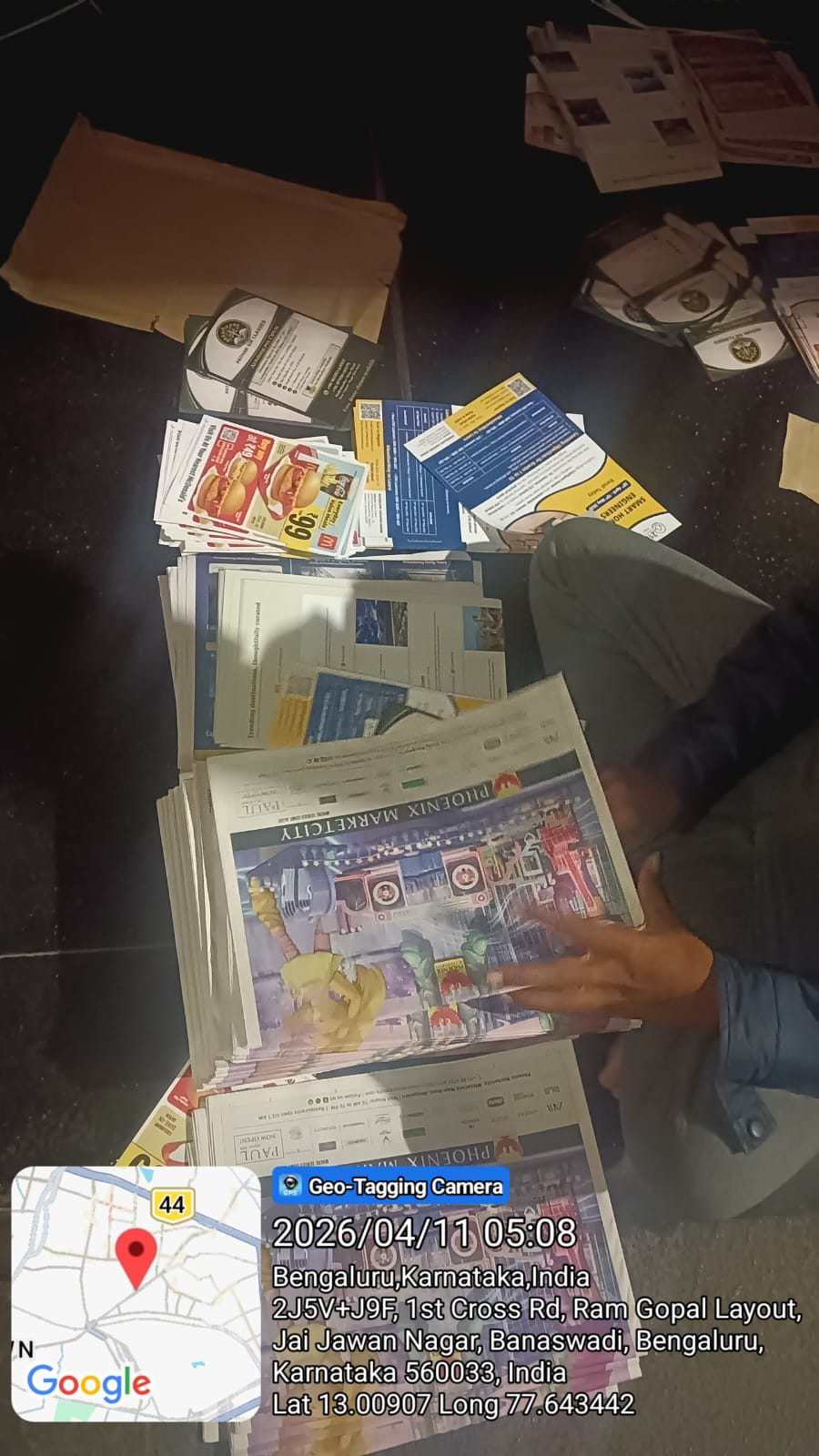
I have run newspaper insertion campaigns for nine Bangalore residential real estate launches in the last 24 months. The brands ranged from a single 80-unit project in HSR Layout to a 600-unit phased launch in Whitefield. The pattern that consistently delivers is the 90-day phase structure, broken into awareness, site-visit drive, and closing push. Single-burst insertion campaigns where the developer fires 1.5 lakh pamphlets in week one almost always underperform the phased version on the same total budget. This is the playbook for the phased version.
Which real estate projects fit this 90-day plan?
Real estate developers and marketing leads launching new residential projects in Bangalore. Sales heads running 90-day launch windows. Brokers planning agency-led launch support. Anyone responsible for insertion-driven prospect flow at ₹4-5.5 lakh budget across a 90-day phased campaign.
What you'll have at the end
- A phase-gated 90-day insertion plan with paper mix per phase
- Pin-code targeting plan refined by phase 1 prospect data
- Audit deliverables to track per-phase delivery
- Per-phase conversion attribution against booking outcomes
Prerequisites
Three things in place by Day 0. Project price band and target demographic clearly defined (this drives the paper mix). A working sales hotline and landing page with separate contact-tracking per insertion variant. RERA registration and project documentation ready for distribution-side compliance review.
Phase 1: Awareness, Days 1-30
Goal: seed brand and project awareness across the catchment. Insertion budget for phase: 70,000-90,000 pamphlets across 3-4 papers. Paper mix for a mid-market 1-2 BHK project in HSR-BTM-Whitefield catchment: ToI 35 percent, Vijaya Karnataka 35 percent, Deccan Herald 20 percent, The Hindu 10 percent. Distribution geography: broad BBMP zone targeting in 8-12 zones aligned to project commute and price-fit.
Insertion frequency: 2 inserts per week, alternating papers. Sundays for ToI and Deccan Herald, Wednesdays for Vijaya Karnataka and The Hindu. Total 8-9 insertion days across 30 days. Creative: project name, location landmark, price-band, RERA number, sales hotline, with a soft offer ("Site visit benefits this month"). Tracked response: hotline call volume by day. Phase 1 typically generates 350-650 inquiries with 40-90 site visits.
Phase 2: Site visit drive, Days 31-60
Goal: convert phase 1 awareness into scheduled site visits, focused on the highest-intent BBMP zones identified by phase 1 prospect geography. Insertion budget for phase: 30,000-50,000 pamphlets pin-code targeted. Paper mix: tighten to ToI plus the strongest secondary paper from phase 1 conversion data. Drop the weakest paper to free budget for tighter targeting.
Distribution geography: pin-code targeted in 8-12 specific pin codes that delivered 60+ percent of phase 1 inquiries. Insertion frequency: 4-5 insertion days across 30 days, weighted to weekend slots (Saturday and Sunday). Creative: site visit hook ("Visit this Sunday, get ₹50,000 booking benefit"), project highlight, price-band, location specifics, sales hotline. Phase 2 typically generates 150-280 site visits with 20-40 booking conversions.
Phase 3: Closing push, Days 61-90
Goal: close the prospects who saw phase 1 and 2 but have not yet booked. Insertion budget: 50,000-70,000 pamphlets with peak booking-weekend timing. Paper mix: same as phase 2 but with a wider zone net to recover prospects who saw phase 1 but did not engage. Creative: closing offer (price-protection, early-bird discount expiring at Day 90, free upgrade or registration sponsorship), project completion or possession milestone proof, RERA number prominently. Phase 3 typically generates 80-160 site visits with 25-50 booking conversions.
The 90-day phased insertion plan at a glance
| Days | Volume | Targeting | Typical outcome | |
|---|---|---|---|---|
| Phase 1: Awareness | Days 1-30 | 70,000-90,000 pamphlets, 3-4 papers | Broad, 8-12 BBMP zones | 350-650 inquiries, 40-90 site visits |
| Phase 2: Site-visit drive | Days 31-60 | 30,000-50,000 pamphlets | Pin-code targeted, 8-12 pin codes | 150-280 site visits, 20-40 bookings |
| Phase 3: Closing push | Days 61-90 | 50,000-70,000 pamphlets | Wider zone net, weekend timing | 80-160 site visits, 25-50 bookings |
All-in 90-day budget: ₹5.3-5.5 lakh including print, 18 percent GST, and audit deliverables.
Audit deliverables across the 90-day window
- Per-insertion-day depot dispatch report with timestamp
- Per-phase distribution log signed by depot supervisor
- Household call-back sample (50-80 across 90 days, sampled per insertion day)
- Pin-code conversion attribution at end of phase 2 and phase 3
- Booking-source attribution tagged by paper plus phase plus pin code
Realistic 90-day budget
- Phase 1 insertion: 80,000 pamphlets at ₹1.9 distribution + ₹0.45 print = ₹1.88 lakh
- Phase 2 insertion: 40,000 pamphlets at ₹2.1 (pin code uplift) + ₹0.45 print = ₹1.02 lakh
- Phase 3 insertion: 60,000 pamphlets at ₹1.95 + ₹0.45 print = ₹1.44 lakh
- GST at 18 percent on full distribution plus print: ₹77,500
- Audit deliverables and call-back panel: ₹18,000-25,000
- All-in 90-day budget: ₹5.3-5.5 lakh for 1.8 lakh pamphlets across the three phases
Common 90-day campaign mistakes
- Single-burst insertion in week 1 instead of phased. Spends faster, generates fewer total bookings.
- Same paper mix across all 3 phases. Phase 1 prospect data should refine phase 2 and 3 mixes.
- No pin-code targeting in phase 2. Wastes 25-35 percent of phase 2 budget on already-burned zones.
- Closing offer in phase 3 too generic. Expiring-discount messaging works better than open-ended scheme messaging.
- Skipping booking-source attribution. Without it, the next launch repeats the wrong allocation choices.
The 7-step launch checklist
- Lock paper mix and zone allocation for phase 1
- Print 80,000 pamphlets and dispatch across 30 days at 2-day frequency
- Track inquiries by paper plus pin code; use Day 30 data to refine phase 2
- Phase 2 pin-code targeted insertion in 8-12 zones with strongest paper mix
- Phase 3 closing-offer insertion with peak weekend timing
- Booking-source attribution by paper plus phase plus pin code at Day 90
- Document campaign in dossier for next launch refinement
If you would like this 90-day playbook executed end-to-end for your Bangalore real estate launch, share the project details and we will reply with a phase-by-phase plan inside two working days.
Lock paper mix and zone allocation for phase 1
For a mid-market 1-2 BHK project: ToI 35 percent, Vijaya Karnataka 35 percent, Deccan Herald 20 percent, The Hindu 10 percent across 8-12 BBMP zones aligned to project commute and price-fit.
Print and dispatch 80,000 pamphlets across 30 days
8-9 insertion days at 2-day frequency. Sundays for ToI and Deccan Herald, Wednesdays for Vijaya Karnataka and The Hindu. Track inquiries per insertion day.
Refine phase 2 mix using Day 30 prospect data
Pull paper-by-pin-code conversion. Tighten to top 2 papers and 8-12 highest-intent pin codes for phase 2.
Pin-code targeted phase 2 insertion (Days 31-60)
40,000 pamphlets at 4-5 weekend-weighted insertion days. Site-visit-hook creative. ₹1-2 lakh budget.
Closing-push phase 3 insertion (Days 61-90)
60,000 pamphlets with closing offer (price-protection, early-bird, expiring-discount messaging). Peak weekend timing. ₹1.4-1.6 lakh budget.
Booking-source attribution at Day 90
Tag bookings by paper plus phase plus pin code. Identify which paper-phase-zone combinations delivered the highest conversion. Use for next launch refinement.
Document in dossier
Total spend, paper-mix per phase, pin-code list per phase, booking conversions per source, mistakes to avoid. Hand to next launch team or future-self for repeat campaigns.
Is a 90-day insertion campaign too long for a Bangalore real estate launch?
No, 90 days is the right window for most Bangalore residential launches. The typical real estate buyer journey is 60-90 days from first awareness to booking decision. A 30-day single-burst campaign loses prospects who are still in research mode at Day 30. The phased 90-day approach catches the full buying cycle. Smaller pre-launch teaser campaigns (10-14 days) before phase 1 can lift phase 1 inquiry volume by 25-40 percent.
Should a Bangalore premium real estate launch use the same 90-day playbook?
Adapt the paper mix and pin-code targeting. Premium launches lean Times of India 60-70 percent, Deccan Herald 20-25 percent, drop Vijaya Karnataka unless the project has bilingual buyer overlap. Pin-code targeting in phase 2 should focus on premium-fit zones (Indiranagar, Koramangala, HSR, parts of Whitefield, Sarjapur). Total budget runs roughly 15-25 percent higher because premium pamphlet rates plus premium positioning surcharge stack.
What insertion campaign mistake hurts Bangalore real estate launches the most?
Skipping pin-code targeting in phase 2 and 3. The single biggest insertion-side ROI driver in real estate launches is targeting prospects who already self-selected through phase 1 awareness. Without pin-code targeting, phases 2 and 3 spread evenly across the same zones as phase 1, and 25-35 percent of the budget gets wasted on prospects who have already self-selected out. Lock pin-code targeting before phase 2 starts.
How does this playbook integrate with digital advertising for a Bangalore real estate launch?
Insertion drives the prospect to the project landing page or hotline; digital re-targeting runs against landing-page visitors during phase 2 and 3 to compound the touch frequency. Insertion typically earns 25-40 percent of total launch leads; digital paid plus organic earns 35-55 percent; site visits from broker referrals close the rest. The mix shifts by project price band; premium projects lean digital-heavier, mid-market projects insertion-heavier.
Is RERA registration required to be displayed on Bangalore real estate insertion?
Yes. Karnataka RERA mandates real estate advertising including newspaper inserts to display the RERA registration number. Inserts without the RERA number are non-compliant and can attract regulatory penalties on the developer. The RERA number should appear in a readable font on every insertion variant. Reputable Bangalore distribution agencies typically refuse to dispatch real estate inserts without RERA registration shown; verify this is bundled into your QA process.
Pamphlet size by phase: A2, A4, or A5
Real estate launches use size strategically across the three phases. The default mix is below; mid-market projects can step down sizes to stretch the budget, premium projects can stay on A2 across all phases.
- Phase 1 awareness (Days 1-30): A2 at ₹1.9 per pamphlet. Premium creative real estate announces project name, location, RERA, price band, hotline. The format pays for visual impact when the audience is first encountering the brand.
- Phase 2 site-visit drive (Days 31-60): A4 at ₹1.5 per pamphlet, pin-code targeted to high-intent zones identified from phase 1 prospect geography. The smaller format covers wider reach in the same zones for the same budget; the audience already knows the project, so creative real estate matters less.
- Phase 3 closing push (Days 61-90): A2 at ₹1.9 again for premium offer impact (price-protection, early-bird discount, free upgrade). The audience is closing-ready and the larger format reinforces the offer's seriousness.
Mid-market 1-2 BHK projects often skip the A2 step and run A4 across all 3 phases, stretching the same ₹5 lakh budget across 30-40 percent more pamphlet volume. A5 at ₹1.2 is rarely the right call for real estate because the format is too small to carry RERA registration, project visual, price band, and hotline all on one pamphlet.
Tags
Quick Answers
How many newspaper inserts does a Bangalore real estate launch typically need over 90 days?
1.5 to 2 lakh pamphlets across the 90-day window. Phase 1 (awareness, Days 1-30): 70,000-90,000 A2 pamphlets at ₹1.9 distribution across 3-4 papers in target catchment. Phase 2 (site-visit drive, Days 31-60): 30,000-50,000 A4 pamphlets at ₹1.5 distribution pin-code targeted to high-intent zones. Phase 3 (closing push, Days 61-90): 50,000-70,000 A2 or A4 pamphlets with discount or bonus messaging. Total budget at A2-and-A4 mix plus print plus GST: ₹4 to ₹5.5 lakh. Premium-positioning campaigns sometimes run A2 across all 3 phases, lifting total budget toward ₹6 lakh.
Which Bangalore newspapers and pamphlet sizes should a real estate launch use?
Three-paper mix as default with size-by-phase logic: phase 1 A2 (premium awareness creative) across Times of India 35 percent, Vijaya Karnataka 35 percent, Deccan Herald 20 percent, The Hindu 10 percent. Phase 2 step down to A4 for pin-code targeted reach. Phase 3 back to A2 for closing-offer impact. Mid-market projects lean Vijaya Karnataka heavy and can step down to A4 even in phase 1 to stretch the budget. Premium projects lean Times of India heavy at A2.
How does the 90-day insertion plan integrate with site visits and closings?
Phase 1 inserts (A2, premium creative) seed brand awareness and direct prospects to the project landing page or sales hotline. Phase 2 inserts (often stepped down to A4 for reach efficiency) target high-intent BBMP zones (defined by phase 1 site-visit data) and drive scheduled visits. Phase 3 inserts run reminder messaging plus a closing offer (price-protection, early-bird discount, free upgrade) timed to peak booking weekends, typically back at A2 for premium offer impact. Phase 2 and 3 conversion rates are 2-4x phase 1 because the audience has already self-selected through prior touchpoints.
Looking for professional Newspaper Insertion services?
The Mediaverse runs end-to-end newspaper insertion campaigns across India with geo-tagged delivery and transparent, all-inclusive pricing.
Explore our Newspaper Insertion solutionsSummarize this guide with AI
Open this article in your favourite AI assistant
Related Guides
Written by

The Mediaverse Team
India's Leading Outdoor Advertising Agency
The Mediaverse is a national-level outdoor advertising and integrated marketing organization that provides complete OOH, ATL, BTL, retail, and transit media solutions across India. With years of experience executing high-performance campaigns for brands in FMCG, Real Estate, E-commerce, EdTech, Automotive, Healthcare, and Retail, The Mediaverse combines creativity, data-driven media planning, and flawless on-ground execution. As a full-stack outdoor advertising provider, The Mediaverse offers Auto Branding, Mobile Van Branding, Newspaper Insertion Advertising, Shop Name Board Branding, In-Store Branding, Hoardings, Transit Media, Kiosks, Mall Media, Activations, and all forms of Below-The-Line marketing. Known for its pan-India network, strategic route planning, premium print quality, and Cheqmate™ GPS-based verification, The Mediaverse ensures 100% transparent and result-oriented campaign delivery. The Mediaverse’s editorial team produces deeply researched, SEO-optimized, and generative-engine-friendly content to help businesses understand the power of outdoor advertising and make informed decisions that maximize brand visibility and ROI across urban, suburban, and rural markets.
Related Articles
Newspaper Inserts vs WhatsApp and SMS Blasts for Local Reach (2026)
The two channels are not competing for the same rupee. Published insert rates at Rs.1.25, Rs.1.70 and Rs.2.20 per copy, the Rs.1,475 per thousand benchmark, the per-message price where a blast wins, and the reach ceiling that decides it for most businesses.
How to plan a newspaper insertion campaign in India: the 2026 step-by-step guide
What does newspaper insertion cost, how precise is the targeting, and how do you run a campaign? The complete 2026 guide to newspaper insertion in India, from pincode targeting to measurement.

Print inserts or digital ads for a local business: the 2026 budget-split decision guide
Is newspaper insertion still worth it against digital ads in 2026? A decision guide with a spec table, when each wins, how to combine them, and a checklist for local businesses.