

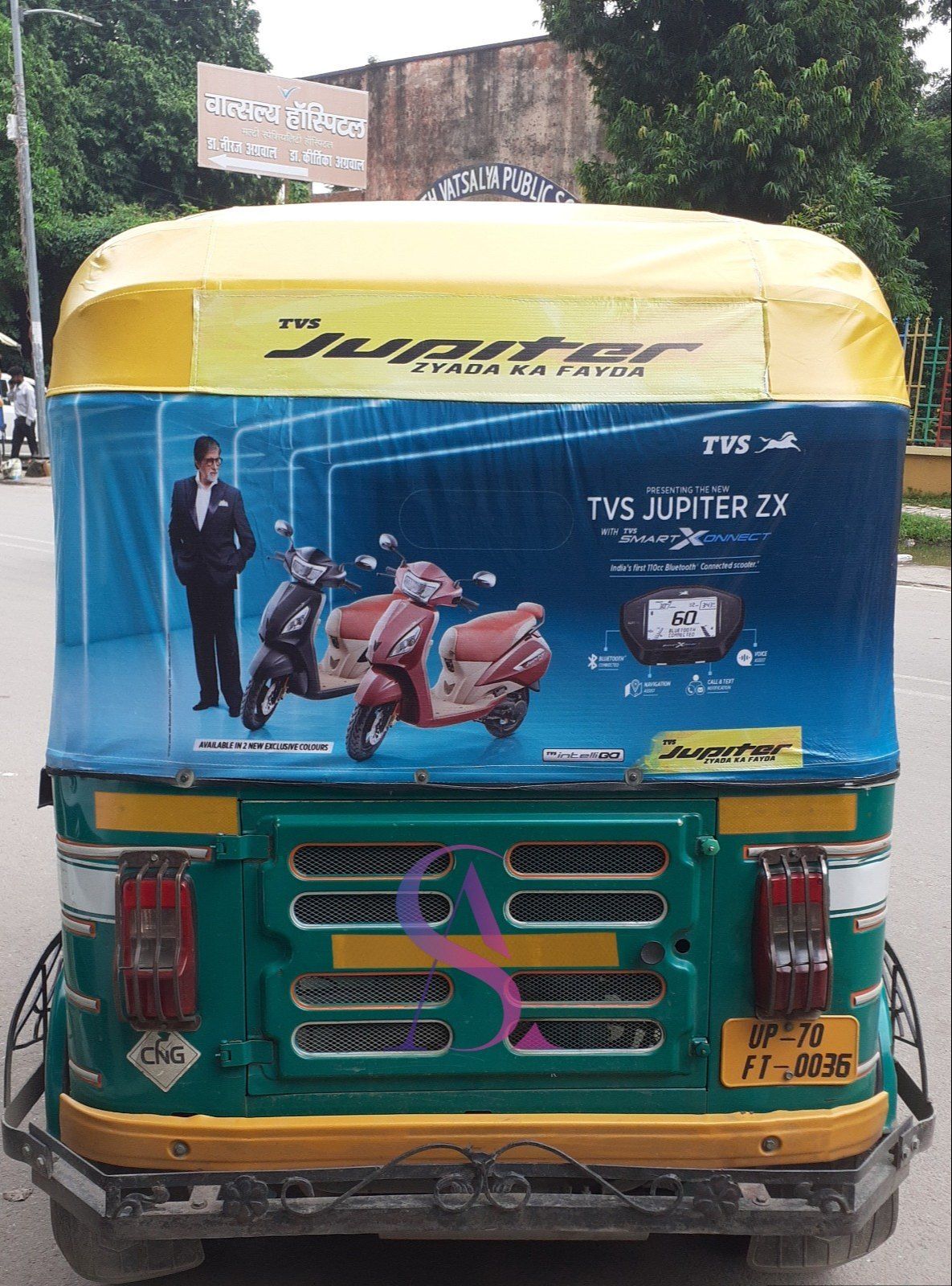
Walk down FC Road in Pune on any weekday afternoon and you pass coaching banners, college students, study-cafes, and a constant stream of auto-rickshaws ferrying learners between classes. That density is the whole point. Pune is the Oxford of the East, with one of India's largest urban student populations, and it makes auto branding uniquely powerful for education. Here are the numbers: full hood branding costs ₹550 to ₹650 per auto per month, back-panel stickers ₹150 to ₹180, and a full wrap ₹2,000 to ₹2,400, all inclusive of design, printing, installation, and maintenance. Pune has approximately 85,000 registered auto-rickshaws across the PMC and PCMC areas. A single branded auto generates an estimated 24,000 to 36,000 daily impressions at a cost-per-thousand of roughly ₹4 to ₹8, the lowest of any format in the city. For any education, EdTech, coaching, upskilling, or study-abroad brand, the FC Road-Deccan-Kothrud education belt is among the best auto branding catchments in the entire country. This guide covers the rates, fleet, catchment map, language, and campaign math for 2026.
Pune auto branding at a glance: the key facts
Seven numbers anchor a Pune auto branding plan in 2026. Fleet size: approximately 85,000 registered auto-rickshaws across PMC and PCMC. Hood branding rate: ₹550 to ₹650 per auto per month. Back-panel rate: ₹150 to ₹180 per auto per month. Full-wrap rate: ₹2,000 to ₹2,400 per auto per month. Daily impressions per auto: 24,000 to 36,000. Cost-per-thousand impressions: ₹4 to ₹8. Recommended minimum for a single 3 to 5 km catchment: 20 to 30 autos for 30 days. The Pune-specific advantage layered on top of these numbers is the city's exceptional student density.
Fleet size and reach math
Pune's roughly 85,000 auto-rickshaws span two municipal bodies: Pune Municipal Corporation (PMC) covers the central city and the education belt, while Pimpri Chinchwad Municipal Corporation (PCMC) covers the northern industrial-and-IT belt across the Mula river. For most advertisers this split matters only for content-compliance paperwork, which a local operator handles. The autos run the Maharashtra black-and-yellow livery. A Pune auto covers 70 to 105 km a day, and at an estimated 240 to 360 viewers per kilometre in Pune traffic, that yields 24,000 to 36,000 daily impressions per auto. The figure is an estimate from route density, consistent across The Mediaverse Pune field data spanning 84 campaigns. A 50-auto cluster in one catchment generates 12 to 18 lakh daily impressions in a 3 to 8 km radius.
What makes Pune distinct is the student population. Savitribai Phule Pune University, Symbiosis, MIT, the dense engineering and management college network, and the coaching ecosystem give Pune one of India's largest urban student concentrations. The education belt around FC Road, JM Road, Deccan, and Kothrud sees a constant flow of students and aspirants on foot and in autos throughout the academic year. For learner-facing brands, this is a structural advantage no generic auto market offers: the audience is concentrated, mobile, and reachable at a fraction of the cost of any other channel.
The five-catchment Pune map
FC Road, Deccan, Kothrud: the education catchment
FC Road, JM Road, Deccan Gymkhana, and Kothrud form Pune's education and student-retail heartland, dense with coaching institutes, colleges, study-cafes, and student-facing retail. Hood rate ₹580 to ₹640. Best for coaching and competitive-exam prep, EdTech, upskilling and certification, study-abroad consultancies, student housing, food and cafes, and youth fashion. The Mediaverse Pune field data shows education campaigns concentrated here deliver the highest walk-in and enquiry attribution per rupee of any category-catchment pairing in the portfolio. If you sell to students or parents, this is the catchment to start with.
Hinjewadi, Magarpatta, Kharadi: the IT corridor
Hinjewadi (the Rajiv Gandhi Infotech Park), Magarpatta, and Kharadi (EON IT Park) reach Pune's IT and ITeS workforce across Infosys, TCS, Wipro, Tech Mahindra, Persistent, and the MNC campuses. Hood rate ₹580 to ₹640. Best for B2B SaaS targeting professionals at home, premium real estate, fintech, food delivery, and lifestyle brands. English-led artwork works here. Autos serving the residential pockets around these corridors (Wakad, Baner for Hinjewadi; Hadapsar for Magarpatta) reach the IT workforce at the home end of the commute.
Koregaon Park, Camp, Boat Club Road: the premium catchment
Koregaon Park, Camp (MG Road), and Boat Club Road form Pune's premium and HNI belt: affluent residents, fine dining, boutique retail, and the city's upscale social scene. Hood rate ₹600 to ₹650, the top of the Pune range. Best for premium retail, healthcare and diagnostics, jewellery, fine dining, hospitality, and high-ticket finance. A premium brand reaches the Koregaon Park and Camp affluent audience through auto branding at a fraction of hoarding cost.
Aundh, Baner, Viman Nagar: upper-mid residential
Aundh, Baner, and Viman Nagar are the upper-middle residential belts, blending IT-professional households with established Pune families. Hood rate ₹570 to ₹620. Best for family-decision categories: schools, family healthcare, household appliances, restaurants, fitness, and mid-premium retail. These belts combine residential density with disposable income, making them strong for household and lifestyle brands.
Pimpri, Chinchwad, Wakad: the PCMC industrial belt
The PCMC belt (Pimpri, Chinchwad, Wakad, Bhosari) covers Pune's industrial and working-household audience, with the auto-and-manufacturing workforce of the Bajaj, Tata Motors, and Force Motors plant ecosystems. Hood rate ₹550 to ₹600, the most economical. Best for value retail, FMCG, two-wheeler dealerships and accessories, household categories, finance apps, and local services. The Pimpri and Chinchwad market belts deliver heavy commuter and shopper stationary visibility.
Pune auto branding catchment rates (2026)
| Catchment | Hood rate (per auto per month) | Best for | |
|---|---|---|---|
| FC Road, Deccan, Kothrud | ₹580 to ₹640 | Coaching, EdTech, student housing, youth fashion | |
| Hinjewadi, Magarpatta, Kharadi | ₹580 to ₹640 | B2B SaaS, premium real estate, fintech, food delivery | |
| Koregaon Park, Camp, Boat Club Road | ₹600 to ₹650 | Premium retail, healthcare, jewellery, fine dining | |
| Aundh, Baner, Viman Nagar | ₹570 to ₹620 | Schools, family healthcare, appliances, fitness | |
| Pimpri, Chinchwad, Wakad | ₹550 to ₹600 | Value retail, FMCG, two-wheeler dealerships, finance apps |
Back panels ₹150 to ₹180 and full wraps ₹2,000 to ₹2,400 per auto per month.
Hood vs back panel in Pune: which format earns its rate?
Back-panel stickers at ₹150 to ₹180 per auto per month are the entry format for single-message awareness, app installs, and offer codes, the right pick for maximising fleet size on a fixed budget. Full hood branding at ₹550 to ₹650 offers the best visibility-to-cost balance with a roughly 270-degree envelope, the default for most campaigns. Full-body wrap at ₹2,000 to ₹2,400 maximises brand-world impact for launches and premium brands. The decision rule: back-panel to maximise reach on a single offer (ideal for EdTech app installs and coaching admissions), hood for balanced multi-angle visibility, wrap for launch impact.
Pune's climate is moderate, but the June to September monsoon still degrades cheap vinyl. The Mediaverse durability audit found 4 mil hot-laminate hood vinyl held under 9 percent mid-campaign damage versus 18 to 23 percent for cheap cold-laminate, especially during monsoon-window campaigns. Confirm the vinyl mil thickness, lamination type, and a free-replacement clause in writing, particularly for any campaign running through the Pune monsoon.
Language and the rules
Marathi-language presence on artwork is expected and converts better for mass-market and residential catchments (PCMC belt, Aundh-Baner family households, traditional Pune neighbourhoods). The education belt and the IT corridor are more bilingual, so English plus Marathi works well there, reflecting the mixed student and professional audience. For a citywide campaign, the right approach is Marathi-primary for mass-market catchments and bilingual for the education and IT belts, rather than a single English creative everywhere, which under-converts in the Marathi-speaking residential belts.
The other rules are standard. Auto advertising in Pune is legal subject to driver and vehicle-owner consent, Maharashtra RTO vehicle compliance, and PMC or PCMC content norms depending on the area. Branding must not obscure the registration plate, permit, fare card, or driver visibility. Political content is restricted within 14 days of any election under ECI rules. There is no state rate ceiling, so rates reflect operator cost drivers, not regulation.
ROI, measurement, and the education-cycle timing
Auto branding in Pune delivers a ₹4 to ₹8 cost-per-thousand impressions, far below hoardings and digital display. Measure outcomes with a unique phone or missed-call number, a QR code with UTM tracking (accepting lower scan rates from moving vehicles), and a unique offer code redeemed in store or at the centre. For campaigns above 30 autos, use at least two of the three and run a two-week pre-campaign baseline. Pune adds a timing layer that sharpens education ROI: the June to August admissions window and the December to January placement-and-internship window concentrate education demand. Time EdTech and coaching campaigns to launch 5 to 8 weeks before these windows so frequency builds before the decision peak. Where auto branding wins in Pune: education and EdTech above all, IT-corridor B2B, healthcare, local and mid-market retail, food delivery, and hyperlocal services. Where it underperforms: pure-digital D2C with no local fulfilment and ultra-premium luxury.
A 2026 Pune auto branding campaign playbook
An EdTech brand launching a competitive-exam course, targeting aspirants across the FC Road-Deccan-Kothrud education belt. Budget ₹1.3 lakh for a 45-day pre-batch campaign timed to the admissions window. Step one, catchment and format: FC Road plus Deccan plus Kothrud plus Shivaji Nagar, back-panel format for maximum fleet reach on a single course-and-app-install message. Step two, fleet size: at ₹170 per auto per month, ₹1.3 lakh over 45 days (1.5 months) buys roughly 510 auto-months, or about 165 autos for the window after design and tracking, so concentrate a 140-auto cluster in the education core. Step three, message: course, outcome hook, app-install QR plus a missed-call number, in bilingual Marathi-English since the student belt is mixed-language. Step four, measurement: unique missed-call number plus an app-install offer code, with UTM tracking on the QR. Step five, timing: launch 6 weeks before the admissions deadline so frequency peaks during decision week. A 140-auto education-belt cluster generates an estimated 27 to 40 lakh daily impressions on the exact streets where Pune's aspirants walk between coaching centres.
How should Pune brands budget auto branding in 2026?
Auto rickshaw branding is Pune's lowest-cost outdoor format, and the city's exceptional student density makes it one of India's best auto markets for education. Match your catchment to your business: FC Road-Deccan-Kothrud for education, Hinjewadi-Magarpatta for IT and B2B, Koregaon Park-Camp for premium, Aundh-Baner for family households, PCMC for industrial and mass-market. Use Marathi-primary for mass-market and bilingual for the education and IT belts. Time education campaigns to the admissions and placement windows. Insist on 4 mil hot-laminate vinyl, especially for monsoon campaigns. Measure with a phone line plus an offer code. With those disciplines, Pune auto branding reaches a defined catchment at ₹4 to ₹8 per thousand impressions and outperforms digital display on cost-per-enquiry for education, IT-corridor, and local businesses.
Why is Pune so good for education and EdTech auto branding?
Pune has one of India's largest urban student populations, earning it the Oxford of the East reputation, with Savitribai Phule Pune University, Symbiosis, MIT, a dense engineering and management college network, and a large coaching ecosystem. The FC Road-Deccan-Kothrud education belt concentrates students and aspirants on foot and in autos throughout the academic year. The Mediaverse field data shows education campaigns in this belt deliver the highest walk-in and enquiry attribution per rupee of any category-catchment pairing in the Pune portfolio, making auto branding the highest-converting affordable channel for coaching, EdTech, upskilling, and study-abroad brands.
When is the best time to run an education auto branding campaign in Pune?
Time it to the education cycle. The June to August admissions window and the December to January placement-and-internship window concentrate education demand in Pune. Launch EdTech and coaching campaigns 5 to 8 weeks before these windows so brand frequency builds before the decision peak. A campaign that lands during the admissions or placement decision window, after weeks of build-up, converts far better than one started cold at the same moment, because auto branding works through repeated exposure and recall.
Do I need separate permits for PMC and PCMC areas in Pune?
Content compliance follows the area: PMC norms apply in the central city and education belt, PCMC norms in the Pimpri-Chinchwad industrial belt across the Mula river. For most campaigns a local operator handles the paperwork for whichever areas the fleet covers, so it is not a barrier. If your catchment spans both (for example an IT-corridor campaign touching both Hinjewadi in PCMC and the central city in PMC), confirm your operator holds active compliance for both bodies, which a Pune-based specialist will.
Quick Answers
How much does auto rickshaw branding cost in Pune in 2026?
Full hood branding costs ₹550 to ₹650 per auto per month in Pune. Back-panel vinyl stickers cost ₹150 to ₹180 per auto per month. A full-body wrap costs ₹2,000 to ₹2,400 per auto per month. All rates include design, printing, installation, and monthly maintenance. Volume discounts apply at 50 plus autos (around 10 percent) and 200 plus autos (around 20 percent). A 50-auto back-panel campaign for 30 days lands at roughly ₹7,500 to ₹9,000 before GST.
How many auto rickshaws are there in Pune?
Pune has approximately 85,000 registered auto-rickshaws across the Pune Municipal Corporation (PMC) and Pimpri Chinchwad Municipal Corporation (PCMC) areas, running the Maharashtra black-and-yellow livery. The fleet covers the student-and-education belt (FC Road, Deccan, Kothrud), the Hinjewadi and Magarpatta IT corridors, and the PCMC industrial belt, giving advertisers strong availability across every catchment.
Is auto rickshaw advertising worth it in Pune?
Yes, and Pune is one of India's strongest auto branding markets for education specifically. Auto branding in Pune delivers an estimated cost-per-thousand impressions of ₹4 to ₹8, the lowest of any outdoor format in the city. Pune's exceptional student population, among India's largest, means the FC Road-Deccan-Kothrud education belt concentrates learners and aspirants at a density few cities match, making auto branding the highest-converting affordable channel for coaching, EdTech, upskilling, and study-abroad brands. It also works well for IT-corridor B2B, local retail, healthcare, and hyperlocal services.
Which Pune areas are best for auto rickshaw branding?
Five catchments stand out. FC Road, Deccan, and Kothrud for education, coaching, and student-facing brands (Pune's strongest auto branding catchment). Hinjewadi, Magarpatta, and Kharadi for the IT corridor and B2B targeting. Koregaon Park, Camp, and Boat Club Road for premium and HNI. Aundh, Baner, and Viman Nagar for upper-mid residential. The PCMC belt (Pimpri, Chinchwad, Wakad) for industrial and mass-market. Match the catchment to your business.
What are the rules for auto rickshaw advertising in Pune?
Auto advertising in Pune is permitted subject to driver and vehicle-owner consent, Maharashtra RTO vehicle compliance, and PMC or PCMC content norms depending on the area. Branding must not obscure the registration plate, permit, fare card, or driver visibility. Marathi-language presence is expected and converts better for mass-market and residential catchments, with English working in the IT corridor and student belt. Political content is restricted within 14 days of any election under ECI rules. There is no state rate ceiling, so rates reflect operator cost drivers, not regulation.
Looking for professional Auto Branding services?
The Mediaverse runs end-to-end auto branding campaigns across India with geo-tagged delivery and transparent, all-inclusive pricing.
Explore our Auto Branding solutionsSummarize this guide with AI
Open this article in your favourite AI assistant
Related Guides
Written by

The Mediaverse Team
India's Leading Outdoor Advertising Agency
The Mediaverse is a national-level outdoor advertising and integrated marketing organization that provides complete OOH, ATL, BTL, retail, and transit media solutions across India. With years of experience executing high-performance campaigns for brands in FMCG, Real Estate, E-commerce, EdTech, Automotive, Healthcare, and Retail, The Mediaverse combines creativity, data-driven media planning, and flawless on-ground execution. As a full-stack outdoor advertising provider, The Mediaverse offers Auto Branding, Mobile Van Branding, Newspaper Insertion Advertising, Shop Name Board Branding, In-Store Branding, Hoardings, Transit Media, Kiosks, Mall Media, Activations, and all forms of Below-The-Line marketing. Known for its pan-India network, strategic route planning, premium print quality, and Cheqmate™ GPS-based verification, The Mediaverse ensures 100% transparent and result-oriented campaign delivery. The Mediaverse’s editorial team produces deeply researched, SEO-optimized, and generative-engine-friendly content to help businesses understand the power of outdoor advertising and make informed decisions that maximize brand visibility and ROI across urban, suburban, and rural markets.
Related Articles
Auto Branding for Restaurant and Cloud Kitchen Launches: The Delivery-Radius Zone Playbook (2026)
Auto branding is priced and deployed by zone, which makes it the outdoor format that can be pointed at a restaurant or cloud kitchen's own delivery radius. Published rates, worked launch-campaign totals, and a five-step zone mapping process.
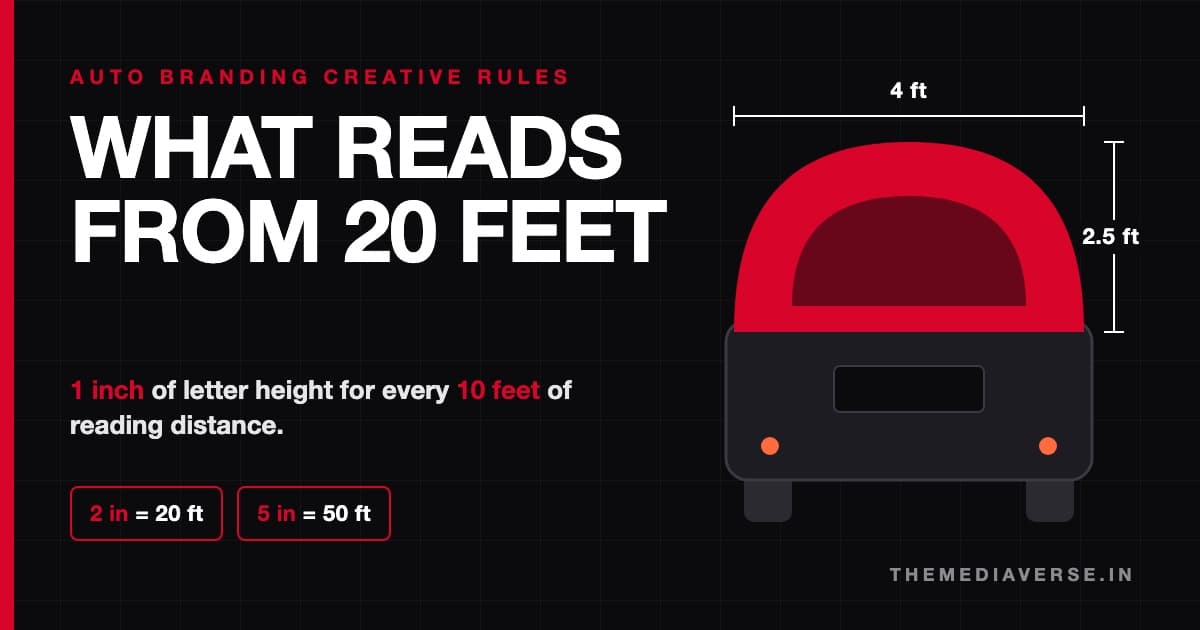
Auto branding creative rules: what actually reads from 20 feet at a signal (2026 playbook)
An auto hood is 4 ft by 2.5 ft and reads at roughly 1 inch of letter height per 10 feet. Eight creative rules ranked by what a reprint on 300 autos costs, plus the paper test to run before the print run.
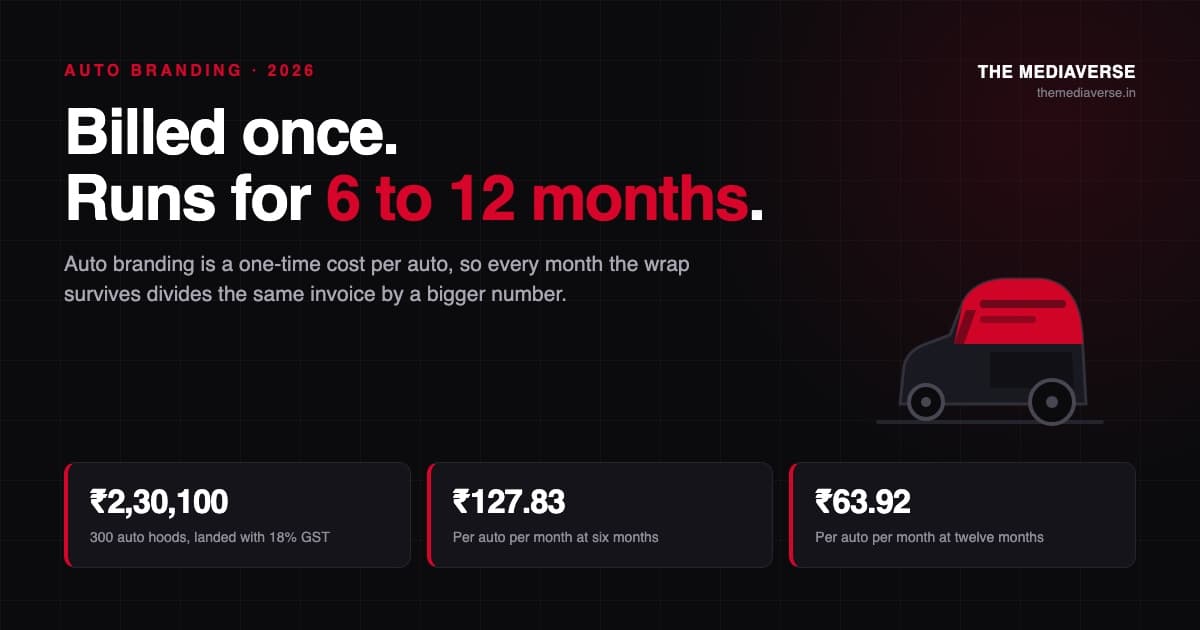
How long should an auto branding campaign run? The material-life math for 2026
Auto branding is billed once per auto, and the published vinyl life is 6 to 12 months. A 300-hood fleet at ₹2,30,100 landed is ₹767 per auto for one month and ₹127.83 per auto per month at six. The full arithmetic, and what really ends a campaign.