

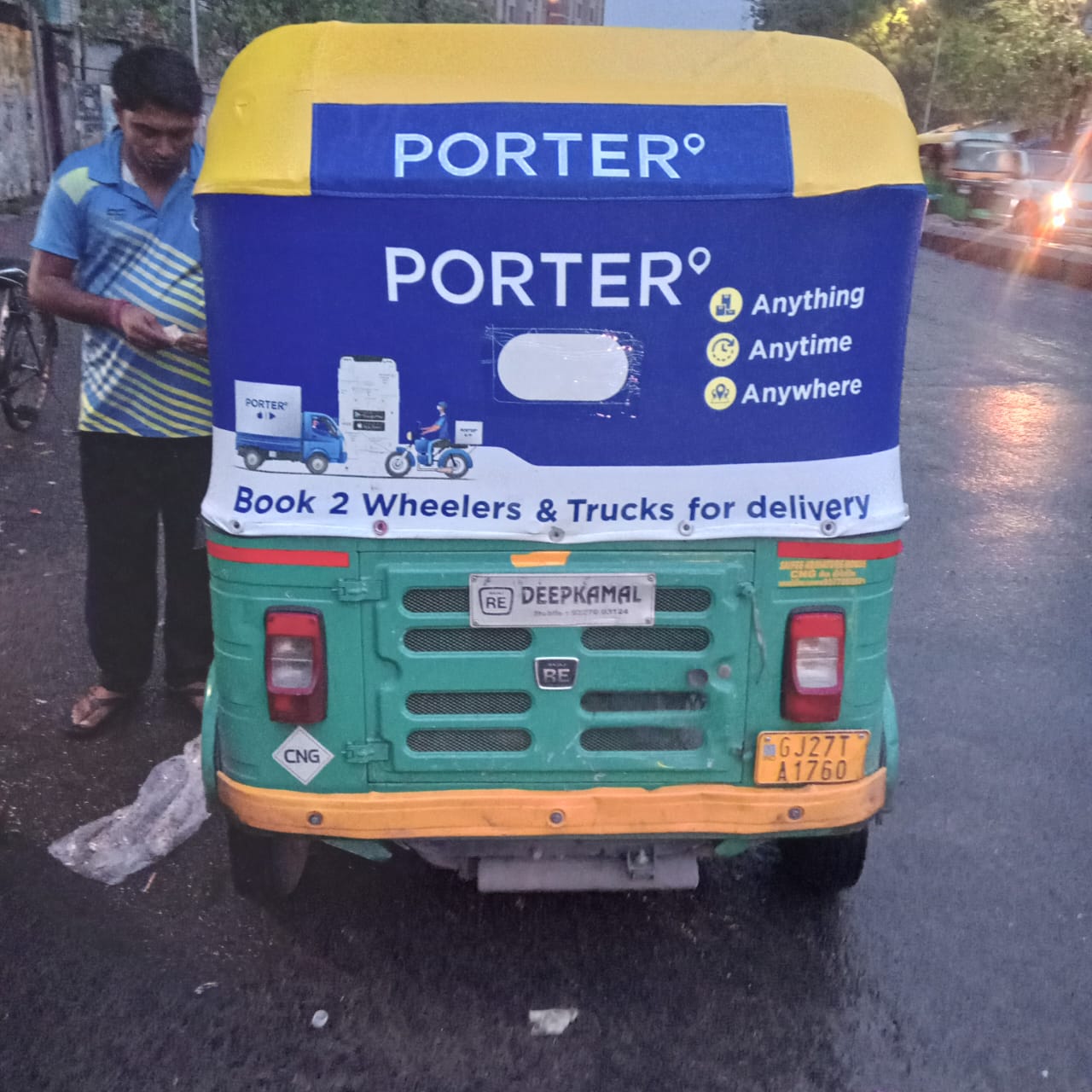
Most advertisers plan auto branding by zone. In Kolkata, that is the wrong unit. Kolkata auto-rickshaws do not run metered point-to-point trips the way they do in Delhi or Bangalore. They run fixed shared routes: each auto operates a defined corridor, picking up and dropping passengers along the same line all day. That single difference changes how you plan, and it works in the advertiser's favour. Here are the numbers first. Full hood branding costs ₹500 to ₹600 per auto per month, the most economical of the major metros, with back-panel stickers ₹140 to ₹170 and a full wrap ₹1,800 to ₹2,200, all inclusive of design, printing, installation, and maintenance. Kolkata has approximately 42,000 registered auto-rickshaws. A single branded auto generates an estimated 22,000 to 34,000 daily impressions at a cost-per-thousand of roughly ₹4 to ₹8. Because autos run fixed routes, you book branding by corridor, and a branded shared auto traverses the same line dozens of times daily, building extraordinary frequency among the commuters and residents along that route. This guide explains the route-based planning model, the rates, the corridor map, the Bengali-language imperative, and the campaign math for 2026.
Kolkata auto branding at a glance: the key facts
Seven facts anchor a Kolkata auto branding plan in 2026. Fleet size: approximately 42,000 registered auto-rickshaws on fixed shared routes. Hood branding rate: ₹500 to ₹600 per auto per month (the lowest of the major metros). Back-panel rate: ₹140 to ₹170 per auto per month. Full-wrap rate: ₹1,800 to ₹2,200 per auto per month. Daily impressions per auto: 22,000 to 34,000. Cost-per-thousand impressions: ₹4 to ₹8. Planning unit: route or corridor, not zone. That last fact is the one that distinguishes Kolkata from every other auto branding market in India.
The fixed-route model and what it means for reach
Kolkata's roughly 42,000 auto-rickshaws operate predominantly on fixed shared-route permits. An auto licensed for the Gariahat to Golpark route runs that corridor all day, back and forth, carrying a stream of passengers along the same line. This is fundamentally different from a metered auto that goes wherever the passenger directs. For advertising, the fixed-route model is an advantage, not a limitation. A branded auto on a fixed route is seen repeatedly by the same commuters, shopkeepers, and residents along that corridor, every day of the campaign. The result is high frequency in a defined geographic line, which is exactly what drives recall and walk-ins for a local business on that corridor.
The reach math: a Kolkata shared auto covers 60 to 95 km a day along its fixed route, and at an estimated 240 to 360 viewers per kilometre in dense Kolkata traffic, that yields 22,000 to 34,000 daily impressions per auto. The figure is an estimate from route density, consistent across The Mediaverse Kolkata field data spanning 72 campaigns. But the more important metric in Kolkata is frequency: a fleet of 30 autos saturating a single corridor delivers far higher repeat-exposure to that corridor's audience than 30 autos scattered across the city. The Mediaverse field data confirms route-concentrated campaigns out-perform zone-spread campaigns on walk-in attribution per rupee, the reverse of standard auto branding advice in metered-auto cities.
The planning implication is simple: identify the routes that pass through your catchment and concentrate the branded fleet on those corridors. A clinic on Rashbehari Avenue should brand the autos that run the Rashbehari corridor, not a random spread across South Kolkata. A coaching centre in Jadavpur should brand the Jadavpur-Garia and Jadavpur-Tollygunge route autos. The fixed-route system gives you precise corridor targeting that metered-auto cities cannot match.
The Kolkata corridor map
Gariahat-Ballygunge-Golpark: South Kolkata retail and HNI
The Gariahat-Ballygunge-Golpark corridor is South Kolkata's premier retail and HNI line, anchored by the Gariahat market, one of the busiest shopping districts in the city. Hood rate ₹550 to ₹600. Best for retail, fashion and sarees, jewellery, premium healthcare and diagnostics, restaurants, and any offer-led South Kolkata campaign. A branded fleet on this corridor reaches the dense Gariahat shopping crowd and the affluent Ballygunge residential audience with high frequency.
Jadavpur-Garia-Tollygunge: residential, student, and coaching
The Jadavpur-Garia-Tollygunge corridors cover dense South-East Kolkata residential plus the Jadavpur University student-and-coaching audience. Hood rate ₹500 to ₹560, economical. Best for coaching and education, value retail, family healthcare, household categories, food delivery, and local services. For an education brand, the Jadavpur route autos reach the student and aspirant audience directly along their daily commute.
Behala: the South-West residential belt
Behala is one of Kolkata's largest residential belts, with dense family-household composition and heavy auto dependence for last-mile connectivity to the metro and rail. Hood rate ₹500 to ₹550. Best for family-decision categories: schools and coaching, family healthcare, household appliances, FMCG, value retail, and restaurants. The Behala route autos saturate a large residential audience that relies on shared autos daily.
Salt Lake and New Town: the IT corridor
Salt Lake (Sectors I to V) and New Town reach Kolkata's IT and corporate workforce across the Sector V tech hub and the planned-township residents. Hood rate ₹530 to ₹590. Best for B2B SaaS targeting professionals, premium real estate, fintech, food delivery, and lifestyle brands. This is the one Kolkata corridor where bilingual Bengali-English artwork performs comparably to Bengali-primary, reflecting the mixed-language IT workforce.
North Kolkata, Ultadanga-Dum Dum, and Dunlop: northern corridors
The northern corridors (Ultadanga, Dum Dum, Shyambazar, Baguiati, and the Dunlop-Baranagar suburban line) cover North Kolkata's traditional residential and commercial audience plus the northern suburbs. Hood rate ₹500 to ₹550. Best for traditional retail, value categories, education, healthcare, and local services targeting North Kolkata and the northern suburbs. These corridors respond strongly to Bengali-rooted creative and reach a traditional audience that digital under-serves.
Kolkata auto branding corridor rates (2026)
| Corridor | Hood rate (per auto per month) | Best for | |
|---|---|---|---|
| Gariahat, Ballygunge, Golpark | ₹550 to ₹600 | Retail, sarees, jewellery, premium healthcare | |
| Jadavpur, Garia, Tollygunge | ₹500 to ₹560 | Coaching, value retail, family healthcare, food delivery | |
| Behala | ₹500 to ₹550 | Schools, appliances, FMCG, restaurants | |
| Salt Lake and New Town | ₹530 to ₹590 | B2B SaaS, premium real estate, fintech | |
| North Kolkata, Ultadanga to Dum Dum, Dunlop | ₹500 to ₹550 | Traditional retail, education, local services |
Back panels ₹140 to ₹170 and full wraps ₹1,800 to ₹2,200 per auto per month.
Hood, back panel, or wrap: what works on Kolkata routes?
Back-panel stickers at ₹140 to ₹170 per auto per month are the entry format for single-message awareness, app installs, and offer codes, the right pick for maximising fleet size on a fixed budget, and the lowest per-auto cost of any major metro. Full hood branding at ₹500 to ₹600 offers the best visibility-to-cost balance with a roughly 270-degree envelope, the default for most campaigns. Full-body wrap at ₹1,800 to ₹2,200 maximises brand-world impact for launches. On a fixed-route auto, even back-panel branding accumulates frequency because the same auto passes the same audience repeatedly, so back-panel works better in Kolkata than in metered-auto cities.
Kolkata's climate factor is persistent high humidity plus the June to September monsoon, which accelerates adhesive failure on cheap vinyl more than in dry-climate cities. The Mediaverse durability audit found 4 mil hot-laminate hood vinyl held under 10 percent mid-campaign damage versus 21 to 26 percent for cheap cold-laminate. In humid Kolkata, the vinyl grade is critical. Confirm the vinyl mil thickness, lamination type, and a free-replacement clause in writing.
The Bengali-language imperative and the rules
Bengali-language artwork is one of the biggest drivers of campaign performance in Kolkata. Bengali-primary creative converts significantly better across the South Kolkata, Jadavpur, Behala, and North Kolkata corridors, reflecting the city's strong Bengali-language culture. Only the Salt Lake-New Town IT corridor performs comparably with bilingual Bengali-English. The out-of-state mistake is running a single English citywide creative, which under-converts across almost every Kolkata corridor. Commission Bengali-first artwork from a Kolkata designer rather than translating creative from another city.
The other rules are standard. Auto advertising in Kolkata is legal subject to driver and vehicle-owner consent, West Bengal Transport Department vehicle compliance, and KMC content norms. Branding must not obscure the registration plate, route permit, fare details, or driver visibility. Political content is restricted within 14 days of any election under ECI rules. There is no state rate ceiling, so rates reflect operator cost drivers, not regulation. The route-permit system, far from being a constraint, is what enables precise corridor targeting.
ROI and measurement
Auto branding in Kolkata delivers a ₹4 to ₹8 cost-per-thousand impressions, far below hoardings and digital display, and the city's low absolute rates make it the most economical major-metro auto market in India. Measure outcomes with a unique phone or missed-call number, a QR code with UTM tracking, and a unique offer code redeemed in store. Because the fixed-route model concentrates exposure, corridor-level attribution is cleaner here than in metered-auto cities: you can tie walk-ins to the specific corridor you branded. Where auto branding wins in Kolkata: corridor-focused local retail (Gariahat, Behala, North Kolkata), education along the Jadavpur and student corridors, healthcare, food delivery, and hyperlocal services, all with Bengali-led creative. Where it underperforms: pure-digital D2C with no local fulfilment, ultra-premium luxury, and any campaign that insists on English-only artwork or zone-spread planning.
A 2026 Kolkata auto branding campaign playbook
A regional retail chain opening a new store near Gariahat, targeting the South Kolkata shopping audience. Budget ₹1.2 lakh for a 45-day campaign. Step one, corridor and format: concentrate on the Gariahat-Golpark-Ballygunge and Rashbehari corridors that feed the store catchment, hood format for multi-angle brand visibility. Step two, fleet size: at ₹580 per auto per month, ₹1.2 lakh over 45 days (1.5 months) buys roughly 140 auto-months, or about 90 autos for the window after design and tracking, so concentrate a 75-auto hood fleet on the Gariahat-feeding corridors. Step three, message: store name, opening-offer hook, address near Gariahat, and a phone number, in Bengali-primary. Step four, measurement: unique phone number plus an opening-offer code redeemed at the store, with corridor-level attribution because the fleet is route-concentrated. Step five, timing: launch 3 to 4 weeks before the store opening so frequency builds along the corridor before launch day. A 75-auto fleet saturating the Gariahat-feeding corridors delivers high repeat-exposure to the exact South Kolkata shopping audience the store needs.
What is the bottom line for Kolkata auto branding in 2026?
Auto rickshaw branding is Kolkata's lowest-cost outdoor format and the most economical major-metro auto market in India. The defining rule is plan by route, not by zone: Kolkata's fixed-route shared autos let you concentrate a branded fleet on the exact corridors that feed your catchment, building high frequency where it matters. Choose your corridors (Gariahat for South Kolkata retail, Jadavpur for student and residential, Behala for South-West families, Salt Lake-New Town for IT, the northern corridors for North Kolkata). Commission Bengali-primary artwork (bilingual only on the IT corridor). Insist on 4 mil hot-laminate vinyl for humid Kolkata. Measure with a phone line plus an offer code, using the clean corridor-level attribution the fixed-route model enables. With those disciplines, Kolkata auto branding reaches a defined corridor at ₹4 to ₹8 per thousand impressions and outperforms digital display on cost-per-walk-in for local retail, education, and hyperlocal businesses.
Why plan Kolkata auto branding by route instead of by zone?
Because Kolkata autos run fixed shared routes, not metered point-to-point trips. An auto licensed for a corridor like Gariahat-Golpark runs that line all day, so a branded auto repeatedly hits the same commuters and residents along the corridor, building high frequency. Concentrating a fleet on the specific routes that feed your catchment delivers far more repeat-exposure to your target audience than scattering the same autos across the city. The Mediaverse field data confirms route-concentrated campaigns out-perform zone-spread campaigns on walk-in attribution per rupee in Kolkata, the reverse of the advice that applies in metered-auto cities.
Is auto branding cheaper in Kolkata than other metros?
Yes. Kolkata is the most economical major-metro auto branding market in India, with hood branding at ₹500 to ₹600 per auto per month versus ₹550 to ₹700 in Delhi, Mumbai, and the southern metros, and back-panel at ₹140 to ₹170. Combined with the high frequency the fixed-route model delivers, this makes corridor-focused Kolkata auto branding one of the best-value outdoor advertising options in India for local and corridor-targeted businesses.
How many autos do I need to cover a Kolkata corridor effectively?
For a single fixed corridor, 25 to 40 autos concentrated on that route builds strong frequency, because each auto repeatedly traverses the line all day. For a major corridor with high passenger volume (such as Gariahat-Golpark), 50 to 75 autos. For a multi-corridor campaign covering a whole catchment, scale by the number of feeding routes. The key is concentration: a smaller fleet saturating one corridor out-performs a larger fleet spread thinly across many, because frequency on the route is what drives recall and walk-ins in Kolkata's fixed-route system.
Tags
Quick Answers
How much does auto rickshaw branding cost in Kolkata in 2026?
Full hood branding costs ₹500 to ₹600 per auto per month in Kolkata, the most economical of the major metros. Back-panel vinyl stickers cost ₹140 to ₹170 per auto per month. A full-body wrap costs ₹1,800 to ₹2,200 per auto per month. All rates include design, printing, installation, and monthly maintenance. Volume discounts apply at 50 plus autos (around 10 percent) and 200 plus autos (around 20 percent). A 50-auto back-panel campaign for 30 days lands at roughly ₹7,000 to ₹8,500 before GST.
How are Kolkata auto rickshaws different from other cities?
Kolkata auto-rickshaws run fixed shared routes rather than metered point-to-point trips. Each auto operates a defined corridor (for example Gariahat to Golpark, or Jadavpur to Garia), picking up and dropping multiple passengers along the same fixed line all day. For advertising this is a major advantage: you book branding by route, and a branded shared auto traverses the same corridor dozens of times daily, delivering very high frequency to the commuters and residents along that line. Kolkata also has approximately 42,000 registered auto-rickshaws, fewer than larger metros, but the fixed-route model makes each one more predictable to plan around.
Is auto rickshaw advertising worth it in Kolkata?
Yes, especially for route-and-corridor-focused campaigns. Auto branding in Kolkata delivers an estimated cost-per-thousand impressions of ₹4 to ₹8, the lowest of any outdoor format in the city, and the most economical major-metro auto market in India. The fixed-route model means a branded auto repeatedly hits the same commuters along a defined corridor, building recall through high frequency. For local retail along a corridor, clinics, coaching, food delivery, and brands targeting a specific route or neighbourhood, Kolkata auto branding consistently outperforms digital display on cost-per-walk-in, provided the artwork is Bengali-led.
Which Kolkata routes and areas are best for auto rickshaw branding?
Because Kolkata autos run fixed routes, plan by corridor. The strongest corridors: Gariahat-Ballygunge-Golpark for South Kolkata retail and HNI. Jadavpur-Garia-Tollygunge for dense residential and student-and-coaching audiences. Behala for the large South-West residential belt. Salt Lake and New Town for the IT corridor and planned-township residents. Ultadanga-Dum Dum and the northern corridors for North Kolkata residential. Dunlop-Baranagar for the northern suburbs. Choose the corridors that pass through your catchment rather than thinking in zones.
Do I need Bengali artwork for auto branding in Kolkata?
Yes, in almost all cases. Bengali-language artwork converts significantly better across Kolkata's residential and retail corridors, reflecting the city's strong Bengali-language culture. Only the Salt Lake-New Town IT corridor performs comparably with bilingual Bengali-English creative. A single English-only creative under-converts across the South Kolkata, Jadavpur, Behala, and North Kolkata corridors. Commission Bengali-first artwork from a Kolkata designer rather than translating creative from another city, because Bengali-led messaging is one of the biggest drivers of campaign performance here.
Looking for professional Auto Branding services?
The Mediaverse runs end-to-end auto branding campaigns across India with geo-tagged delivery and transparent, all-inclusive pricing.
Explore our Auto Branding solutionsSummarize this guide with AI
Open this article in your favourite AI assistant
Related Guides
Written by

The Mediaverse Team
India's Leading Outdoor Advertising Agency
The Mediaverse is a national-level outdoor advertising and integrated marketing organization that provides complete OOH, ATL, BTL, retail, and transit media solutions across India. With years of experience executing high-performance campaigns for brands in FMCG, Real Estate, E-commerce, EdTech, Automotive, Healthcare, and Retail, The Mediaverse combines creativity, data-driven media planning, and flawless on-ground execution. As a full-stack outdoor advertising provider, The Mediaverse offers Auto Branding, Mobile Van Branding, Newspaper Insertion Advertising, Shop Name Board Branding, In-Store Branding, Hoardings, Transit Media, Kiosks, Mall Media, Activations, and all forms of Below-The-Line marketing. Known for its pan-India network, strategic route planning, premium print quality, and Cheqmate™ GPS-based verification, The Mediaverse ensures 100% transparent and result-oriented campaign delivery. The Mediaverse’s editorial team produces deeply researched, SEO-optimized, and generative-engine-friendly content to help businesses understand the power of outdoor advertising and make informed decisions that maximize brand visibility and ROI across urban, suburban, and rural markets.
Related Articles
Auto Branding for Restaurant and Cloud Kitchen Launches: The Delivery-Radius Zone Playbook (2026)
Auto branding is priced and deployed by zone, which makes it the outdoor format that can be pointed at a restaurant or cloud kitchen's own delivery radius. Published rates, worked launch-campaign totals, and a five-step zone mapping process.
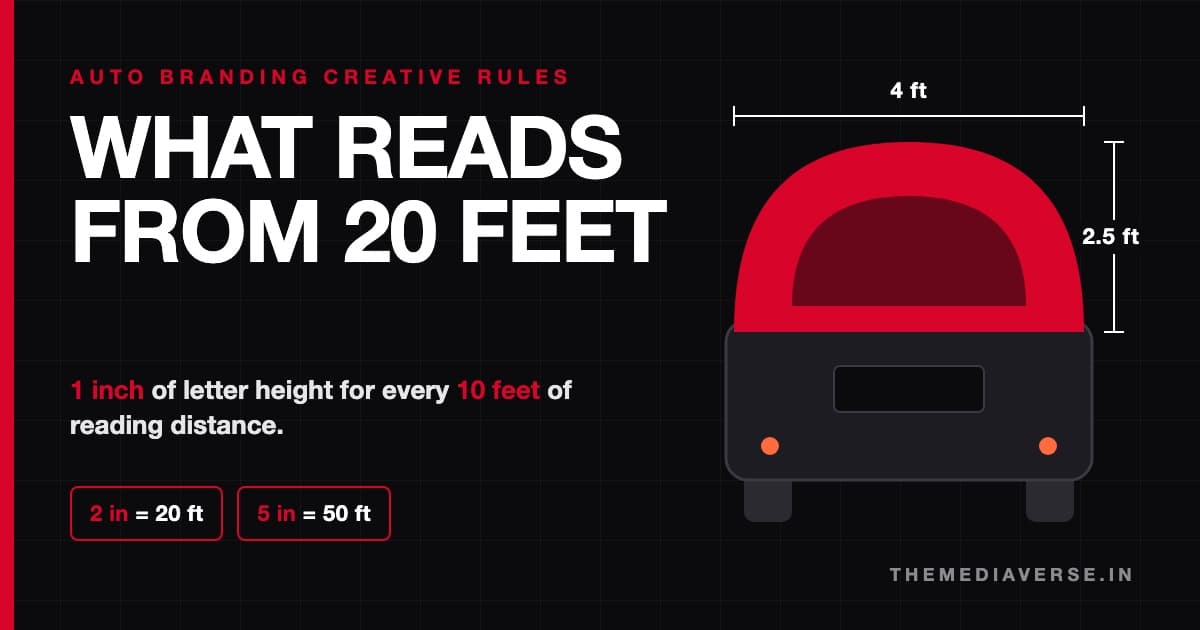
Auto branding creative rules: what actually reads from 20 feet at a signal (2026 playbook)
An auto hood is 4 ft by 2.5 ft and reads at roughly 1 inch of letter height per 10 feet. Eight creative rules ranked by what a reprint on 300 autos costs, plus the paper test to run before the print run.
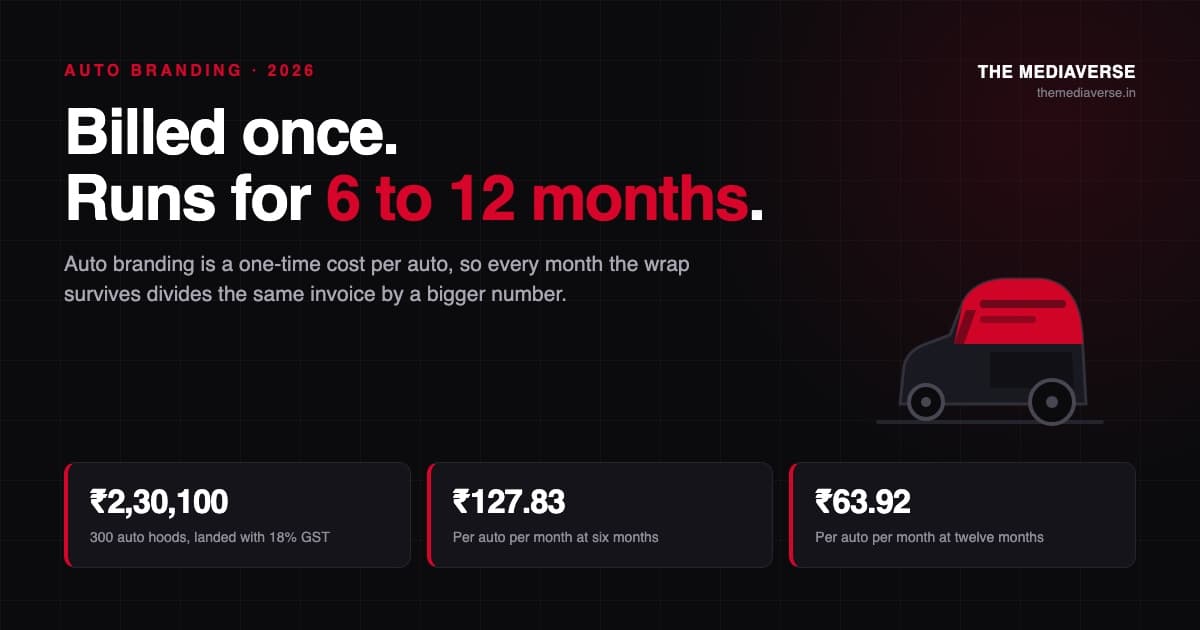
How long should an auto branding campaign run? The material-life math for 2026
Auto branding is billed once per auto, and the published vinyl life is 6 to 12 months. A 300-hood fleet at ₹2,30,100 landed is ₹767 per auto for one month and ₹127.83 per auto per month at six. The full arithmetic, and what really ends a campaign.