

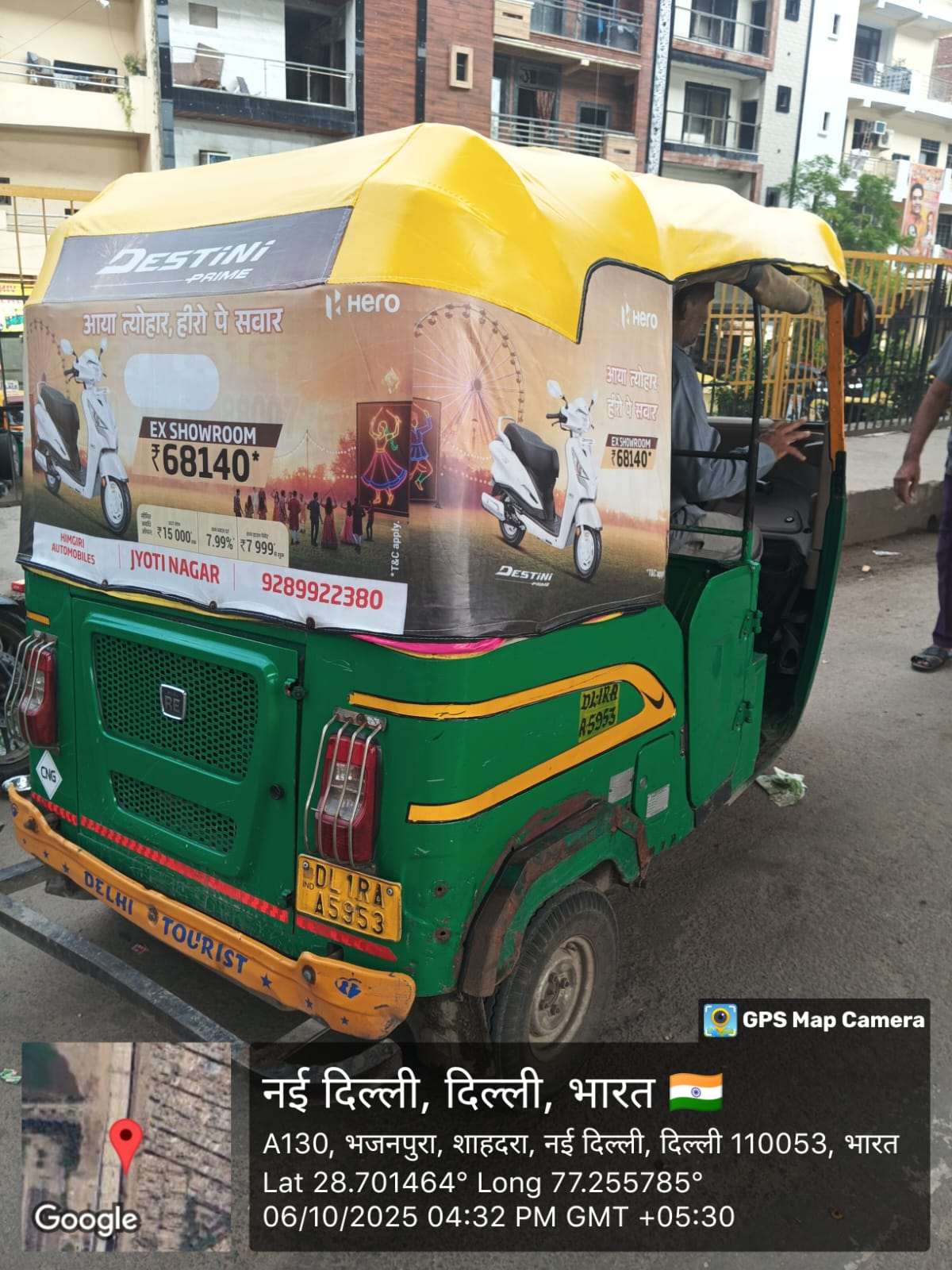
On a Navratri evening, SG Highway turns into a river of CNG autos ferrying families in their finest chaniya cholis toward the garba grounds. Look closely and the autos are carrying two payloads: the passengers inside, and the brand messages wrapped across their hoods. For nine nights, Ahmedabad's auto fleet becomes the most-watched moving billboard in Gujarat, threading through the exact crowds at the exact moment they are spending. That scene is the single best argument for auto branding in this city, but the economics work year-round too. Here are the numbers first. Full hood branding costs ₹500 to ₹600 per auto per month, among the most economical rates of any major Indian city, with back-panel stickers ₹140 to ₹170 and a full wrap ₹1,900 to ₹2,300, all inclusive of design, printing, installation, and maintenance. Ahmedabad has approximately 1.2 lakh registered CNG auto-rickshaws, one of the largest fleets in western India. A single branded auto generates an estimated 28,000 to 42,000 daily impressions at a cost-per-thousand of roughly ₹4 to ₹7. Two things make this city distinctive: Gujarat is a dry state with stricter content rules, and Navratri is the highest-ROI window of the year. This guide covers the rates, the zones, the rules, the festival timing, and the campaign math for 2026.
Ahmedabad auto branding at a glance: the key facts
Seven facts anchor an Ahmedabad auto branding plan in 2026. Fleet size: approximately 1.2 lakh registered CNG auto-rickshaws across the AMC and Gandhinagar belt. Hood branding rate: ₹500 to ₹600 per auto per month (among the lowest of any major city). Back-panel rate: ₹140 to ₹170 per auto per month. Full-wrap rate: ₹1,900 to ₹2,300 per auto per month. Daily impressions per auto: 28,000 to 42,000. Cost-per-thousand impressions: ₹4 to ₹7. Peak season: Navratri (nine nights), the single largest consumer-spending and auto branding ROI window of the year, carrying a 15 to 25 percent rate premium. Those numbers make Ahmedabad one of the best-value and most seasonally-driven auto markets in India.
Fleet size and the reach math
Ahmedabad's approximately 1.2 lakh auto-rickshaws are almost entirely CNG-powered and function as the dominant intermediate public transport across the city, feeding the BRTS (Janmarg) and metro corridors and covering the residential and commercial gaps the rapid-transit network leaves. For an advertiser, the large fleet plus the low rates is the core of the value proposition: you can put a meaningful number of branded autos on the road for a modest budget and still achieve real frequency in your target zones.
The reach math: an Ahmedabad auto covers 70 to 110 km a day across its working routes, and at an estimated 320 to 440 viewers per kilometre in the city's wide, busy arterial traffic, that yields 28,000 to 42,000 daily impressions per auto. The figure is an estimate from route density and traffic exposure, consistent across The Mediaverse Ahmedabad field data spanning 81 campaigns. A focused 60-auto hood campaign concentrated in two or three zones therefore delivers an estimated 1.7 to 2.5 million daily impressions, at a monthly cost of roughly ₹30,000 to ₹36,000. No other outdoor format in Ahmedabad delivers that impression volume at that price.
The strategic choice is concentration versus spread. For a citywide brand or an FMCG launch, spread the fleet across the major zones for broad reach. For a local business, a clinic, a store, or a coaching centre, concentrate the fleet in the two or three zones that match your catchment so the same autos build repeat-exposure frequency with your target audience. Frequency, not just reach, is what drives recall and walk-ins.
The Ahmedabad zone map
SG Highway, Bodakdev, Thaltej, Prahlad Nagar: premium and corporate
The SG Highway spine plus Bodakdev, Thaltej, and Prahlad Nagar is Ahmedabad's premium, corporate, and IT belt, lined with corporate offices, malls, premium retail, restaurants, and HNI residences. Hood rate ₹550 to ₹600. Best for real estate, automobiles, financial services, premium healthcare, hospitality, lifestyle brands, and B2B. This is the one Ahmedabad belt where bilingual Gujarati-English artwork performs comparably to Gujarati-primary, reflecting the corporate and out-of-state professional audience.
CG Road and Navrangpura: the central commercial core
CG Road and Navrangpura form the central commercial and retail core, with the city's established shopping streets, showrooms, restaurants, and offices. Hood rate ₹520 to ₹580. Best for retail, fashion and apparel, jewellery, eateries, consumer electronics, and offer-led campaigns. Gujarati-primary creative converts strongly here. A branded fleet on the CG Road corridor reaches the dense central-Ahmedabad shopping and office audience.
Maninagar and the east: mass-market and trading
Maninagar and the eastern belt cover the dense mass-market, trading, and coaching audience, one of the most populous parts of the city. Hood rate ₹500 to ₹550, economical. Best for value retail, coaching and education, family healthcare, household categories, FMCG, and political campaigns. Gujarati-primary creative is essential here. The east-Ahmedabad zones reach a high-density mass audience that responds strongly to vernacular, value-led messaging.
Vastrapur, Satellite, Naranpura: premium residential
Vastrapur, Satellite, and Naranpura are premium-to-mid residential zones with family households, schools, and neighbourhood retail. Hood rate ₹520 to ₹580. Best for schools and coaching, family healthcare, household appliances, apparel, restaurants, and real estate. These family-decision categories respond well to Gujarati-primary creative routed through the residential streets where the autos do last-mile pickups.
Bopal, Chandkheda, Gota, and the walled city: emerging and traditional
The emerging residential belts (Bopal, South Bopal, Chandkheda, Gota, Vejalpur) are fast-growing family zones ideal for real estate, schools, and household categories at ₹500 to ₹550 hood rates. Separately, the walled city and old-Ahmedabad textile and diamond-trade zones reach a traditional B2B and trading audience for textile, jewellery, and wholesale categories, where deeply Gujarati-rooted creative is non-negotiable. Choose between emerging-residential reach and traditional-trade targeting based on your category.
Ahmedabad auto branding zone rates (2026)
| Zone | Hood rate (per auto per month) | Best for | |
|---|---|---|---|
| SG Highway, Bodakdev, Thaltej, Prahlad Nagar | ₹550 to ₹600 | Real estate, financial services, premium healthcare, B2B | |
| CG Road and Navrangpura | ₹520 to ₹580 | Retail, fashion, jewellery, offer-led campaigns | |
| Maninagar and the east | ₹500 to ₹550 | Value retail, coaching, FMCG, family healthcare | |
| Vastrapur, Satellite, Naranpura | ₹520 to ₹580 | Schools, family healthcare, appliances, real estate | |
| Bopal, Chandkheda, Gota | ₹500 to ₹550 | Real estate, schools, household categories |
Back panels ₹140 to ₹170 and full wraps ₹1,900 to ₹2,300 per auto per month across all zones.
Which format wins in Ahmedabad: hood, panel, or wrap?
Back-panel stickers at ₹140 to ₹170 per auto per month are the entry format for single-message awareness, app installs, and offer codes, the right pick for maximising fleet size on a fixed budget. Full hood branding at ₹500 to ₹600 offers the best visibility-to-cost balance with a roughly 270-degree viewing envelope, the default for most Ahmedabad campaigns and the format that performs best during Navratri crowds. Full-body wrap at ₹1,900 to ₹2,300 maximises brand-world impact for launches and premium positioning on the SG Highway belt. For most advertisers, hood is the workhorse; add a back-panel layer to widen the fleet for festival windows.
Ahmedabad's climate factor is extreme summer heat, with 45 degrees Celsius peaks and intense UV that accelerate adhesive failure and ink fade on cheap vinyl. The Mediaverse durability audit found 4 mil hot-laminate hood vinyl held under 9 percent mid-campaign damage versus 22 to 28 percent for cheap cold-laminate. In Ahmedabad's heat, the vinyl grade is critical. Confirm the vinyl mil thickness, heat-rated lamination, UV-stable inks, and a free-replacement clause in writing.
The dry-state rules and the Gujarati-language imperative
Two Ahmedabad-specific rules shape every campaign. First, Gujarat is a dry state under prohibition, so any alcohol, liquor, or surrogate liquor advertising is prohibited on autos, and content is screened more strictly than in other states. Brands in adjacent categories (clubs, party venues, certain beverages) should clear creative early to avoid rejection. Second, Gujarati-language artwork is one of the biggest drivers of performance: Gujarati-primary creative converts significantly better across CG Road, Maninagar, Naranpura, Vastrapur, and the walled-city zones, with only the SG Highway corporate-IT belt performing comparably on bilingual Gujarati-English. Running a single English citywide creative under-converts across almost every zone.
The standard rules also apply. Auto advertising in Ahmedabad is legal subject to driver and vehicle-owner consent, Gujarat RTO vehicle compliance, and AMC content norms. Branding must not obscure the registration plate, permit, fare details, or driver visibility. Political content is restricted within 14 days of any election under ECI rules. There is no state rate ceiling, so rates reflect operator cost drivers and seasonal demand, not regulation. The practical takeaway: commission Gujarati-first creative from a local Ahmedabad designer and pre-clear any category that brushes against the dry-state rules.
Navratri and the seasonality of Ahmedabad auto branding
Navratri is the defining seasonal feature of advertising in Ahmedabad. The nine nights of garba draw the entire city out in the evenings, concentrate the largest consumer-spending of the year (apparel, jewellery, food, vehicles, electronics), and create dense, predictable crowd clusters around the garba grounds and the shopping streets. The Mediaverse field data confirms Navratri-window campaigns deliver the highest recall and walk-in attribution per rupee of any window in the year. The play: route a branded fleet on the garba-ground approach roads and the festival shopping corridors during the nine nights, with evening-weighted routing to match when the crowds are out. Book early, because Navratri-window rates run 15 to 25 percent higher on tight inventory. Beyond Navratri, the Diwali and wedding-season windows (October to December) and Uttarayan (the January kite festival) are secondary spikes worth timing around.
ROI and measurement
Auto branding in Ahmedabad delivers a ₹4 to ₹7 cost-per-thousand impressions, among the lowest of any outdoor format in any Indian metro. Measure outcomes with a unique phone or missed-call number, a QR code with UTM tracking, and a unique offer code redeemed in store, and run a 7-day pre-campaign baseline so you can attribute the lift. Where auto branding wins in Ahmedabad: festival-timed retail (apparel, jewellery, electronics) around Navratri and Diwali, real estate on the SG Highway and emerging-residential belts, coaching and education in Maninagar and the residential zones, healthcare, and FMCG, all with Gujarati-led creative. Where it underperforms: alcohol and any prohibition-restricted category, ultra-premium luxury, pure-digital D2C with no local fulfilment, and any campaign that insists on English-only artwork.
A 2026 Ahmedabad auto branding campaign playbook
A regional apparel and ethnic-wear brand wants to own the Navratri shopping window in Ahmedabad. Budget ₹1.8 lakh for a 35-day campaign across the festival run-up and the nine nights. Step one, zones and format: concentrate on CG Road and Maninagar for mass-market shoppers plus the SG Highway-Vastrapur belt for premium buyers, hood format for maximum festival-crowd visibility. Step two, fleet size: at a Navratri-premium ₹680 per auto per month, ₹1.8 lakh over 35 days buys roughly 240 auto-months, or about 110 autos for the window after design and tracking, so split roughly 60 autos across CG Road and Maninagar and 50 across SG Highway and Vastrapur. Step three, message: brand name, Navratri-collection hook, nearest store address, and a phone number, in Gujarati-primary (bilingual on the SG Highway autos). Step four, routing: evening-weighted on the garba-ground approach roads and shopping corridors through the nine nights. Step five, measurement: unique phone number plus a Navratri-collection offer code redeemed in store, with a pre-festival baseline. A 110-auto fleet timed to Navratri reaches the city at its single highest buying-intent moment, the kind of timing that no static hoarding can match.
What does 2026 hold for Ahmedabad auto campaigns?
Auto rickshaw branding is among the most economical outdoor formats in Ahmedabad and one of the best-value auto markets in India, backed by a 1.2 lakh fleet and ₹4 to ₹7 cost-per-thousand impressions. Two disciplines define a winning campaign here. First, time it to Navratri: the nine nights are the single largest consumer-spending and highest-ROI auto branding window of the year, so book early and route a fleet on the garba-ground and shopping corridors. Second, go Gujarati-first and clear the dry-state rules: Gujarati-primary creative out-converts English across almost every zone, bilingual works only on the SG Highway corporate belt, and alcohol or surrogate content is prohibited. Match your zones to your audience, insist on heat-rated 4 mil hot-laminate vinyl for the 45-degree summers, and measure with a phone line plus an offer code against a baseline. With those disciplines, Ahmedabad auto branding outperforms digital display on cost-per-walk-in for festival retail, real estate, education, and local business.
When is the best time for auto branding in Ahmedabad?
Navratri is the single best window. The nine nights of garba draw the whole city out in the evenings and concentrate the largest consumer-spending of the year across apparel, jewellery, food, electronics, and vehicles, so a branded fleet routed on the garba-ground and shopping corridors captures peak buying intent. The Mediaverse field data shows Navratri-window campaigns deliver the highest recall and walk-in attribution per rupee of any window in the year. Book early because Navratri rates run 15 to 25 percent higher on tight inventory. Diwali and the wedding season (October to December) and Uttarayan in January are secondary spikes worth timing around.
Are there special advertising rules in Ahmedabad because Gujarat is a dry state?
Yes. Gujarat is under prohibition, so any alcohol, liquor, or surrogate liquor advertising is prohibited on autos, and content is screened more strictly than in other states. Brands in adjacent categories should clear creative early to avoid rejection. Beyond that, the standard rules apply: driver and vehicle-owner consent, Gujarat RTO compliance, AMC content norms, no obstruction of the registration plate or fare details, and a 14-day pre-election restriction on political content. Working with a local agency that knows the AMC and dry-state screening avoids delays.
How many autos do I need for an effective Ahmedabad campaign?
For a focused local campaign concentrated in two or three zones, 50 to 80 hood autos build measurable frequency in your catchment. For a citywide brand or FMCG launch, 150 to 300 autos spread across the major zones. For a Navratri push, scale up and book early because inventory tightens and rates rise 15 to 25 percent. The key is concentration for local businesses: a fleet focused in the zones that match your audience builds the repeat-exposure frequency that drives recall and walk-ins, which a thin citywide spread cannot.
Tags
Quick Answers
How much does auto rickshaw branding cost in Ahmedabad in 2026?
Full hood branding costs ₹500 to ₹600 per auto per month in Ahmedabad, among the most economical rates of any major Indian city. Back-panel vinyl stickers cost ₹140 to ₹170 per auto per month. A full-body wrap costs ₹1,900 to ₹2,300 per auto per month. All rates include design, printing, installation, and monthly maintenance. Volume discounts apply at 50 plus autos (around 10 percent) and 250 plus autos (around 20 percent). A 60-auto hood campaign for 30 days lands at roughly ₹30,000 to ₹36,000 before GST. Navratri-window rates run 15 to 25 percent higher because demand spikes.
How many auto rickshaws are there in Ahmedabad?
Ahmedabad has approximately 1.2 lakh registered auto-rickshaws across the Ahmedabad Municipal Corporation area and the Gandhinagar belt, one of the largest auto fleets in western India. The fleet is almost entirely CNG-powered. Autos are the dominant intermediate-public-transport mode feeding the BRTS (Janmarg) and metro corridors, covering the gaps the rapid-transit network leaves across the residential and commercial belts. The large fleet and low rates make Ahmedabad one of the best-value auto branding markets in India for citywide and zone-focused campaigns.
Is auto rickshaw advertising worth it in Ahmedabad?
Yes. Auto branding in Ahmedabad delivers an estimated cost-per-thousand impressions of ₹4 to ₹7, among the lowest of any outdoor format in any Indian metro, because of the large fleet and low absolute rates. It is especially worth it for festival-timed campaigns: Navratri creates the single largest consumer-spending window of the year, and a branded fleet on the garba-ground and shopping routes during the nine nights captures attention at peak buying intent. For local retail, jewellery, apparel, real estate, healthcare, and education, Ahmedabad auto branding consistently outperforms digital display on cost-per-walk-in when the artwork is Gujarati-led.
Which Ahmedabad areas are best for auto rickshaw branding?
Match the zone to your audience. SG Highway, Bodakdev, Thaltej, and Prahlad Nagar for premium, corporate, IT, and HNI audiences. CG Road and Navrangpura for the central commercial and retail core. Maninagar for the dense mass-market, trading, and coaching audience on the east. Vastrapur and Satellite for premium residential families. Naranpura, Bopal, Chandkheda, and Gota for the large residential belts. The walled-city and old-Ahmedabad textile and diamond-trade zones for traditional B2B. Concentrate the fleet in two or three zones that match your catchment for measurable frequency.
What are the rules for auto advertising in Gujarat, and do I need Gujarati artwork?
Two Ahmedabad-specific rules matter. First, Gujarat is a dry state, so any alcohol, liquor, or surrogate liquor advertising is prohibited on autos, and content is screened more strictly than in other states. Second, Gujarati-language artwork converts significantly better across almost every Ahmedabad zone, reflecting the city's strong Gujarati commercial culture, with only the SG Highway corporate-IT belt performing comparably on bilingual Gujarati-English. Standard rules also apply: driver and owner consent, no obstruction of the registration plate or fare details, and a 14-day pre-election political content restriction. Commission Gujarati-first creative from a local designer.
Looking for professional Auto Branding services?
The Mediaverse runs end-to-end auto branding campaigns across India with geo-tagged delivery and transparent, all-inclusive pricing.
Explore our Auto Branding solutionsSummarize this guide with AI
Open this article in your favourite AI assistant
Related Guides
Written by

The Mediaverse Team
India's Leading Outdoor Advertising Agency
The Mediaverse is a national-level outdoor advertising and integrated marketing organization that provides complete OOH, ATL, BTL, retail, and transit media solutions across India. With years of experience executing high-performance campaigns for brands in FMCG, Real Estate, E-commerce, EdTech, Automotive, Healthcare, and Retail, The Mediaverse combines creativity, data-driven media planning, and flawless on-ground execution. As a full-stack outdoor advertising provider, The Mediaverse offers Auto Branding, Mobile Van Branding, Newspaper Insertion Advertising, Shop Name Board Branding, In-Store Branding, Hoardings, Transit Media, Kiosks, Mall Media, Activations, and all forms of Below-The-Line marketing. Known for its pan-India network, strategic route planning, premium print quality, and Cheqmate™ GPS-based verification, The Mediaverse ensures 100% transparent and result-oriented campaign delivery. The Mediaverse’s editorial team produces deeply researched, SEO-optimized, and generative-engine-friendly content to help businesses understand the power of outdoor advertising and make informed decisions that maximize brand visibility and ROI across urban, suburban, and rural markets.
Related Articles
Auto Branding for Restaurant and Cloud Kitchen Launches: The Delivery-Radius Zone Playbook (2026)
Auto branding is priced and deployed by zone, which makes it the outdoor format that can be pointed at a restaurant or cloud kitchen's own delivery radius. Published rates, worked launch-campaign totals, and a five-step zone mapping process.
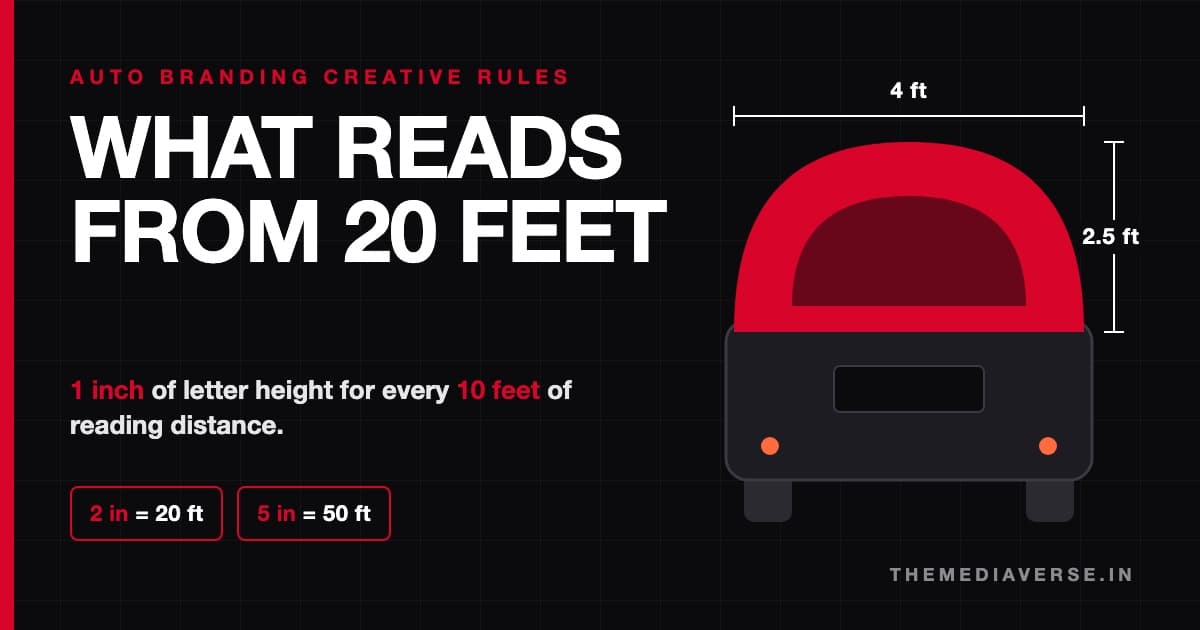
Auto branding creative rules: what actually reads from 20 feet at a signal (2026 playbook)
An auto hood is 4 ft by 2.5 ft and reads at roughly 1 inch of letter height per 10 feet. Eight creative rules ranked by what a reprint on 300 autos costs, plus the paper test to run before the print run.
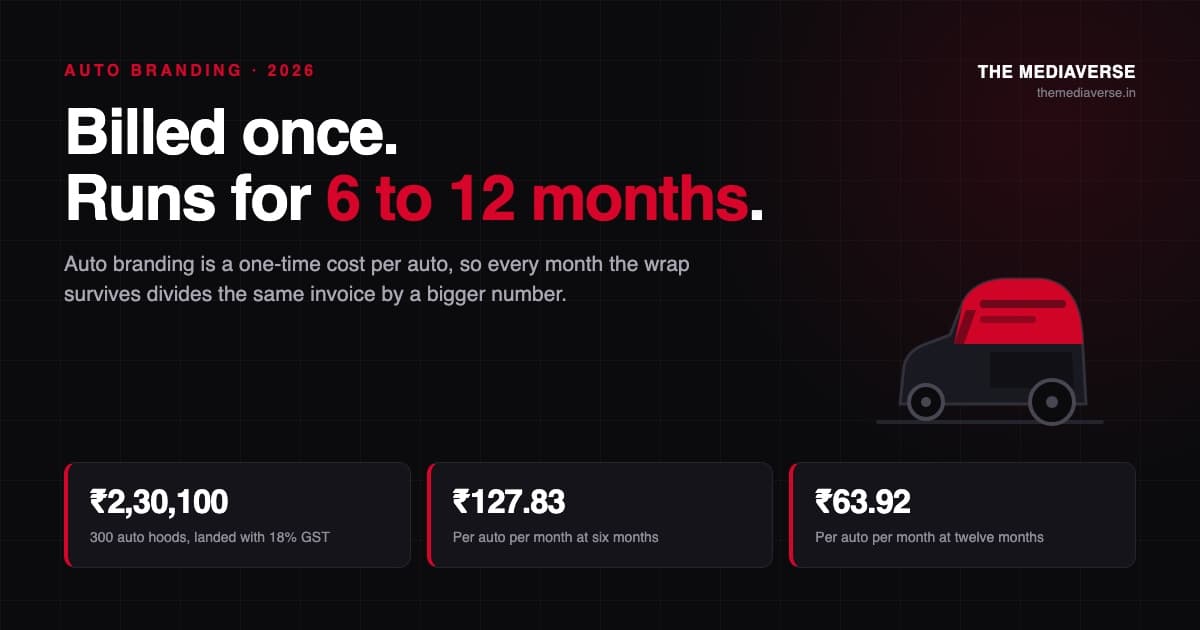
How long should an auto branding campaign run? The material-life math for 2026
Auto branding is billed once per auto, and the published vinyl life is 6 to 12 months. A 300-hood fleet at ₹2,30,100 landed is ₹767 per auto for one month and ₹127.83 per auto per month at six. The full arithmetic, and what really ends a campaign.