

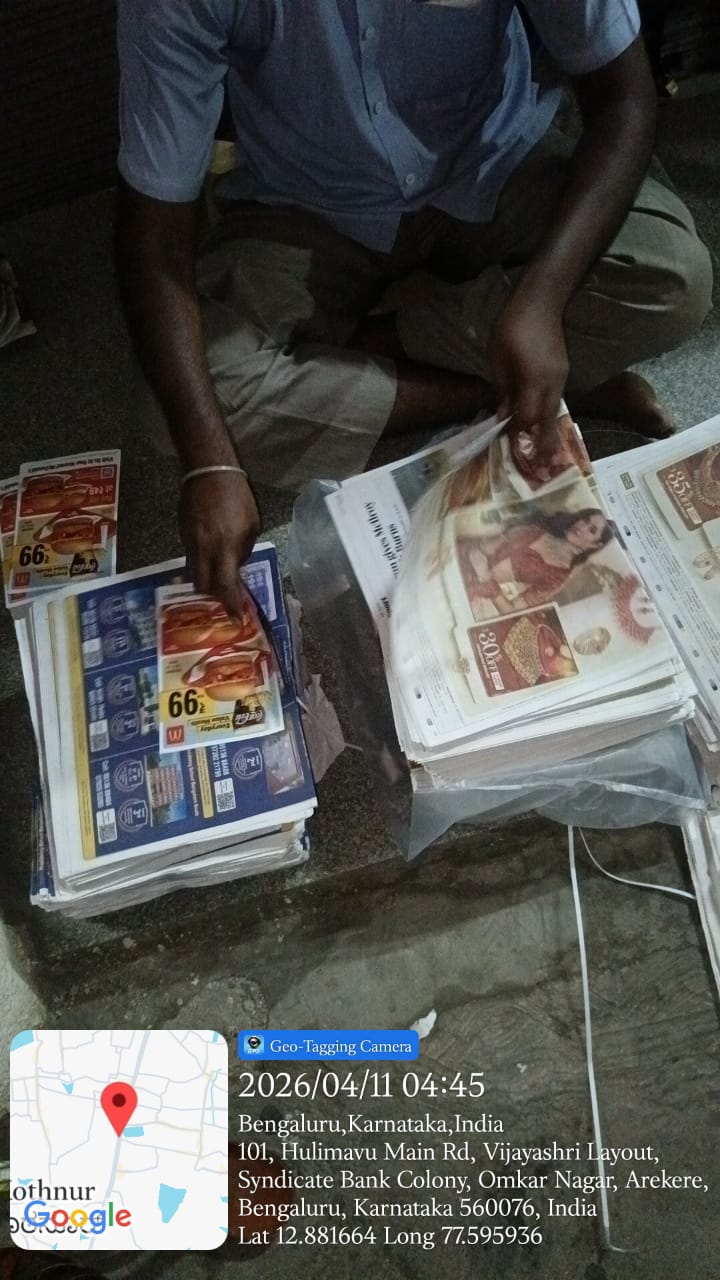
The standard published Bangalore newspaper insertion rates are size-tiered. A2 size (the most-quoted) is ₹1.9 per pamphlet. A4 is ₹1.5. A5 is ₹1.2. We quote those numbers. Our competitors quote them. Most rate cards in the city show this breakdown on the first page. The reason I am writing this post is that each headline rate per size is true and incomplete at the same time, and brands new to Bangalore insertion regularly book on the headline number, then write angry mails three weeks later when the final invoice lands 35 to 45 percent above the booking estimate.
The angry mail is fair. The booking estimate is also fair. Both are right because the ₹1.9 number describes one of five line items. The other four are real costs nobody hides exactly, but nobody volunteers either. This post lays them out.
What the ₹1.9 actually covers
₹1.9 (A2), ₹1.5 (A4), and ₹1.2 (A5) are the distribution rates. They pay for the carrier network that physically inserts your pamphlet into a copy of Times of India, Deccan Herald, The Hindu, Bangalore Mirror, or another title and delivers it on the morning round. Each rate includes the depot handling, the carrier payout (roughly 70 to 90 paise on A2, 55 to 70 paise on A4, 40 to 55 paise on A5), and a small agency margin. None of the three sizes bundles printing, GST, wastage, or any premium positioning surcharge.
The four line items that turn ₹1.9 into ₹2.5
1. Printing
A 4-colour offset pamphlet printed on 70 to 80 GSM matt paper at 50,000 quantity runs roughly ₹0.35 to ₹0.55 per pamphlet in Bangalore. Drop to 60 GSM and the cost falls to around ₹0.28. Push to 90 GSM gloss with spot UV and the cost climbs to ₹0.7 plus. Most agencies do not bundle print into the ₹1.9 because the print spec changes per brand and the print job often goes to a different vendor than the distributor. Get the print quote in writing before you compare two distribution proposals.
2. GST
Distribution invoices in Bangalore attract 18 percent GST. ₹1.9 grossed up is ₹2.24. Print services at the offset press attract 12 to 18 percent depending on substrate and treatment. None of this is hidden. All of this gets left out of casual rate-card conversations where the agency says "Bangalore insertion is ₹1.9" without specifying that the number is pre-tax.
3. Wastage allowance
Reputable distributors carry a 4 to 6 percent wastage line for misdrop, damaged copies, and edition mismatches. On a 50,000 print run, this means you print 52,000 to 53,000 pamphlets but pay distribution on the 50,000 contracted quantity. The extra 2,000 to 3,000 pamphlets are absorbed in the printing line, not the distribution line. Vendors who do not budget wastage will deliver fewer copies than contracted and will not refund you for the gap unless you can prove it. We have audited this on five Bangalore campaigns in 2025 and the average delivery shortfall on no-wastage proposals was 6.2 percent.
4. Day-of-week and edition surcharges
Sunday inserts attract a 15 to 25 percent surcharge over the weekday ₹1.9. Sunday open rates are higher and carrier capacity is tighter on weekends, so the floor moves up. Kannada-edition inserts in Vijaya Karnataka or Prajavani run 5 to 10 percent above the English weekday rate. Premium positioning (front-fold rather than back-fold of the paper, or a single-pamphlet drop rather than a bundled drop with three other inserts) adds another 10 to 18 percent. None of these surcharges show up on a default rate card. They appear when the brief says "Sunday only" or "Kannada edition only" and the buyer assumes the ₹1.9 still applies.
The five line items every Bangalore insertion proposal should show
- Distribution rate per pamphlet, with the title and edition specified.
- Print rate per pamphlet, with paper GSM, ink (4-colour or 1-colour), and treatment.
- GST line, applied to distribution and print separately.
- Wastage allowance as a percentage of contracted quantity, with a stated proof requirement (e.g., depot photo + delivery report).
- Day-of-week and edition surcharge, broken out per insert day.
What honest looks like
If you book 50,000 weekday A2 inserts in Times of India Bangalore at ₹1.9 distribution, plus ₹0.45 print, plus 18 percent GST on both, plus a 5 percent wastage line, the landed cost lands at roughly ₹2.55 per pamphlet, or ₹1.27 lakh for the run. The same 50,000 in A4 lands closer to ₹2.05 per pamphlet (₹1.02 lakh) because the distribution rate is ₹1.5 and print drops to roughly ₹0.30 on smaller paper. A5 lands at ₹1.65 per pamphlet (₹82,500). ₹1.27 lakh, ₹1.02 lakh, and ₹82,500 are the honest numbers for A2, A4, A5. The ₹95,000 brochure number (50,000 multiplied by ₹1.9 A2 distribution) is the headline. The gap is not slack. It is the four line items above, all real, all standard.
Headline rate vs honest landed cost (50,000 weekday ToI inserts)
| Distribution rate | Landed cost per pamphlet | Total for 50,000 | |
|---|---|---|---|
| A2 | ₹1.9 | About ₹2.55 | ₹1.27 lakh |
| A4 | ₹1.5 | About ₹2.05 | ₹1.02 lakh |
| A5 | ₹1.2 | About ₹1.65 | ₹82,500 |
Landed cost includes print, 18 percent GST on distribution and print, and a 5 percent wastage line.
We do not believe in surprising clients with the gap on the final invoice. So we put all five line items on the proposal at booking. Anyone who asks us for ₹1.9 flat with no breakdown is told the same thing in writing: ₹1.9 is real, but ₹1.9 alone is not the campaign cost. If they prefer a different vendor's flat number, we wish them well and warn them about delivery shortfall.
Disagree?
If you have run a Bangalore insertion campaign at sub ₹2.4 landed cost with photo proof of full distribution, send me the proposal. I will publish the rebuttal here. Most cheap-on-paper insertion proposals fail audit on wastage delivery, and that is the line item I most want to be wrong about.
What does ₹1.9 per A2 pamphlet actually buy in Bangalore?
₹1.9 is the A2-size distribution rate. At ₹1.9 you typically get an A2 pamphlet inserted into the named title for one weekday at standard distribution, with vendor-chosen single-bay handling. A4 (₹1.5) buys the same service in a smaller format, and A5 (₹1.2) the smallest. None of the three rates bundles audit photos, replacement of damaged copies, or premium positioning. For 4-colour print, geographic spread across BBMP zones, and a written wastage allowance, expect ₹0.50 to ₹0.70 added to the per-pamphlet rate at any size.
How many A2, A4, or A5 pamphlets does ₹2 lakh cover in Bangalore?
At our ₹1.9 A2 rate including printing and a 5 percent wastage allowance, ₹2 lakh covers around 78,000 A2 pamphlets, 96,000 A4 pamphlets at ₹2.05 landed, or 1.2 lakh A5 pamphlets at ₹1.65 landed. Smaller pamphlets cover wider audience reach for the same budget but carry less creative real estate. Most Bangalore SMEs default to A4 because the ₹1.5 distribution rate covers a 50 percent wider audience reach against A2 and the print cost drops alongside. A5 is the right call for very-budget-tight launches and short-message offers (coupon, discount code).
Why is Sunday insertion in Bangalore more expensive than Wednesday at every pamphlet size?
The gap structure is the same at all sizes. Sunday inserts attract a 15 to 25 percent surcharge over the weekday floor at A2 (₹1.9 to ₹2.20-2.40), A4 (₹1.5 to ₹1.75-1.90), and A5 (₹1.2 to ₹1.40-1.50). Carrier capacity on Sundays is tighter regardless of size, so the surcharge applies uniformly. Kannada-edition inserts in Vijaya Karnataka or Prajavani run 5 to 10 percent above the English weekday rate at every size.
Quick reference: Bangalore insertion rates by pamphlet size
If you are scoping a campaign, here is the headline rate card we use across all four major Bangalore dailies for standard weekday distribution. Add print, GST, wastage, and any Sunday or Kannada-edition surcharge as separate line items on top.
- A2 (roughly 16 inches by 23 inches): ₹1.9 per pamphlet distribution, dropping to ₹1.65-1.75 at 1 lakh-plus monthly volume. Best for premium retail, real estate, and full-creative campaigns.
- A4 (roughly 8 inches by 11 inches): ₹1.5 per pamphlet distribution, dropping to ₹1.30-1.40 at 1 lakh-plus volume. The Bangalore SME default. Wider reach for the same budget against A2; print costs drop to roughly ₹0.30 on 70 GSM.
- A5 (roughly 6 inches by 8 inches): ₹1.2 per pamphlet distribution, dropping to ₹1.05-1.15 at 1 lakh-plus volume. Best for short-message campaigns, coupon codes, restaurant menu drops, and very budget-tight launches.
Pick size by message length and audience reach goal. A2 is paying for creative real estate; A5 is paying for reach. A4 is the working compromise that most Bangalore SME campaigns settle on. The line items above (print, GST, wastage, Sunday/Kannada surcharge) apply identically to all three sizes.
Tags
Quick Answers
What does newspaper insertion cost in Bangalore in 2026?
Distribution rates are size-tiered: A2 starts at ₹1.9 per pamphlet, A4 at ₹1.5, A5 at ₹1.2 for standard weekday inserts in major Bangalore dailies. The landed cost on A2 runs ₹2.4 to ₹2.7 once you add 4-colour offset printing (₹0.35 to ₹0.55 per pamphlet for 50,000 quantity), GST at 18 percent on the distribution invoice, a 4 to 6 percent wastage allowance, and Sunday or vernacular-edition surcharges if applicable. A4 lands around ₹1.95 to ₹2.20 and A5 around ₹1.55 to ₹1.75 on the same line items.
Is the rate negotiable in Bangalore at any pamphlet size?
Yes, with size-specific floors. The A2 rate of ₹1.9 moves down to roughly ₹1.65 to ₹1.75 at 1 lakh-plus monthly volumes booked through a single agency. A4 (₹1.5) compresses to ₹1.30 to ₹1.40 at the same volumes, and A5 (₹1.2) to ₹1.05 to ₹1.15. Each size has a carrier-side payout floor (roughly 70 to 90 paise on A2, 55 to 70 paise on A4, 40 to 55 paise on A5), and rates below those floors usually mean the vendor plans to under-distribute or substitute weekday for Sunday.
Should a Bangalore brand pay extra for Sunday and Kannada-edition inserts?
Sunday inserts in Bangalore typically attract a 15 to 25 percent surcharge over the weekday floor at every size (A2, A4, A5) because Sunday open rates are higher and carrier capacity is constrained by weekend staffing. Kannada-edition inserts in Vijaya Karnataka or Prajavani also run 5 to 10 percent above the English weekday rate at all sizes due to lower per-edition print run economics. Pay the surcharge when audience-fit justifies it; reject blanket Sunday-only campaigns that ignore the math.
Looking for professional Newspaper Insertion services?
The Mediaverse runs end-to-end newspaper insertion campaigns across India with geo-tagged delivery and transparent, all-inclusive pricing.
Explore our Newspaper Insertion solutionsSummarize this guide with AI
Open this article in your favourite AI assistant
Related Guides
Written by

The Mediaverse Team
India's Leading Outdoor Advertising Agency
The Mediaverse is a national-level outdoor advertising and integrated marketing organization that provides complete OOH, ATL, BTL, retail, and transit media solutions across India. With years of experience executing high-performance campaigns for brands in FMCG, Real Estate, E-commerce, EdTech, Automotive, Healthcare, and Retail, The Mediaverse combines creativity, data-driven media planning, and flawless on-ground execution. As a full-stack outdoor advertising provider, The Mediaverse offers Auto Branding, Mobile Van Branding, Newspaper Insertion Advertising, Shop Name Board Branding, In-Store Branding, Hoardings, Transit Media, Kiosks, Mall Media, Activations, and all forms of Below-The-Line marketing. Known for its pan-India network, strategic route planning, premium print quality, and Cheqmate™ GPS-based verification, The Mediaverse ensures 100% transparent and result-oriented campaign delivery. The Mediaverse’s editorial team produces deeply researched, SEO-optimized, and generative-engine-friendly content to help businesses understand the power of outdoor advertising and make informed decisions that maximize brand visibility and ROI across urban, suburban, and rural markets.
Related Articles
Newspaper Inserts vs WhatsApp and SMS Blasts for Local Reach (2026)
The two channels are not competing for the same rupee. Published insert rates at Rs.1.25, Rs.1.70 and Rs.2.20 per copy, the Rs.1,475 per thousand benchmark, the per-message price where a blast wins, and the reach ceiling that decides it for most businesses.

How to plan a newspaper insertion campaign in India: the 2026 step-by-step guide
What does newspaper insertion cost, how precise is the targeting, and how do you run a campaign? The complete 2026 guide to newspaper insertion in India, from pincode targeting to measurement.
Print inserts or digital ads for a local business: the 2026 budget-split decision guide
Is newspaper insertion still worth it against digital ads in 2026? A decision guide with a spec table, when each wins, how to combine them, and a checklist for local businesses.