

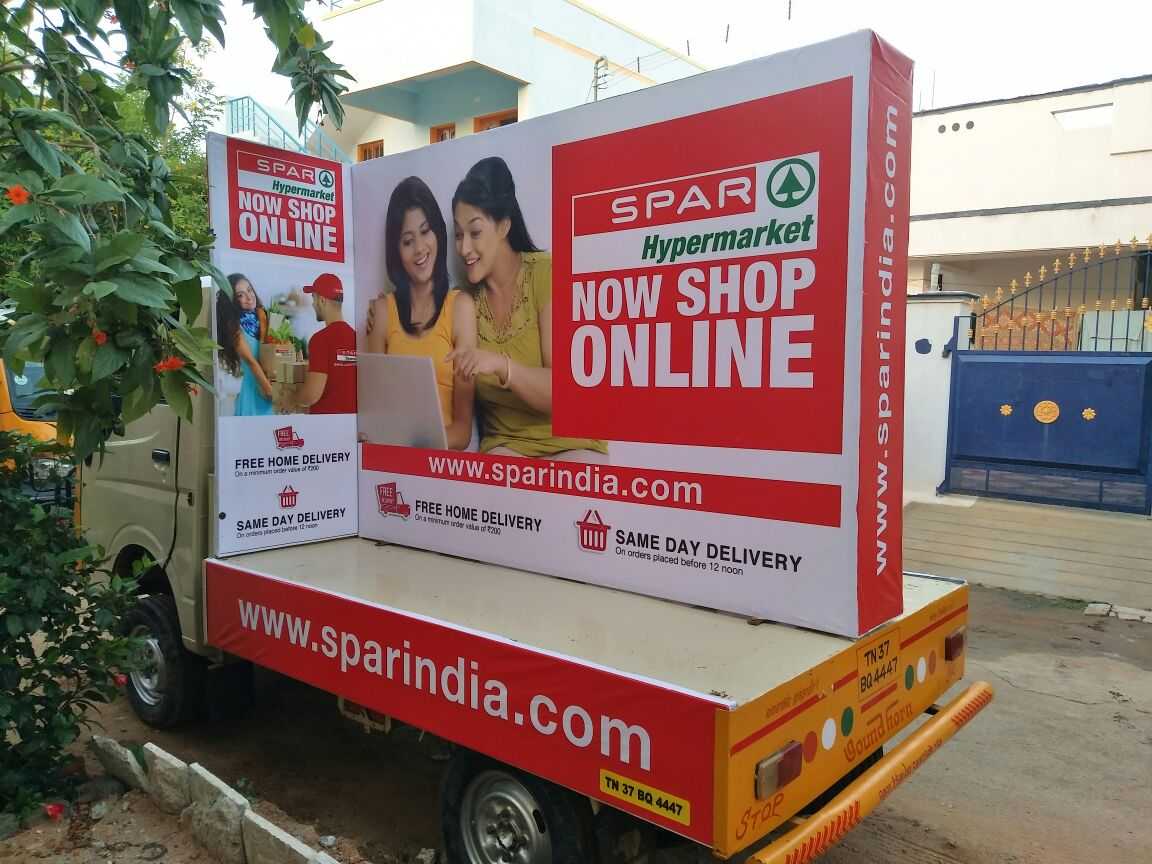
9:42 AM, Tuesday, on the Sarjapur Junction approach. Our T-shape van has been on the corridor since 8:15 AM. The signal cycles every 90 seconds. We have just stopped behind a Volvo bus, which means our T-shape board is staring at the windshields of fourteen vehicles behind us for the next 80 seconds. This is the audience tech-corridor campaigns are paying for, and the timing window is the difference between a campaign that earns its keep and one that wastes ₹75,000.
Most agencies hand a brand a Bangalore mobile van and say "drive the corridor for 8 hours". The brand pays ₹75k. The van runs from 9 AM to 6 PM. Half the active hours fall outside the high-impression windows, and the campaign delivers 60-65 percent of the impressions it could have. This playbook is the version we run when we want to deliver 100 percent.
Who should run tech-corridor van routes?
B2B SaaS, fintech, EdTech, quick-commerce, and food-delivery brand managers running Bangalore tech-corridor T-shape mobile van campaigns. Marketing teams responsible for awareness or recall lift in tech-employee audiences. Anyone planning a 30-day mobile van campaign at ₹75,000-1.2 lakh budget on Outer Ring Road, Sarjapur Road, Whitefield, or Marathahalli stretches.
What you'll have at the end
- A 7-day-a-week route timetable with hour-by-hour van positioning
- Five named signal stops with dwell-time data for high-impression positioning
- GPS-audited verification of route adherence
- Avoidance map for low-impression hours that waste budget
Prerequisites
T-shape van booked for 30 days at ₹75,000-90,000 (depending on whether out-of-core spillover is included). GPS audit add-on at ₹4,500-7,500 per month. BBMP route plan acknowledgement filed at the appropriate ward office. Creative approved and printed before Day 1.
The five-stretch tech-corridor route map
Stretch 1: Bellandur Junction approach
Bellandur Junction is the highest-dwell signal stop on the Bangalore tech corridor. Evening peak signal cycles at 90-120 seconds, with vehicle queues stretching 200-300 metres back during 5:45-7:30 PM. Position the van in the rightmost lane (turn lane toward Sarjapur Outer Ring Road) at 5:45 PM and rotate at 7:00 PM. Audited average dwell impressions during this 75-minute window: 6,500-9,000.
Stretch 2: Sarjapur Junction approach
Sarjapur Junction is the morning-peak counterpart to Bellandur. From 8:30 AM to 10:15 AM, the inbound stretch toward Wipro Corporate Office and the parallel tech parks runs at 25-40 km/h. Signal dwell averages 45-70 seconds. Position the van in the leftmost lane (slow lane) for an unobstructed T-shape view to the right-side traffic. Audited average dwell impressions during this 105-minute window: 7,000-9,500.
Stretch 3: ITPL feeder lane
ITPL evening exit (5:30-7:00 PM) routes 25,000-35,000 vehicles through a 4-signal stretch. Position the van on the southbound feeder lane between the second and third signal. Average dwell 50-80 seconds. Audited dwell impressions: 5,500-7,500 in 90 minutes. Note: ITPL traffic is mostly tech employees with consistent commute patterns; same audience sees the van on multiple consecutive days, which compounds recall lift.
Stretch 4: Marathahalli Bridge area
Marathahalli Bridge serves as the crossover between tech (Whitefield, Bellandur) and consumer (Indiranagar feeder, Outer Ring Road shopping) audiences. Mid-morning (10:30 AM-12:30 PM) sees mixed traffic with longer signal cycles. Average dwell 40-65 seconds. Audited impressions: 4,000-5,500 in 120 minutes. Best slot for cross-segment campaigns wanting both tech and consumer reach.
Stretch 5: Embassy Tech Village exit
Embassy Tech Village exits 22,000-30,000 employees in the 6:30-8:00 PM window on weekdays. The tech village exit signal connects to ORR Bellandur direction. Average dwell 45-75 seconds. Audited dwell impressions: 5,500-7,000 in 90 minutes. High-quality tech-employee audience (premium B2B SaaS, fintech).
Tech-Corridor Signal Stops: Windows and Audited Dwell Impressions
| Best window | Audited dwell impressions | |
|---|---|---|
| Bellandur Junction | 5:45 to 7:00 PM | 6,500 to 9,000 in 75 minutes |
| Sarjapur Junction | 8:30 to 10:15 AM | 7,000 to 9,500 in 105 minutes |
| ITPL feeder lane | 5:30 to 7:00 PM | 5,500 to 7,500 in 90 minutes |
| Marathahalli Bridge | 10:30 AM to 12:30 PM | 4,000 to 5,500 in 120 minutes |
| Embassy Tech Village exit | 6:30 to 8:00 PM | 5,500 to 7,000 in 90 minutes |
Monthly all-in: T-shape van ₹75,000 plus GPS audit ₹6,000 plus BBMP acknowledgement ₹3,000 plus creative ₹12,000 = ₹96,000 pre-tax, about ₹1.13 lakh post-GST.
The hour-by-hour weekday timetable
- 8:00-8:30 AM: pre-positioning at Sarjapur Junction (no live impression value, route position only)
- 8:30-10:15 AM: Sarjapur Junction approach (high-impression window)
- 10:15-12:30 PM: Whitefield-Marathahalli mid-morning corridor (medium-impression)
- 12:30-2:30 PM: lunch dwell at one corporate-park location for max 90-minute halt (medium-impression, audio loop value)
- 2:30-5:00 PM: corridor cruise alternating ORR-Sarjapur-Whitefield (medium-impression, brand awareness mode)
- 5:00-5:30 PM: position at Bellandur Junction (pre-evening setup)
- 5:30-7:00 PM: Bellandur Junction (highest-impression evening window)
- 7:00-8:30 PM: ITPL feeder + Embassy Tech Village exit (continued high-impression)
- 8:30-9:00 PM: depot return + GPS audit logout
The weekend variation
Saturday and Sunday tech corridors are nearly empty. Shift weekend route to mall traffic (Phoenix Marketcity 12 PM-4 PM, Mantri Square 1 PM-5 PM, Orion Mall evening) and weekend tech-park residents (Whitefield-Marathahalli residential pockets 10 AM-12 PM, 4 PM-7 PM). Audited weekend impressions: 4,000-6,500 per active hour, slightly below weekday peak windows but materially above weekend tech-corridor cruise (which delivers under 2,500 per hour).
Common mistakes in Bangalore tech-corridor van campaigns
- Driving the corridor 9 AM to 6 PM uniformly without timing the signal-stop windows. Wastes 30-40 percent of active hours.
- Using weekday route on weekends. Weekday tech-corridor stretches are dead on weekends; the mall route is the right pivot.
- Skipping the GPS audit add-on. Without GPS data, you cannot confirm whether the van actually positioned at the named signal stops.
- Ignoring lunch dwell at corporate parks. A 90-minute halt at a Manyata Tech Park or RMZ Ecospace lunch hour delivers higher engagement than 90 minutes of cruising.
- Running the same exact route every day. Audience repeat increases recall but predictable route also breeds creative fatigue. Vary the corridor balance day-by-day to refresh the audience set.
Realistic monthly budget
- T-shape van vehicle: ₹75,000
- GPS audit add-on: ₹6,000
- BBMP route plan acknowledgement: ₹3,000
- Creative production (one-time): ₹12,000
- Realistic all-in pre-tax: ₹96,000; post-GST: ₹1.13 lakh
Final 7-step checklist
- Lock the 5-stretch route map (Bellandur, Sarjapur, ITPL, Marathahalli, Embassy Tech Village)
- Build hour-by-hour weekday timetable around 3 high-impression windows
- Plan weekend mall route as a separate timetable
- Add GPS audit and BBMP fee to the booking
- Insert one 90-minute corporate-park lunch halt per day
- Vary corridor balance day-by-day to refresh audience exposure
- Audit weekly via GPS log + photo proof; replan if any window is under-delivering
If you want this playbook executed for your specific Bangalore tech-corridor campaign, share the brief and we will reply with a 5-stretch timetable inside two working days.
Lock the 5-stretch route
Bellandur Junction (evening peak), Sarjapur Junction (morning peak), ITPL feeder (evening), Marathahalli Bridge (mid-morning), Embassy Tech Village exit (evening). These are the highest-dwell stretches in our 2025 audits.
Build the hour-by-hour weekday timetable
8:30-10:15 AM Sarjapur. 10:15-12:30 PM Whitefield-Marathahalli. 12:30-2:30 PM corporate-park lunch halt. 2:30-5:00 PM corridor cruise. 5:00-5:30 PM Bellandur position. 5:30-7:00 PM Bellandur Junction. 7:00-8:30 PM ITPL + Embassy Tech Village. 8:30-9:00 PM depot.
Plan weekend mall route
Saturday and Sunday tech corridors are dead. Shift to Phoenix Marketcity 12-4 PM, Mantri Square 1-5 PM, Orion Mall 5-8 PM. Weekend tech-park residential pockets in morning slot 10-12 PM. Audited weekend impressions: 4,000-6,500 per active hour.
Add GPS audit and BBMP route fee
GPS audit at ₹6,000/month for daily route logs with timestamps. BBMP route plan acknowledgement at ₹3,000 one-time for the corridor permit. Both are non-negotiable for tech-corridor campaigns.
Insert lunch halt
One 90-minute halt per weekday at a corporate-park lunch (Manyata, RMZ Ecospace, ITPL, Embassy). Activation permit at ₹2,000-7,500 per location per day. Lunch halt converts the cruising hour into engagement-mode impressions.
Vary corridor balance daily
Monday: Sarjapur-heavy. Tuesday: Whitefield-heavy. Wednesday: Marathahalli-heavy. Thursday: Bellandur-heavy. Friday: balanced. Refreshes audience exposure and prevents creative fatigue from predictable van placement.
Audit weekly with GPS and photo proof
Pull the GPS log every Monday for the prior week. Confirm each high-impression window had the van positioned at the named stretch. Spot-check 3 photo proofs per week showing the van at the named signal stop. Replan if any window under-delivers.
Is the Bangalore tech-corridor route safe to drive during monsoon?
Mostly yes. ORR-Sarjapur-Whitefield stretches have functional drainage and BBMP coverage. Bellandur Junction sees periodic flooding in heavy monsoon (typically 2-4 days per year in July-August). Marathahalli Bridge area sees occasional waterlogging on the lower lanes. Weather-shutdown clauses in the vendor contract should cover unsafe-to-drive days; confirm before signing. Most monsoons cause 4-7 lost active hours rather than full days.
Can a Bangalore mobile van do 6:30-9 PM evening peak only at a discount?
Yes. Some vendors offer evening-only packages (3 hours per day) at ₹38,000-46,000 per month. The math works for very specific use cases (event marketing, evening-only retail, restaurant launches) where daytime presence has no audience value. For most awareness campaigns, the morning peak still adds 30-40 percent of campaign impressions, so the discount is typically not worth losing the morning slot.
How does this playbook change for an LED van instead of T-shape?
LED van extends the high-impression evening window because motion creative remains visible after sundown when static T-shape boards lose contrast. Evening window stretches to 5:30 PM-9:30 PM (vs 5:30-9 PM for T-shape). LED van also performs better at extended dwell (ITPL feeder, Embassy Tech Village) where the audience has time to process motion content. Morning peak is similar performance for both formats.
Tags
Quick Answers
What are the highest-impression Bangalore tech-corridor windows for a mobile van campaign?
Three windows. Morning peak 8:30 AM to 11 AM (tech-park entry traffic). Evening peak 5:30 PM to 9 PM (tech-park exit + leisure overlap). Weekend mid-day 12 PM to 4 PM (mall and family traffic). Inside these windows, T-shape vans deliver 5,000-7,500 dwell impressions per active hour. Outside, the same van delivers 2,500-3,500 per hour. The 14-15 active hours that overlap with these windows in a 7-day week generate 65-70 percent of campaign-total impressions.
Which Bangalore tech corridor stretches deliver the highest dwell time for mobile van branding?
Five named stretches in our 2025 audits. (1) Bellandur Junction at evening peak (signal dwell 60-90 seconds). (2) Sarjapur Junction approach during morning peak (40-70 seconds). (3) Marathahalli Bridge area (40-65 seconds, mixed audience). (4) ITPL feeder lane during evening exit (50-80 seconds). (5) Embassy Tech Village exit signal (45-75 seconds). Position the van at any of these for 25 to 45 minutes per peak window for highest dwell-impression stack.
Should a Bangalore mobile van campaign drive corridors during morning AND evening peaks?
Yes for awareness campaigns, no for sampling. Awareness benefits from both peaks; the same audience commuting both directions sees the brand twice and recall lift compounds. Sampling campaigns should park the canter at corporate-park lunch (12:30-2 PM) and weekend society gates instead because lunch and weekend dwell drives direct interaction. Crew costs make double-peak driving uneconomical for canter campaigns.
Looking for professional Mobile Van Branding services?
The Mediaverse runs end-to-end mobile van branding campaigns across India with geo-tagged delivery and transparent, all-inclusive pricing.
Explore our Mobile Van Branding solutionsSummarize this guide with AI
Open this article in your favourite AI assistant
Related Guides
Written by

The Mediaverse Team
India's Leading Outdoor Advertising Agency
The Mediaverse is a national-level outdoor advertising and integrated marketing organization that provides complete OOH, ATL, BTL, retail, and transit media solutions across India. With years of experience executing high-performance campaigns for brands in FMCG, Real Estate, E-commerce, EdTech, Automotive, Healthcare, and Retail, The Mediaverse combines creativity, data-driven media planning, and flawless on-ground execution. As a full-stack outdoor advertising provider, The Mediaverse offers Auto Branding, Mobile Van Branding, Newspaper Insertion Advertising, Shop Name Board Branding, In-Store Branding, Hoardings, Transit Media, Kiosks, Mall Media, Activations, and all forms of Below-The-Line marketing. Known for its pan-India network, strategic route planning, premium print quality, and Cheqmate™ GPS-based verification, The Mediaverse ensures 100% transparent and result-oriented campaign delivery. The Mediaverse’s editorial team produces deeply researched, SEO-optimized, and generative-engine-friendly content to help businesses understand the power of outdoor advertising and make informed decisions that maximize brand visibility and ROI across urban, suburban, and rural markets.
Related Articles

Mobile Van Branding in Lucknow (2026): Rates, Routes and the E-Rickshaw Question
Lucknow van branding is fabrication plus a day rate: Rs.11,000 buys a single T-Shape day. The full 2026 card, why the LED truck is the cheap option for a one-day booking, what the published three-van and four-van budgets land at after GST, and how the format compares with a Lucknow auto on cost per view.
LED Truck at Rs.8,000 a Day vs T-Shape Van at Rs.2,500: When the 3.2x Premium Pays (Chennai, 2026)
Chennai prices a T-Shape van at Rs.2,500 a day and an LED display truck at Rs.8,000, both with the same published 40 km route and 6 hour window. Here is what the extra Rs.5,500 a day buys, the three cases where it pays, and the arithmetic that shows when it does not.

The One-Day Campaign: Mobile Van Is the Only Outdoor Format You Can Book for a Single Day (2026)
Auto hoods start at 300 autos, no-parking boards at 1,000 and newspaper inserts at 50,000 copies. The mobile van is the only outdoor format The Mediaverse publishes with a minimum measured in days rather than units, and one day starts at Rs.2,200.